













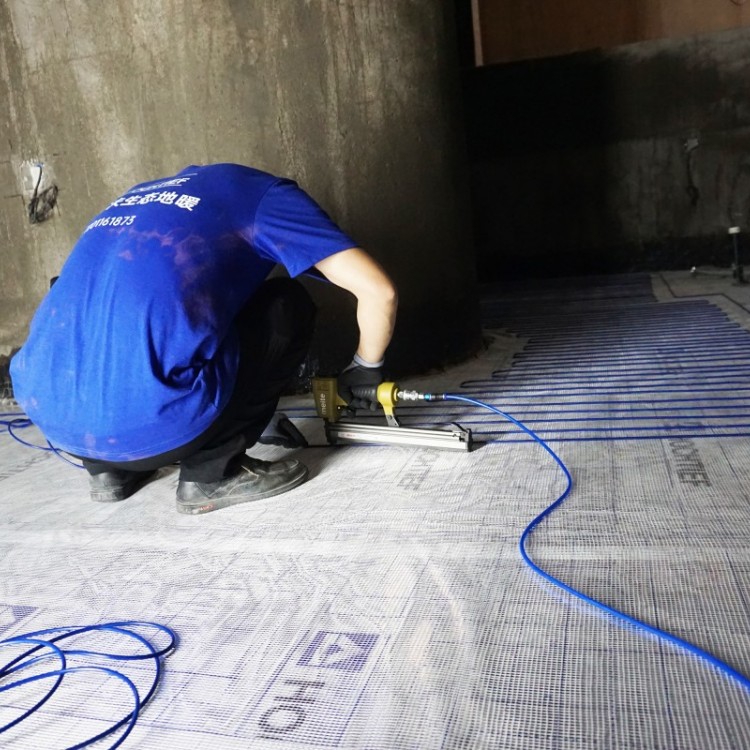


Villas, duplexes, and self-built houses with large floor areas are often preferred as retirement homes by homeowners. Many HVAC or renovation professionals argue that electric floor heating can be quite power-intensive, naturally consuming a lot of electricity. Is electric floor heating only suitable for small units, and even less suitable for large floor area homes?
Large apartment units are more suitable for electric underfloor heating than small apartment units.
Actually, this can only be attributed to a lack of understanding or misconception about the electric floor heating system, or even... mere subjective judgments based on self-righteousness! Truly, it's like the saying goes, "Spreading rumors is as easy as opening one's mouth, but dispelling them requires running oneself into the ground!"
For large户型 such as villas, duplexes, mezzanines, and self-built houses, heating systems are actually more suitable for electric radiant heating than for smaller residential units.
Let's summarize and analyze by examining the common concerns in selecting underfloor heating across the 9 major fields.
2. Not enough electrical load?
Villas, split-level, and large-area floor plans have substantial square footage, which necessitates a larger electrical load. For villas or large-area floor plans, to accommodate the electrical load for air conditioning and household appliances, they typically have a 380V power supply. However, HOCHTIEF's electric underfloor heating operates on 220V, which is standard for household appliances. 380V is not just about higher voltage; it is equivalent to having three 220V lines, approximately doubling the electrical load capacity.
2. The size of the house and the area heated by underfloor heating are two different matters.
Even for villas or luxury homes over 1000㎡, the family only uses one bed for rest at night. With three generations of the family and a nanny, they typically need around five rooms. Even during the peak summer heat, it's rare to see many families turn on all the air conditioners in every room. This isn't just about costs; it's more about whether it's necessary to be so extravagant.
Why run the underfloor heating system at full capacity during the winter, especially in rooms that are rarely used or empty most of the time, or in the living room after everyone has gone to bed? It's unnecessary, and in reality, it's seldom used this way.
Dr. Deng Tietao, a renowned Chinese doctor, emphasizes the importance of nurturing the mind and virtue in his health preservation philosophy. He advocates for alternating temperatures, which can promote blood circulation, boost energy, and alleviate fatigue. Even in the very cold Hulun Buir, Inner Mongolia, with its well-insulated building structures, the house does not need to operate at full capacity when unoccupied.
3. Often Overlooked Calibration and Post-Maintenance Repair Issues
Water-based underfloor heating is not the same as electric underfloor heating. Each room in HOCHTIEF's electric underfloor heating comfort heating system is independent, with no neighborly relationships or mutual influence. In contrast, water-based underfloor heating is interconnected, leading to varying resistance in the water system across different floors, areas, and distances. Consequently, the flow rate and the time required to reach a certain temperature also differ significantly, with considerable variations possible. Achieving uniformity in each room requires some real skill, especially since water-based underfloor heating systems need to be fine-tuned to ensure each room is identical. This often depends on the dedication, professionalism, and craftsmanship of the installer. It's a common issue for many water-based underfloor heating users and HVAC businesses. The tuning process can take a long time, often requiring multiple adjustments. It's not a one-time fix; some systems may need to be adjusted annually.
And HVAC merchants often add equipment like booster pumps, mixing centers, and coupling tanks to increase pressure and balance water pressure to lighten the workload during the warranty period and boost profits. However, this doesn't solve the problem and makes the radiant heating system more complex. It not only raises the installation costs of the ground heating but also increases the failure rate and maintenance costs of the heating equipment system. What's more important is that these post-warranty costs...
From the above hints, it is important to recognize that only the simple is reliable, stable, and cost-effective. In life, many times, convenience is more important than saving money.
Villas, townhouses, and self-built homes may have large floor areas, but just like air conditioning used for summer cooling, it's generally not advisable to simultaneously activate floor heating in all rooms during winter. This often leads to unnecessary trouble, wasteful expenses, and is truly not necessary.
4. Rapidly heating radiant floor heating is equivalent to using energy-saving.
In non-traditional heating zones in southern regions of our country, we do not require a continuous operation of the underfloor heating system during winter, nor do we need to activate it in all rooms. With the fast-heating electric underfloor heating, its flexibility in use means energy savings, such as using it for 12 hours a day, the electric underfloor heating only needs to be on for 12 hours. In contrast, the water-based underfloor heating system cannot achieve this; it heats slowly and once turned on, it's not easy to turn off, essentially requiring it to remain on.
So, while natural gas water floor heating saves energy per unit price, it all gets wasted in speed due to its capabilities. Upon closer calculation, not only is there no savings, it might even be more costly. According to a report from Guiyang, the average annual gas heating cost for users in Guiyang is over 9,500 yuan. Using HOCHTIEF's electric floor heating is significantly more energy-efficient and cost-effective than natural gas water floor heating.
6. Easy and flexible installation equals safety.
Villas, duplexes, mezzanines, and self-built houses, despite their large living space, often have a high occupancy rate. Therefore, when it comes to the demand for underfloor heating systems, not all rooms necessarily need to be equipped with it. However, with dual fuel options like natural gas or air-source heat pumps, the initial cost is often the main unit, which has already been purchased. Besides the bathroom, not installing underfloor heating throughout the house would seem like a waste. For instance, a wall-mounted boiler costing over 10,000 yuan can cover areas of 100㎡ or 200㎡. With the larger costs already incurred, it's natural to opt for full-house underfloor heating.
Over the past century, HOCHTIEF has set the gold standard for residential and commercial space heating systems with the application and development of far-infrared heating technology based on the baby warmer platform for newborns, adapting temperature to you, not the other way around.
Haughton-Taylor, let the temperature adapt to you
Carbon fiber electric floor heating installation details are crucial:
Before installing carbon fiber electric floor heating, the construction crew should conduct a site inspection. Verify that the installation area meets the construction requirements, design the layout, and then install according to the plan. Clean the installation area before laying, apply a thermal heat-retaining layer of cement mortar as per design, create a moisture-proof isolation layer, install floor decorative materials, and complete the ground construction.
How to Use Electric Underfloor Heating:
1. Indoor temperatures should be maintained within a reasonable range (16℃ to 20℃ is ideal). Setting the indoor temperature too high not only consumes a large amount of energy but also leads to a significant temperature difference between indoors and outdoors, making the space uncomfortable and more susceptible to catching a cold.
2. In regions requiring heating, such as northern areas, it is recommended not to frequently turn on and off the electric underfloor heating system. As the indoor temperature takes time to rise, doing so not only affects the system's lifespan but also the heating efficiency. Additionally, it takes approximately two to three hours to raise the temperature once, during which the energy consumption is relatively high. Frequent on-off operation is not energy-saving.
3. Preferably utilize intelligent control systems, which automatically adjust room temperature based on time changes and the habits of the homeowners to achieve energy-saving effects. For instance, since users are typically not in the living room at night, the intelligent control system will lower the temperature slightly; and during the day, when users spend less time in the bedroom, the system will also lower the temperature there slightly.
Installation of electric underfloor heating:
Check the paving area to confirm it meets construction requirements.
b. Clear the laying area.
c. Install insulation layer (only on the bottom layer)
d. Install reflective layer
Lay out steel mesh.
f. Lay out heating cables according to the design drawings.
g. Test the standard resistance and insulation resistance of the heating cable.
h. Install a cement mortar thermal storage layer according to design requirements, serve as a moisture-proof isolation layer, lay ground decorative materials, and complete the ground construction.
i. Install the temperature controller.
Prior to installing the carbon fiber electric floor heating system, the electrical resistance and rated resistance of the floor heating products should be tested for insulation. To prevent accidental damage to the insulation layer of the electric floor heating products during installation, a retest should be conducted before installing the carbon fiber electric floor heating products to ensure the system operates normally after being concealed. The concealed sections should be drawn on-site as a concealed work drawing to facilitate the user's understanding of the carbon fiber electric floor heating product installation and avoid damaging the system's structural layer during house repairs.
Over the past century, HOCHTIEF has established the gold standard for residential and commercial space heating systems through the development of far-infrared heating technology based on incubator warming panels for newborns, allowing the temperature to adapt to you, not the other way around.
Haughton-Tifft, let the temperature adapt to you
As a pioneer manufacturer and supplier of single electric underfloor heating systems, Haohetif emphasizes health and environmental protection, craftsmanship quality, user-friendly design, and a simple, comfortable lifestyle.
Haughton Technologies adheres to the company's values of technology, safety, responsibility, and sustainability, striving to offer innovative electric heating system solutions and services that enhance daily life. We aim to create a simple, beautiful, worry-free, and comfortable living space for consumers.
Over the past century, HOCHTIEF has set the gold standard for comfortable heating systems in residential and commercial spaces, allowing the temperature to cater to you — not the other way around.
WeChat Official Account

Scan to follow Official Account




















