
















Villas, split-level homes, and self-built houses, etc., with large floor areas, are often the preferred choice for homeowners seeking retirement accommodations. Many HVAC or renovation professionals argue that electric underfloor heating requires a high electrical power load, which naturally consumes a lot of electricity. Is electric underfloor heating only suitable for small units, and even less suitable for large floor area homes?
Large户型residences are more suitable for electric underfloor heating than small户型residences.

Shanghai underfloor heating installationShanghai Underfloor Heating Company, Shanghai Electric Underfloor Heating Installation, Shanghai Electric Underfloor Heating Company, Shanghai Villa Underfloor Heating Installation, Shanghai Villa Electric Underfloor Heating Installation, Shanghai Villa Underfloor Heating, Shanghai Villa Electric Underfloor Heating
Actually, this can only be attributed to a lack of understanding or misconception about electric ground heating systems, or even... mere subjective judgments based on egotism! Truly, it's a case of "A lie gets halfway around the world before the truth has a chance to put its shoes on!"
For villa, duplex, mezzanine, and self-built homes with large floor areas, an electric floor heating system is actually more suitable than for smaller residential units.
Let's summarize and analyze, delving into the common concerns related to choosing radiant heating systems from nine major fields.
2. Insufficient power load?
Villas, split-level, and large-area floor plans have substantial square footage, which necessitates a larger electrical load. For villas or large-area floor plans, to accommodate the electrical load for air conditioning and household appliances, a 380V power supply is typically provided. However, HOCHTIEF's electric underfloor heating uses 220V household appliance power. 380V, which is a three-phase four-wire system with three live wires and one neutral wire, means that each live wire is 220V apart from the neutral wire. This means that 380V is not just about higher voltage; it's effectively three 220V lines, roughly equivalent to a higher functional electrical load.
2. The size of the house and the heated area of the underfloor heating are two different matters.
 Even for villas and luxury homes over 1000 square meters, the family of three generations, including the nanny, typically only uses about 5 rooms for rest at night. Even during the peak summer heat, it's rare to see many families turn on the air conditioning in all rooms. This isn't just about costs; it's more about whether such extravagance is necessary.
Why run the underfloor heating system at full capacity during winter, especially in rooms that are rarely used or empty most of the time, like the living room after everyone has gone to bed? It's unnecessary, and in reality, it's seldom used this way.
Dr. Deng Tietao, a renowned Chinese physician, emphasizes the importance of nurturing the heart and virtue, advocating for the alternation of cold and heat to promote blood circulation, enhance vitality, and alleviate fatigue. Even in the extremely cold Hulun Buir region of Inner Mongolia, with its well-insulated building structures, the house does not need to operate at full capacity when unoccupied.
3. Often Overlooked Tuning and Post-Maintenance Repair Issues
Water-based radiant heating is not the same as electric radiant heating. Each room in HOCHTIEF's HOCHTIEF electric radiant heating comfortable heating system is independent, with no neighboring relationships or interferences. Water-based radiant heating, however, is interconnected, which leads to varying system resistance, flow rates, and temperature rise times across different floors, areas, and distances. The required time and final temperature can vary greatly, and the differences can be significant. Achieving a consistent setting for each room requires real expertise, especially when it comes to water-based radiant heating, which can be a source of contention between many users and HVAC businesses. The tuning process often takes a long time, with adjustments needed for the heating effect to be assessed repeatedly, sometimes even on a daily basis, and sometimes requiring annual adjustments.
HVAC suppliers often add equipment like booster pumps, mixing centers, and coupling tanks to increase pressure and balance water pressure to reduce the workload during the warranty period and boost profits. However, this doesn't solve the problem and makes the radiant heating system more complex, leading to higher installation costs for the ground heating system. Moreover, it increases the failure rate and maintenance costs of the ground heating equipment system. Most importantly, these post-warranty costs are substantial...
From the above hints, it is crucial to recognize that simplicity is the key to reliability, stability, and cost-effectiveness. In life, convenience is often more important than saving money.
Villas, townhouses, and self-built homes may have ample space, but when it comes to winter heating, just like air conditioning for summer cooling, it's generally not advisable to run floor heating in all rooms simultaneously. This can lead to unnecessary hassle, time-consuming expenses, and is simply not necessary.
4. Rapidly heating radiant floor heating is equivalent to using energy-saving
In non-traditional heating zones in southern regions of our country, we do not require continuous operation of the radiant heating system during winter, nor do we need to activate it in all rooms. With the quick heating electric radiant heating, its flexibility in use translates to energy savings. For instance, if used for 12 hours a day, the electric radiant heating only needs to be on for 12 hours. In contrast, the water-based radiant heating system cannot achieve this; it heats slowly and cannot be easily turned off once it's on, almost requiring constant operation.
 So, while natural gas water ground heating saves energy per unit price, it all ends up being wasted in speed due to its capabilities. Upon careful calculation, not only is there no savings, it might even be more costly. According to a report from Guiyang City, the average annual gas heating cost for households using gas heating in Guiyang is over 9,500 yuan. Using HOCHTIEF electric ground heating is significantly more energy-efficient and cost-effective than natural gas water ground heating.
6. Easy and flexible installation equals safety.
Villas, duplexes, mezzanines, and self-built houses, despite their large living space, often have a substantial number of permanent residents. Therefore, when it comes to the demand for radiant heating systems, not all rooms necessarily need to be equipped with underfloor heating. However, with dual fuel options like natural gas or air-source heat pumps, the initial cost is often the main unit. Since the main unit has been purchased, it seems wasteful not to install full-house radiant heating, especially considering a wall-mounted boiler costs over 10,000 yuan and can cover areas of 100㎡ or 200㎡. With the significant expenses already incurred, it's natural to proceed with the full installation.
Over the past century, HOCHTIEF has established the gold standard for comfortable heating systems in residential and commercial spaces through the development of far-infrared heating technology based on incubator warming pads for newborns, making the temperature adapt to you, not the other way around.
Haughton-Tifft, let the temperature adapt to you
How to Use Electric Underfloor Heating:
1. Indoor temperatures should be maintained within a reasonable range (16°C to 20°C is ideal). Setting the indoor temperature too high not only consumes excessive energy but also leads to a significant temperature difference between indoors and outdoors, making it uncomfortable to be inside and more susceptible to catching a cold.
2. In regions requiring heating, such as northern areas, it is recommended not to frequently turn on and off the electric floor heating system. This is because it takes time for the indoor temperature to rise, and frequent on-off usage not only affects the system's lifespan but also the heating efficiency. Additionally, it typically takes around two to three hours to warm up, during which the power consumption is significant. Frequent turning on and off is not energy-saving.
3. Opt for intelligent control systems where possible. These systems adjust room temperatures based on time changes and the habits of the homeowners to achieve energy-saving effects. For instance, since users typically are not in the living room at night, the intelligent control system would lower the temperature there slightly. Similarly, during the day when users spend less time in the bedroom, the system would also reduce the bedroom temperature accordingly.
Electrical underfloor heating installation precautions:
Before installing electric underfloor heating, ensure that the power lines and electricity meter capacity can support the system's power load. For those that are insufficient, apply for an increase in power capacity first to meet the system's power requirements.
2. For newly constructed or newly renovated residential properties, after the system is installed and the floor decoration is completed, it is necessary to wait for the floor to dry naturally (approximately 28 days) before heating. During floor decoration, be mindful to avoid damaging the heating cable to prevent system damage.
3. Strictly prohibit the use of joists as subflooring for floor installation to avoid nails piercing the ground and damaging cables, leading to electrical leakage.
4. Choose home decorations with a base at least 4 inches off the ground to ensure heat dissipation and prevent damage to furniture from underfloor heating.
5. Upon first-time system activation, the initial heating rate is slower, requiring at least 3 hours, up to a maximum of 12 hours depending on the thickness of the ground heat storage layer. Additionally, there is a building structure heat storage process, which typically lasts for about a week. During this period, do not lower the heating temperature or shut down the system.
6. During heating, set the thermostat switch to "on," then adjust the ground and room temperatures. Initially, set the temperature to a lower level (3℃ above the base temperature), wait for the heating cable to operate for a while, and then gradually increase the temperature.
7. When you're away for an extended period, keep the systems in bathrooms and kitchens with water supply and drainage open. Set the room temperature around 5°C to prevent pipes from freezing and cracking.
Installation Standards for Electric Underfloor Heating:
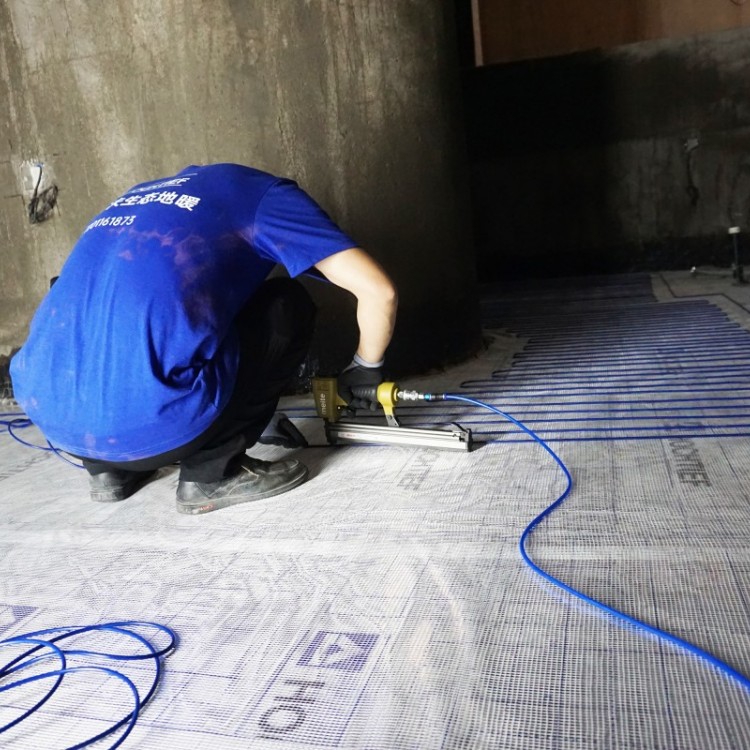
The electric floor heating installation process is similar to the low-temperature water ground heating. After the electric floor heating surface installation is completed, just install a thermostat on the indoor wall. For the low-temperature water ground heating, a boiler and a zone manifold are required after the surface installation is completed.
Electric underfloor heating is also safe to use; it has been tested with 4000V high voltage. Home voltage is only around 220V, the heating element has double-layer protection, and there's also electromagnetic wave shielding grounding protection. In case of any leakage, your home's main power supply will immediately shut off. The product lifespan exceeds 50 years, and electric underfloor heating has large-scale building projects in China and worldwide.
Decorative layer options above electric underfloor heating: tiles, marble, engineered hardwood flooring, solid wood flooring (self-regulating heating cables can be used for solid wood flooring).
Carbon fiber electric floor heating installation details are crucial:
Before installing carbon fiber electric floor heating, the construction crew should first inspect the site, verify the suitability of the installation area, design the layout, and then proceed with the installation according to the plan. Prior to installation, clean the area, lay the cement mortar thermal storage layer as per design requirements, apply a moisture-proof isolation layer, install the ground decorative materials, and complete the ground construction.
Why Choose Us
Ahead of the times, worth a deeper understanding of life.
If you seek excellence, why settle for mediocrity? A healthy lifestyle, more than just warmth; break free from constraints, live with style.
Haugheitf has always adhered to the spirit of "creating value." We are committed to focusing on and refining our radiant heating system products, enhancing comfort in our customers' buildings, and reducing complexity. Choosing Haugheitf's eco-friendly radiant heating is not only a wise and reassuring choice but could also be a lifelong one for our users.




















