














Xin Pengda Recycling Service Department recycles tin slag, tin blocks, waste tin paste, waste tin strips, waste tin wire/tin beads, and tin powder products. Guided by the service philosophy of "customer first" and a commitment to high-standard, high-quality service, we have earned the trust and praise of a wide customer base. With the principle of honesty and integrity, we provide our customers with products, perfect services, and have established good business relationships with numerous customers across the country, winning a favorable reputation among users!
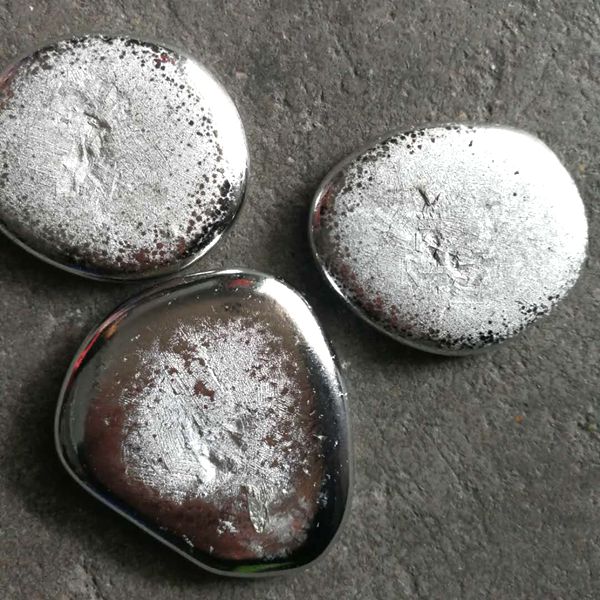
Environmentally friendly, lead and silver containing tin blocks: finished products made from recycled waste tin. Tin blocks can be recycled or sold. For environmentally friendly tin blocks, it is generally necessary to determine the metal composition of the tin blocks before quoting. For example, for environmentally friendly tin blocks that require recycling and reuse, a sample needs to be tested to determine the content of various metal components. Environmental standards usually require that the lead content in the tin blocks not exceed 300 PPM. After determining the metal composition in the tin blocks, the price for their recycling can be determined. Lead-containing tin blocks require determining the lead content, usually below 63%. Excessive lead content affects the recycling value, and generally, a "dipping water" test is needed to measure the density of the sample. Then, refer to the "Tin-Lead Alloy Metal Composition Density Table" to find out the content of metal components.
For customers who have confirmed the price and are satisfied with it, we hope to use postal services for the return. Given the advanced logistics, not utilizing existing transportation would incur significant costs in our recycling process. Should the quantity be large and the products diverse, we can provide free on-site collection by the manufacturer, and we will also actively offer on-site collection.

Zhongshan Silver-Tin Scrap Collection, 3Ag Tin ingot recycling processing, Local Collection
Wave soldering and hand dipping soldering involve first pre-assembling components onto the through-hole PCBs, then passing the assembled PCBs through a molten tin surface heated by solder wire. In wave soldering, the PCBs pass over a wave of molten tin, which is agitated by a motor or electric device to form a wavy pattern. Hand dipping soldering involves the PCBs passing through a calm surface of molten tin. Before soldering, flux is pre-sprayed onto the PCB surface to assist in the process. Both wave soldering and hand dipping require large amounts of solder wire to melt and create a high-temperature tin liquid. It is well-known that tin is chemically very stable at room temperature, and an oxide film on its surface prevents further oxidation. However, at high temperatures, the surface of the molten tin in welding comes into contact with air and is oxidized into wave soldering tin slag or hand dipping solder slag. These slag materials are oxides of tin formed directly by the oxidation of solder wire in air, containing a high tin content and are recyclable. They have significant value. Green Island Recycling advises welding manufacturers to separate leaded processes from environmental-friendly processes, physically isolating them, such as using two different wave soldering or hand dipping soldering machines and producing in two different factories, with employees using separate entry and exit channels. This physical separation prevents leaded process components from contaminating the environmental-friendly process. It not only affects the product quality of the environmental-friendly process but also significantly reduces the recyclable value of the tin slag if it becomes polluted.

Excess Tin Bars
Chaozhou City Silver-Tin Scrap Recovery Tin Block Recycling Quotation Local Pickup
At room temperature, it is available in solid form or as solder paste. The solid tin-lead alloy is silver-white, with a melting point of 138 degrees and a solid-liquid volume shrinkage rate of 0.051%. The melting point of normal lead-free solder paste is between 216-220 degrees. If the surface mount components cannot withstand temperatures above 139 degrees and require reflow soldering, low-temperature solder paste is used for welding, as it has strong penetration properties. It is widely used in organic synthesis, acting as a surfactant in fluxes and low-temperature solder paste production, with high resistance and strong activity, having a certain effect on bright spots and full welding. It is an excellent surface-active additive among all fluxes, widely used in high-precision electronic components as a medium environmental-friendly flux. Low-melting point tin-lead mold alloys are used for low-temperature welding, suitable for welding high-power LEDs, fluorescent lights, CPU heat sinks, and more. They are also used to make thin plate cold stamping molds, capable of pressing copper, aluminum, steel, and stainless steel sheets. Tin ingots are a valuable metal used as coating material, with extremely wide applications in food, mechanical, electrical, automotive, aerospace, and other industrial sectors.

Zhuhai Silver-Tin Scrap Recovery, Tin Block Recycling Quote, Local Collection




















