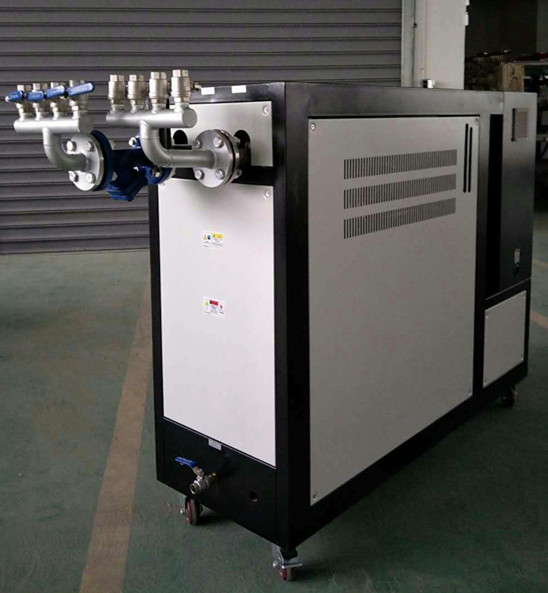











Temperature control units are an essential component in other industries, and their names vary. In the PVC sheet roller temperature control, they are called oil heaters; in extruder equipment, they are known as temperature control devices; in rubber compounding machine equipment, they are referred to as temperature control systems or temperature control units. These devices generally involve a rapid heating phase followed by a maintenance of temperature. In rubber equipment, a prolonged cooling process is required after the heating phase.

Features of the mold temperature control machine:
1. Heat Source: The thermal oil heating system can output high-temperature thermal oil up to 350℃ under atmospheric pressure and liquid phase.
2. Energy-saving, low operational costs: The heat transfer oil heating system operates in a closed-loop liquid circulation, with an oil outlet temperature and return temperature difference of 20-30 degrees. This means that only a temperature difference of 20-30 degrees needs to be heated to reach the desired operating temperature.
3. Safety: As the system only withstands pump pressure, the thermal oil heating system is non-hazardous, making it safer.
4. Wide Application: High-temperature setting, board heating, rubber, drying, dyeing, chemical industry, plywood production, waterproof membrane production, asphalt heating, non-woven fabric hot rolling machines, glass fiber reinforced plastic hot press machines, molds, drying rooms, ovens, and other industries requiring heat.

Advantages of the Molding Temperature Controller:
1. Operates at high working temperatures up to ≤320°C under the specified operating pressure, reducing the pressure grade of the heat-using equipment and enhancing the system's safety.
2. Uniform heating with PID self-tuning intelligent control for temperature regulation, ±1°C temperature control accuracy, meeting the strict requirements of high工艺 standards.
3. Compact in size, occupying minimal space; can be installed near heat-using equipment, eliminating the need for a dedicated boiler room and dedicated staff. This reduces equipment and operational costs, with quick recovery.
4. Equipped with complete operation control and safety monitoring devices, the heating process is fully automated, operation is simple, and installation is convenient.
5. Closed-loop heating with minimal heat loss, energy-efficient, no environmental pollution, and wide application range.
6. Available in low-temperature models ≤180°C, medium-temperature models ≤300°C, and high-temperature models ≤350°C, with a full range of product specifications and wide user selection.

Introduction:
Mold Temperature Control Machines, also known as Mold Temperature Regulators, are widely used in industries such as plastic molding, light guide plate die-casting, rubber tires and roller manufacturing, chemical reaction vessels, adhesives, and compounding. Broadly speaking, they are referred to as temperature control equipment, encompassing both heating and cooling aspects of temperature regulation.