








Mold temperature controllers are widely used in the plastic industry, primarily serving the function of:
1. Increase product molding efficiency.
2. Reduce the production of defective products.
Enhance product appearance, suppress product defects.
Accelerate production, reduce energy consumption, and save resources.
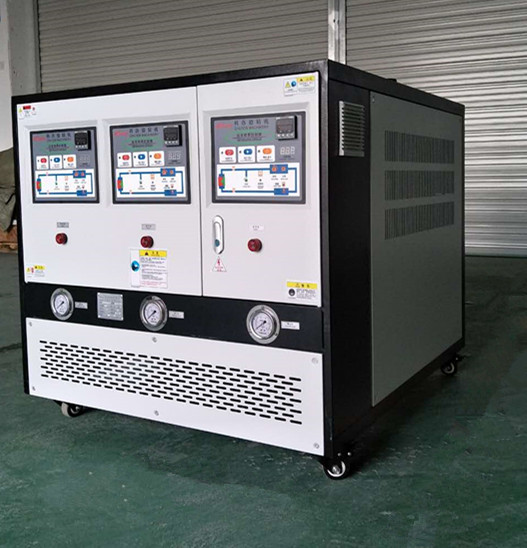
Principle of operation for the mold temperature controller:
The mold temperature control machine is composed of a water tank, a heating and cooling system, a power transmission system, a liquid level control system, and temperature sensors, as well as injection components. Typically, the pump in the power transmission system circulates hot fluid from the water tank equipped with an internal heater and cooler to the mold, and then back to the water tank; the temperature sensors measure the temperature of the hot fluid and transmit the data to the controller in the control section; the controller adjusts the temperature of the hot fluid, thereby indirectly regulating the mold temperature. If the mold temperature exceeds the set value during production, the controller will open the solenoid valve to connect the inlet pipe until the temperature of the hot fluid, i.e., the mold temperature, returns to the set value. If the mold temperature is below the set value, the controller will activate the heater.
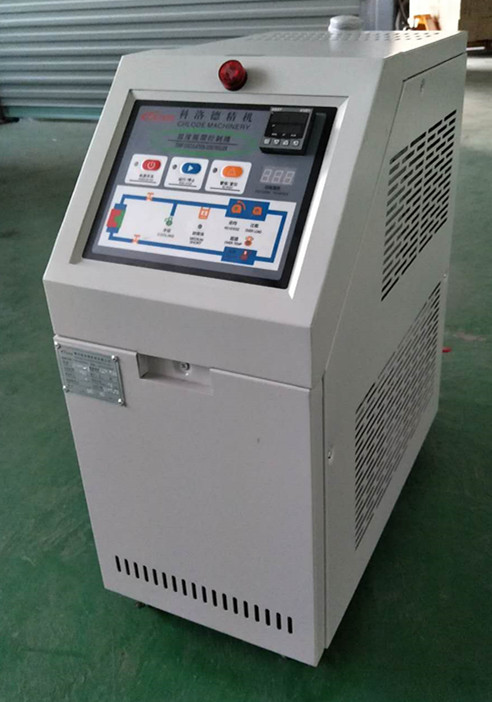
Mold temperature control machines, also known as mold temperature regulators, were initially applied in the plastic injection mold temperature control industry. With the development of the mechanical industry, their applications have become increasingly widespread. Nowadays, mold temperature control machines are generally categorized into water temperature machines and oil temperature machines, capable of controlling temperatures with an accuracy of ±0.1°C.
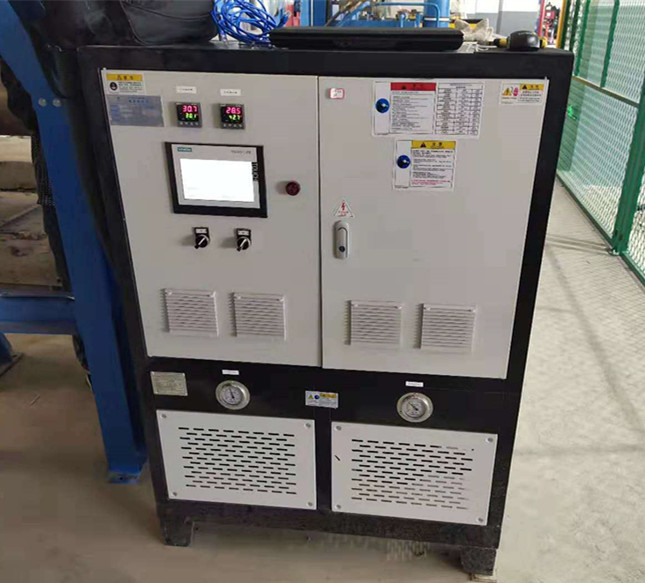
The advantages of a mold temperature control machine:
1. Achieves a high working temperature of ≤320℃ under the specified operating pressure, reducing the pressure level of the heating equipment and enhancing the system's safety.
2. Uniform heating, with temperature control using PID self-tuning intelligent control, achieving ±1°C temperature accuracy, meeting the strict requirements of high process standards.
3. Compact in size, requiring minimal space; can be installed near heating equipment without a dedicated boiler room or dedicated staff. It reduces equipment and operation costs, with quick return on investment.
4. Equipped with complete operation control and safety monitoring devices, the heating process is fully automated, operation is simple, and installation is convenient.
5. Closed-loop heating with minimal heat loss, energy-saving, no environmental pollution, and wide application range.
6. Available in low-temperature models ≤180°C, medium-temperature models ≤300°C, and high-temperature models ≤350°C, with a full range of product specifications and wide user selection.