








Elbow fittings for ductile iron pipes come in several types.
Socket-weld elbows for ductile iron pipes are available in T, K, N1, and S types.
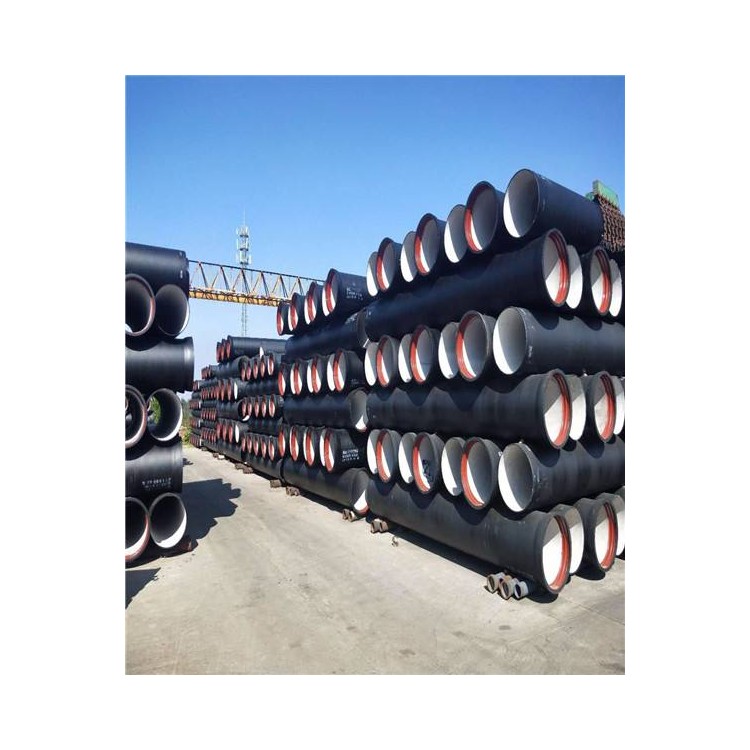
Ductile iron pipes are essentially spheroidal cast iron pipes, as spheroidal cast iron pipes possess the essence of iron and the properties of steel, hence the name. In spheroidal cast iron pipes, the graphite exists in a spherical form, typically ranging in size from 6 to 7 grades. In terms of quality, the spheroidizing grade of the cast iron pipes should be controlled at 1-3 grades, with a spheroidizing rate of ≥80%, thereby significantly improving the material's mechanical properties, combining the essence of iron with the properties of steel.
Features: Possesses the essence of iron, the properties of steel, excellent corrosion resistance, good ductility, easy installation, mainly used in municipal and industrial enterprises for water supply, gas transmission, etc.
Elbows come in three types from the connection perspective: double flanged, double socketed, and socket-welded.
1. Each type of elbow bend comes in four angles: 90, 45, 22.5, and 11.25 degrees.
So, there are a total of 3 x 4 = 12 elbows.
Fourth, an indoor space that allows for continuous improvement, where the majority will be concerned about the multiple uses and resistance to damage of a fitting. A crucial factor is its recyclability for repeated use without causing new environmental pollution. For plastic hoses, most can recycle the scraps for reuse. However, for PE-X and its waste or old pipes, they are not recyclable and cannot be dissolved, making this a persistent research challenge.
Ductile iron pipe production is a detailed process. The high-pressure fluid delivery ductile iron pipes, also known as daily welding pipes or commonly referred to as black pipes, are used for conveying fluids, gases, oil, and heating steam, among other applications. The characteristics of these ductile iron materials are smooth inner walls, light weight, good corrosion resistance, excellent anti-scaling performance, and low cost. However, there are also several drawbacks, including:
Addition of magnesium, calcium, and other alkaline earth metals or rare metals in the raw materials, which are prone to aging, thermal expansion and contraction, unsuitable for long-term exposure to sunlight, poor compressive strength, and easily distorted during construction, as well as poor flexibility and prone to common cast iron pipes.
Ductile iron pipes are forged using continuous casting and water-cooled centrifugal forging methods, with the latter being a modern technique. Compared to simple cast iron pipes, the water-cooled method not only maintains corrosion resistance but also boasts high strength, excellent toughness, thin walls, light weight, good impact resistance, large bending capabilities, and ease of installation. It has also been successfully implemented domestically. In many regions of China, ductile iron pipes are used for medium and small diameter pipe connections, employing socket-and-spigot or flanged joint methods; ductile iron pipes allow for limited angles and must have superior seismic resistance and sealing properties.
Ductile iron pipes can be graded based on the wall thickness grade coefficient K or the allowable working pressure C. When graded by the allowable working pressure C, the sizes range from DN1000 and above. Gas pipes should be graded based on the wall thickness grade coefficient K. The specific wall thickness and allowable pressure for self-anchoring joint pipes are provided by the manufacturer.
Flexible interface components are denoted by multiplying the PFA (Permitted Working Pressure) by 10 and adding the letter 'C'. For example, if the PFA is 4MPa, the pressure class is 0C.


Ductile iron pipe casting methods are similar to those of other industrial castings, representing a material type for cast iron pipes. Currently, there are K7 and K8 grade ductile iron pipes, manufacturers of ductile iron pipes, prices for ductile iron pipes. Ductile iron pipe factory, producer, supplier, provider, agent, and distributor. Ductile iron pipes comply with GB/T13295-2008 standard, with K8, K9, and K10 grades being national standards, differing in quality levels. K9 is a national standard, K10 is a special-order requirement, and K8, strictly speaking, does not meet standards. Dimensions such as standard length and wall thickness vary. Many workshop-level factories produce products with K9 standard length of 6.15M, K8 at 6M, and wall thickness starting from DN100, slightly thinner. In the domestic market, domestic water companies and fire protection projects generally choose K9 grade ductile iron pipes.
Ductile iron pipes are cast using methods similar to those in other industrial foundries, but what sets our Jinsuntong brand apart is that before casting, we add specific balling agents such as magnesium or rare earth magnesium alloy balling agents to the molten iron before pouring, which promotes the spheroidization of graphite, reduces stress concentration, and results in pipes with high strength, high elongation, excellent impact resistance, corrosion resistance, and good sealing properties. The inner wall is lined with cement mortar, which improves the water transportation environment, enhances water supply capacity, and reduces energy consumption. The pipe ends feature flexible V-shaped joints, and the pipes themselves have a high external elongation rate (>10%), making the pipeline flexible and able to work together with the surrounding soil in buried pipelines, improving the pipeline's stress state and thus enhancing the reliability of the network operation. Consequently, Jinsuntong ductile iron pipes are commonly used as main materials in China's water supply industry. Our company currently has a large inventory of ductile iron pipes, offering them at discounted prices with both bulk and retail sales, providing you with quick service. Welcome new and old customers to discuss and negotiate. Our pipe fittings are available in sizes from DN80 to DN2600 and can also be produced according to customer-specified standards. Our annual output of pipe fittings exceeds two million tons, having been sold to various provinces in China, as well as Europe, the Middle East, Southeast Asia, and other countries and regions. Since its establishment, our company has always adhered to the principle of "quality." Our processing and testing equipment, including the mold workshop, machining workshop, hydraulic testing workshop, laboratory, and sand cleaning workshop, is comprehensive, and we passed the ISO9001:2000 quality management system certification in 2002.