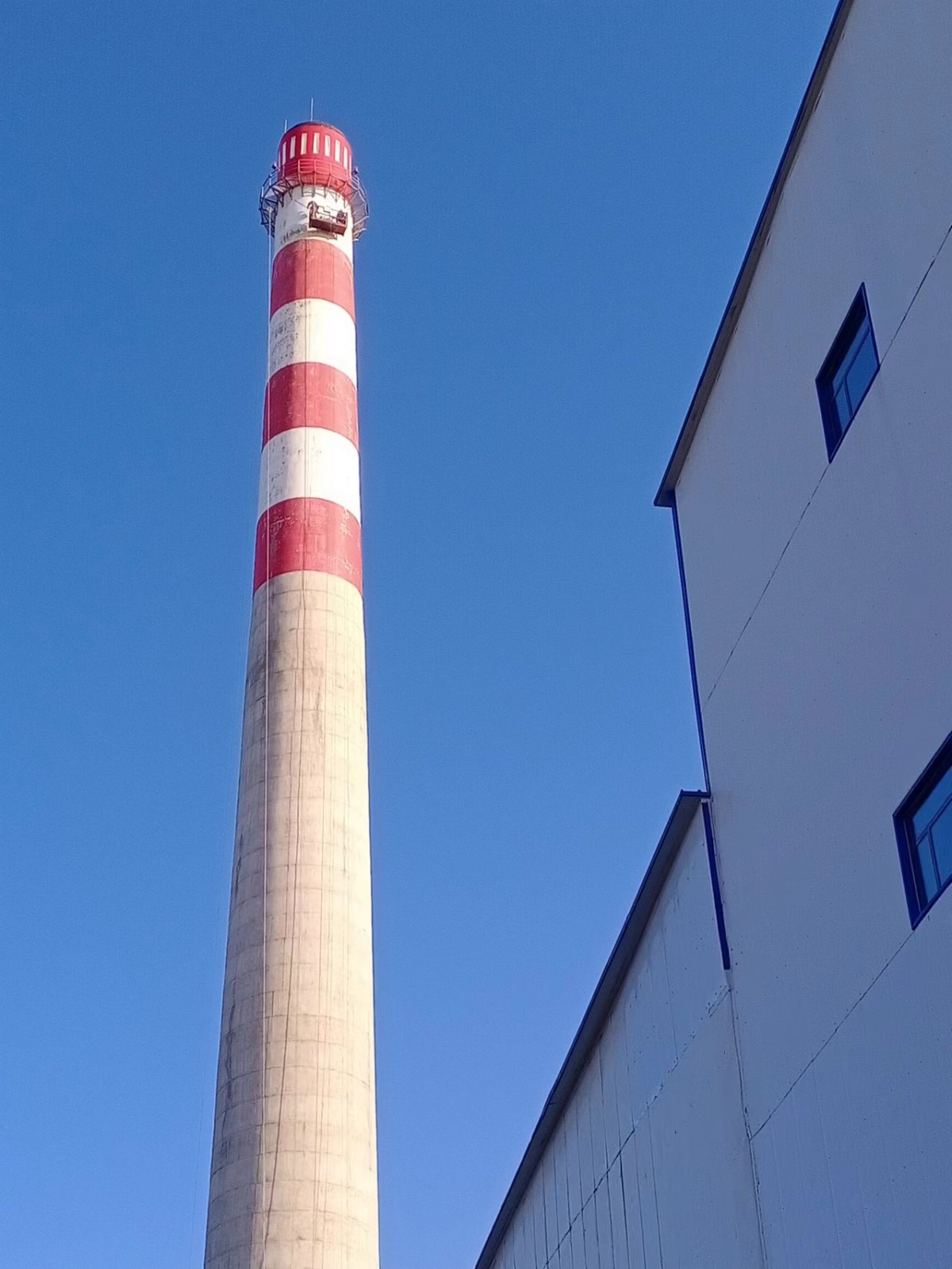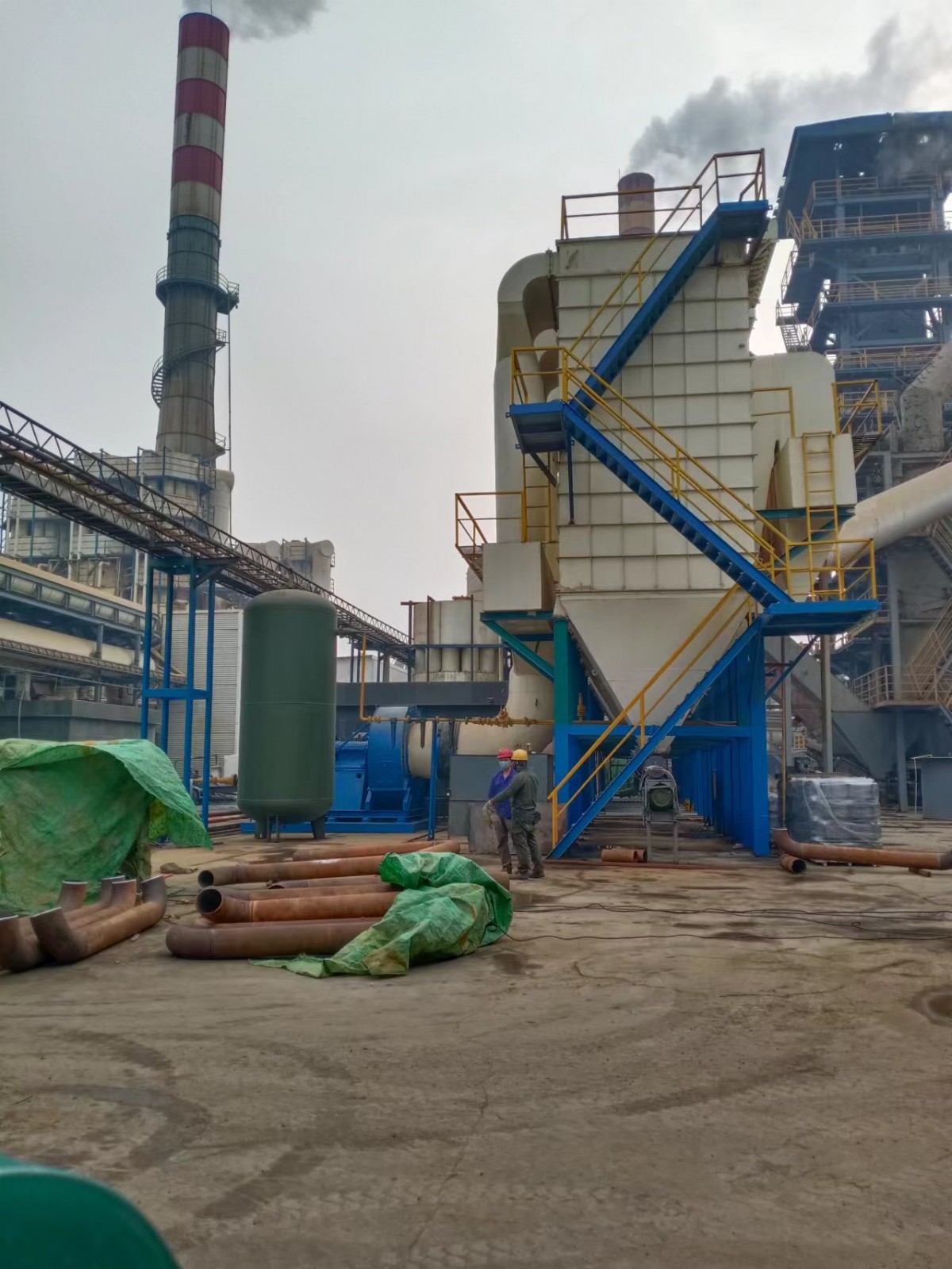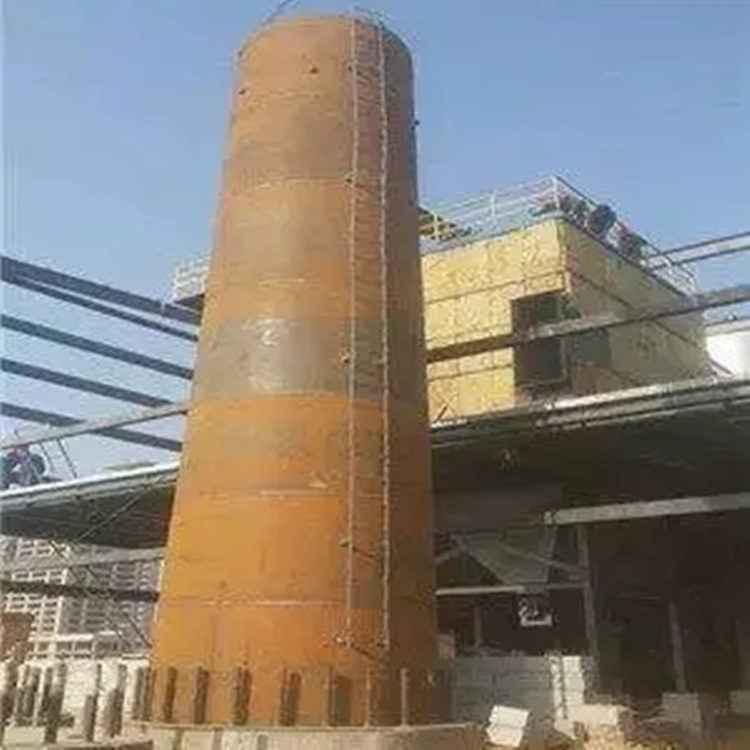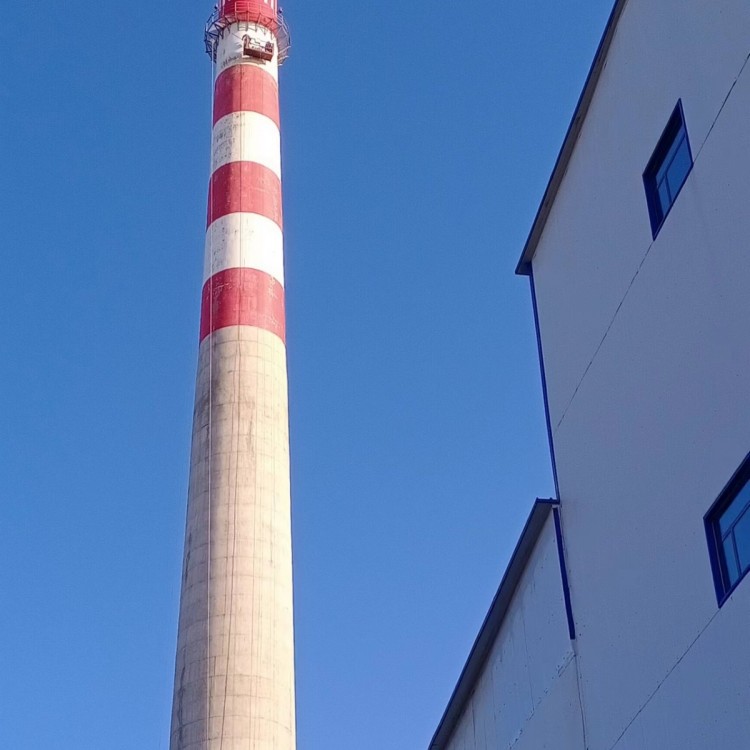

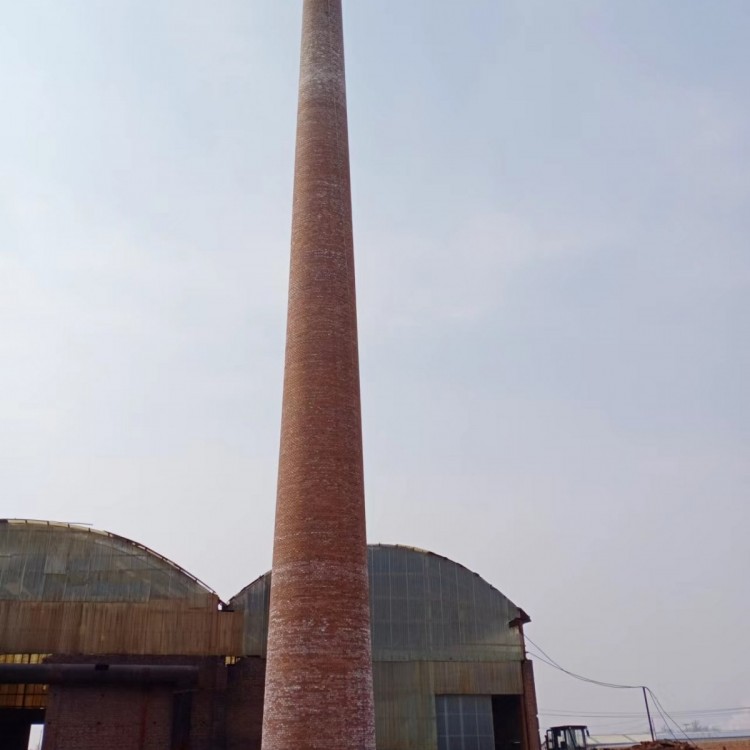







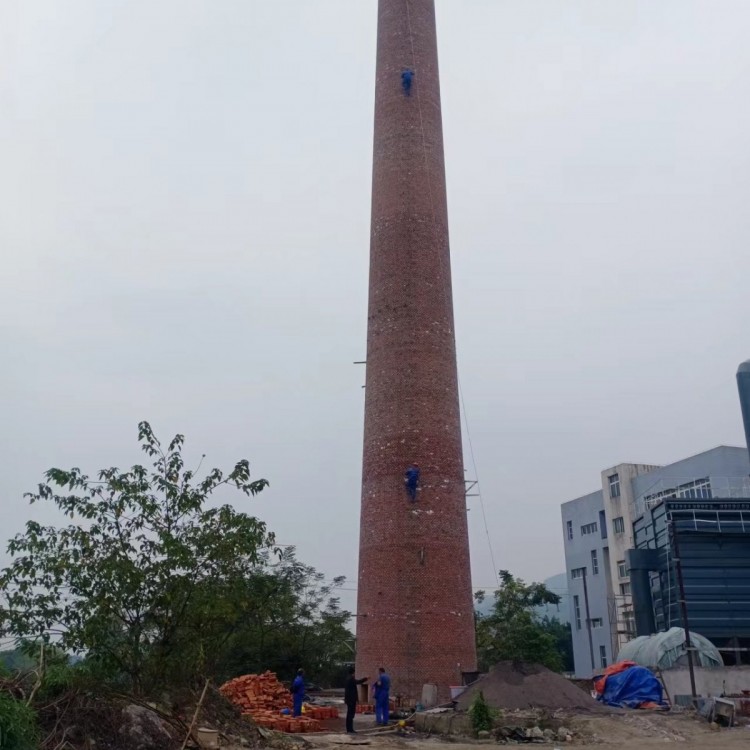
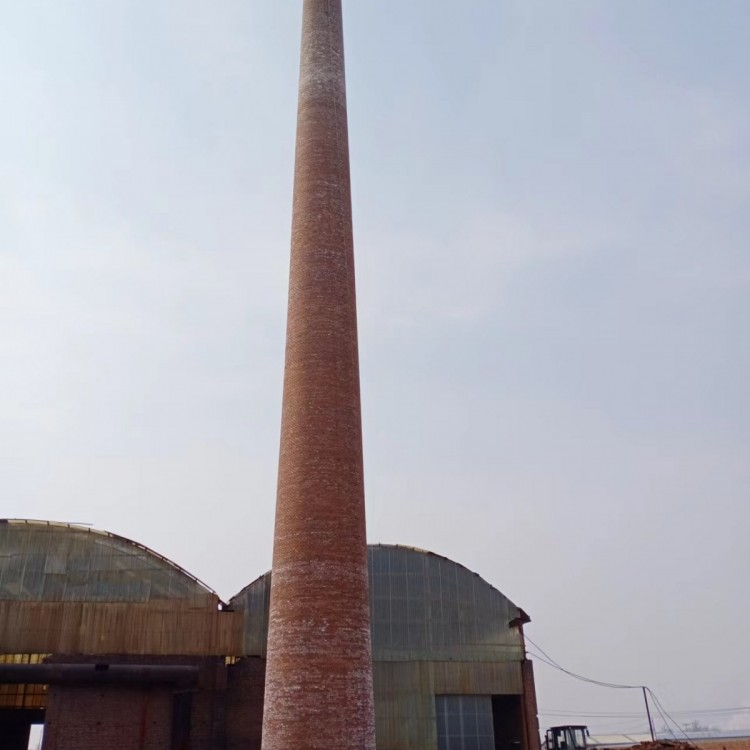
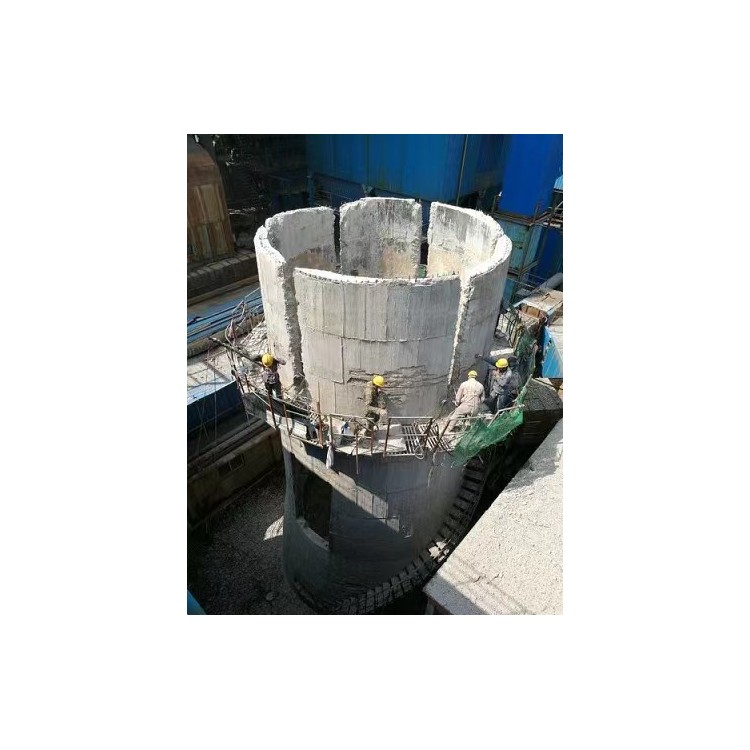
55-meter brick chimney demolition and heightening; personnel and materials for the lifting equipment; all objects that could fall in the work area should be removed or secured first; tools and equipment must be organized; no throwing items from heights to prevent injury; comply with safety inspections; strictly follow the safety requirements of the safety inspectors; high-altitude work safety signs, tools, instruments, electrical facilities, and various equipment must be used. Among them, enterprises in the papermaking and thermal power industries have obtained the emission permit by the end of June this year, while the other 13 industries will start in the second half of the year. According to local requirements, entities and institutions must obtain permits for emissions; more emissions mean more responsibility. The content of pollutants in the emission permits mainly includes air pollutants and water pollutants, and other pollutants will be gradually included in accordance with the law. Utilizing advanced technologies such as "no scaffolding, no production halt, and suspended work at heights," we provide:

Points must be safe and reliable. Absolutely no operation under the influence of alcohol or illness. Before operation, test the machinery to ensure normal operation. No walking or working on the upper chord supports, cantilevers, or unfastened components of the truss. Communication devices must be set up when working at heights, and continuous communication with the ground is required. A designated person is responsible for supervision. Absolutely no jesting or playing around during working hours. Necessary warnings must be posted.
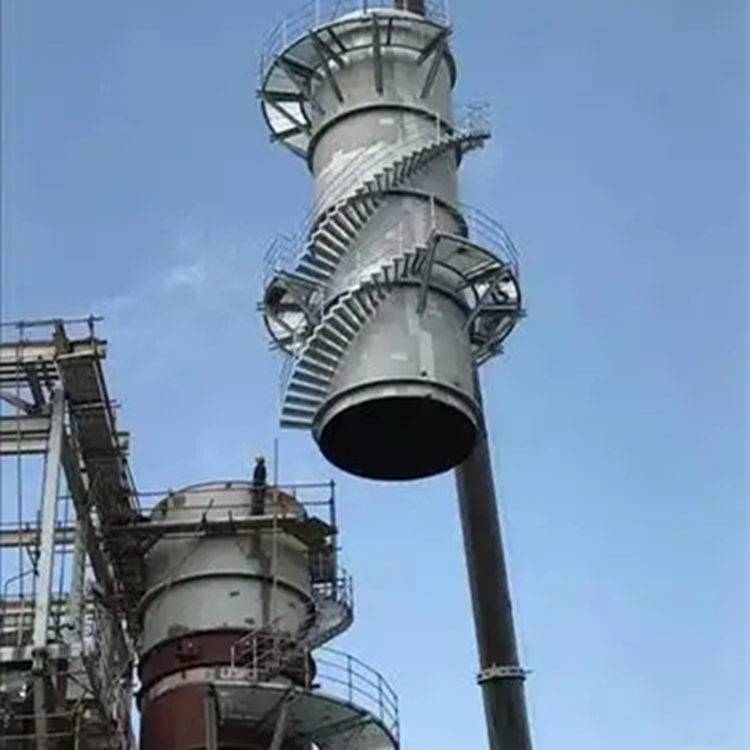
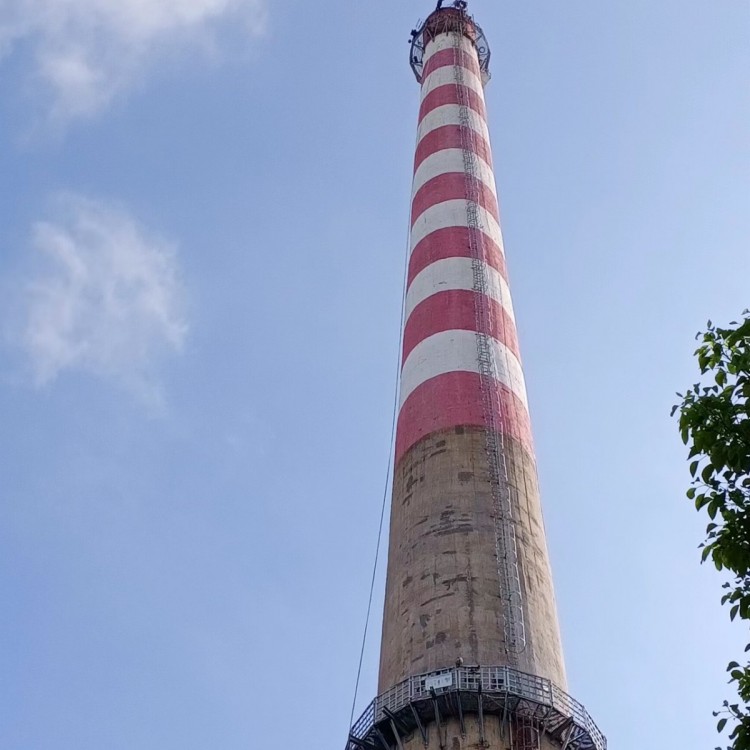
Engineering Overview: To facilitate the monitoring of flue gas emissions from coal-fired boilers, your company has decided to install a flue gas online detection platform at a height of 25 meters down from the 120-meter chimney height (i.e., H=25m). This includes a 25-meter spiral staircase; and to rust-proof and anticorrosion the safety cage of the chimney climbing platform. Based on the joint on-site observations and in combination with our company's many years of construction technology and experience, we propose the following construction plan. Construction sequence → Steel component processing and shaping, anticorrosion (one coat of primer) → Platform installation → Bracket welding → Installation of zigzag ladder → Rail welding → Rust removal and anticorrosion of the chimney climbing platform safety cage → Overall anticorrosion of the platform spiral staircase.
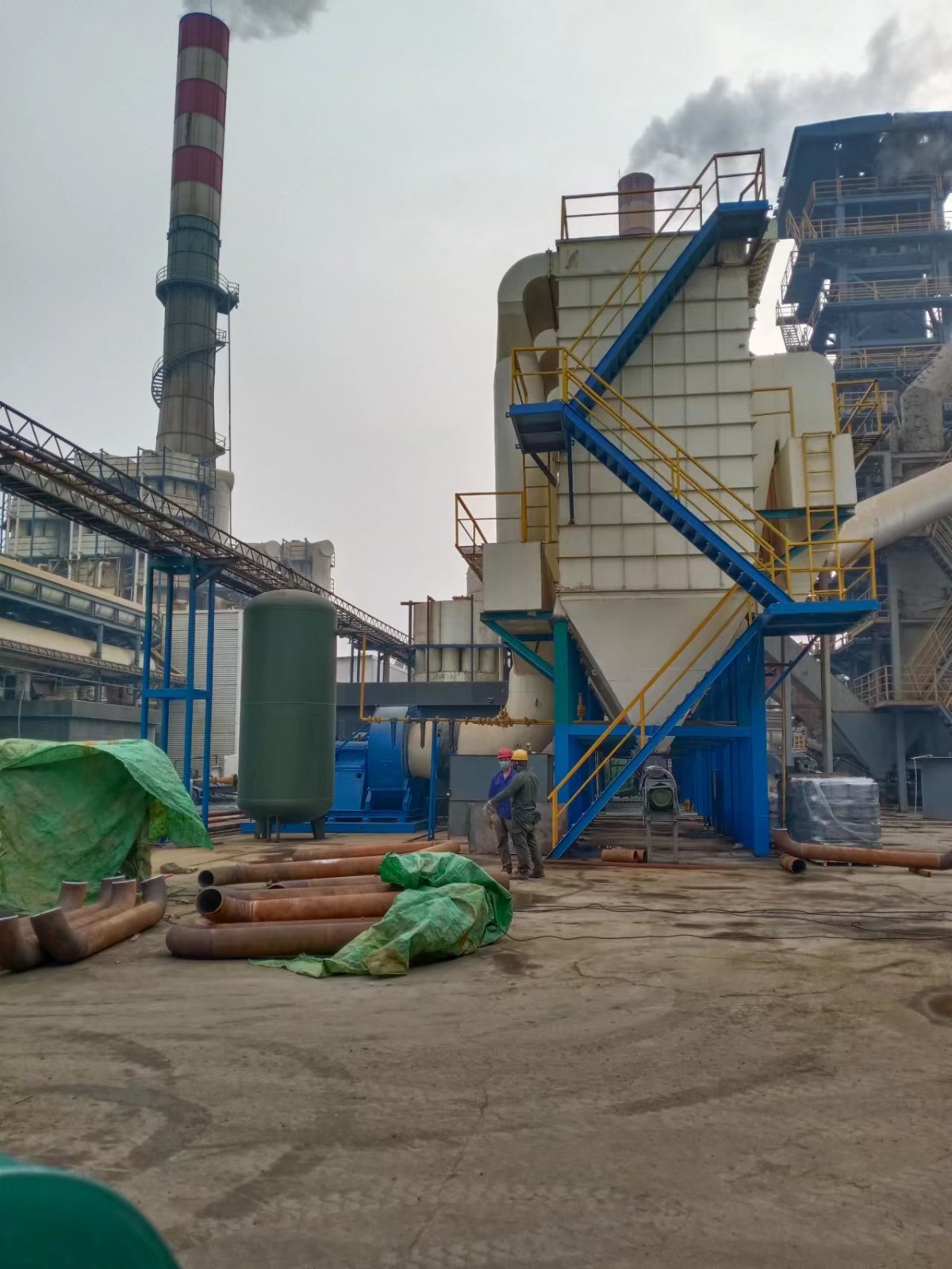
II. Construction Measures for Spiral Stairs
1. Wall panel manufacturing: Utilizing 25×40×8 steel plates for brackets and supports, with a main spacing of 300mm; tread spacing of 800mm; railing posts made of 100×40×5 steel tubes; top rail in 100×40×5 steel tubes, with 40×4 flat iron used in the frame. After the platform steel structure is completed, apply two coats of anti-rust primer.
2. Installation: Use φ20×20 expansion bolts to first install the wall support points (as fixed points for the spiral staircase) at the installation platform according to the dimensions of the chimney exterior wall, with a spacing of 300mm. Then, weld the tread components together, followed by welding the uprights, handrails, and guardrails to form a continuous seat for the spiral staircase; thus, a complete spiral staircase is formed.
Chimney installation with a spiral staircase platform
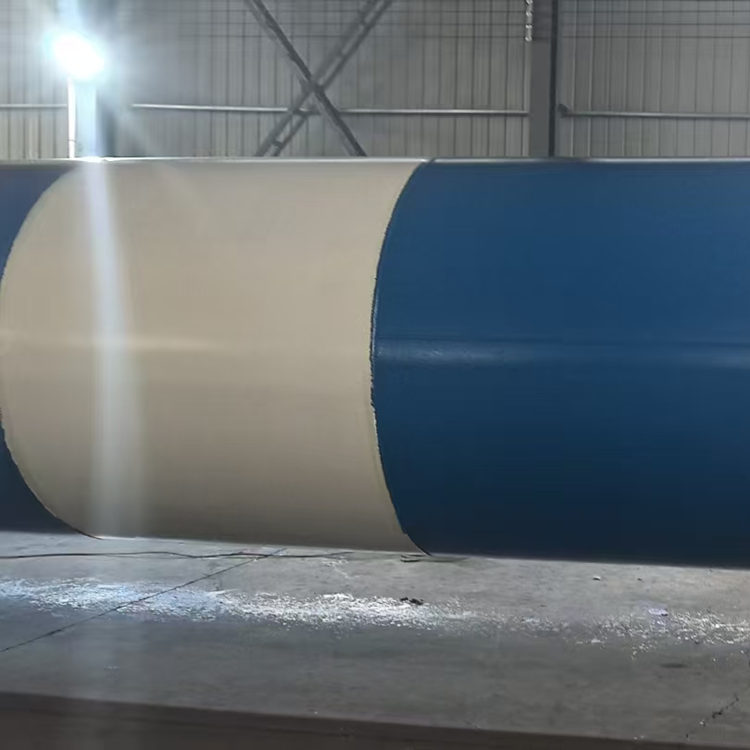
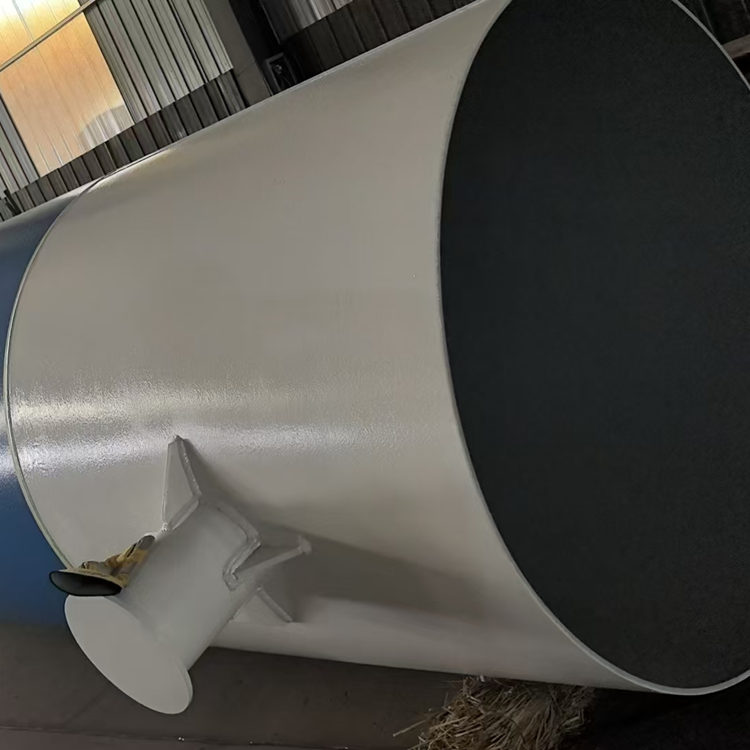
Three, Corrosion Protection for Chimney Ladder Guardrail Platforms: 1. Corrosion protection for chimney ladders and platform guardrails: First, thoroughly clean and remove rust, sweeping away all surface dust; Next, use tools like a spatula to scrape off any lifting or peeling parts, then apply three coats of corrosion-resistant paint using a roller and manual brushing.
Section 4: Technical Measures:
1. The project employs a suspended platform climbing method without scaffolding. During operations, an "S" shaped steel hook made of φ25 steel rebar is securely fastened at a fixed position on the lower chimney platform. A pulley is then hung from the "S" shaped hook, and a φ18mm white sisal rope is threaded through the pulley and anchored at a fixed point. The other end of the white sisal rope is secured to a "U" shaped bolt lock, with the movable climbing platform attached to the "U" shaped bolt lock for the workers to operate on. During construction, a simple crowbar is fixed outside the railing of the lower chimney platform, equipped with a 1T pulley. The φ18mm white sisal rope is used for vertical transportation of steel components.
V. Quality Assurance Measures:
1. Our company adheres to the quality policy of "Customers are God, Quality is Life," and diligently operates the GB/T quality management system. We strictly supervise the quality of each project and process, ensuring that materials, semi-finished products, and finished goods during the construction process are all under controlled conditions, thereby effectively guaranteeing the quality of the construction work from the root.
All operators must strictly follow the technical and safety briefing content. Welders are required to hold a valid certification to perform their duties.
3. Welding rods should be accompanied by a factory certificate of quality or material report. It is required that welding rods be dried in an oven before use. The welding wire and flux selected for submerged arc welding must be compatible with the base material.
4. After the steel component is manufactured, it must be rust-removed and primed with paint. The paint application should be done by hand, ensuring the paint film thickness meets the design specifications.
5. When welding multiple seams, the transverse seam with the largest shrinkage deformation should be焊接 first, followed by the longitudinal seam, or the butt joint seam should be焊接 before the corner weld seam. The main welds of the welding type steel should be焊接 before assembling the stiffener plate components.
6. The steel structure hoisting process strictly adheres to the "GB50205-95 Code for Construction and Acceptance of Steel Structures" and the "GB50221-95 Standard for Quality Inspection and Appraisal of Steel Structure Engineering."
7. Pre-construction inspection of the steel component's dimensions and welding quality is mandatory, and must pass before construction can begin. A technical briefing must be conducted prior to construction.
8. Special trade workers must have a certification issued by the Labor Bureau to be on the job during construction. Adhere to the three-inspection system (self-inspection, mutual inspection, and *inspection) during construction and strictly inspect the quality of each process.
Chimney Installation Platform
9. After the overall "Z" truss steel structure passes the installation and acceptance, the weld seams, spatter, dust, and other debris on the areas to be painted should be cleaned thoroughly. Apply rust-inhibiting primer to the welding areas.
10. Steel paint materials used in engineering must be accompanied by a "Production License," "Product Quality Inspection Certificate," and "Product Qualification Certificate," and the authenticity of the products must be verified according to their coding and password.
11. After the overall platform steel structure installation and acceptance are approved, the welds, welding spatter, dust, and other debris on the areas to be painted should be cleaned thoroughly. Additionally, apply anti-rust primer to the welding areas.
12. Paint materials used in engineering projects must be accompanied by a "Production License," "Product Quality Inspection Certificate," and "Product Qualification Certificate." Authenticity verification of the products must be conducted based on their coding and password.
13. Paint mixing must strictly adhere to the standards outlined in the "User's Guide" for paint coatings and the product's instruction manual. Mixing and adjusting paint must be carried out by designated personnel. Carefully read, understand, and master the product manual, strictly follow the mixing ratios, and control the paint concentration. Mixing must be done using containers and tools, and the amount of paint mixed should be strictly tracked to match the day's application requirements. The painted surface after application must not show pinholes, cracks, peeling, or missed spots. The coating should be smooth and even, without drips, scratches, or orange peel textures.
14. The interval between each paint coat must be no less than 12 hours, and the next paint process can only be carried out with the consent of the client's representative. The paint surface must be uniform in color, evenly applied, with no missed spots or drips.

Section 6: Safety Protection Measures
1. The project adheres to the guiding principle of "safety first, safety is more important than mountains" and implements the policy of "safety first, prevention-oriented." It establishes a comprehensive safety management system with the project manager as the overall responsible person for safe construction, dedicated safety officers in charge, and part-time safety officers in each construction team.
2. All construction personnel must strictly comply with safety construction regulations and the owner's factory rules and regulations. They must also complete training and pass the examination by the factory's safety supervision department before they can participate in construction.
All construction personnel must hold a "Special Occupation Operation Certificate" for high-altitude suspended work and operate strictly in accordance with high-altitude work specifications.
4. Establish and implement comprehensive safety construction regulations, and strictly adhere to the provisions of the construction "Safety Agreement." The factory's safety supervision department has the authority to handle and penalize any violations of construction safety behaviors and personnel.
5. Prior to construction, clearly mark the safe construction area with fences or ropes with prominent safety signs, and establish multiple "High-Altitude Work" warning signs. Unauthorized non-construction personnel are strictly prohibited from entering the construction site.
6. Construction personnel must wear appropriate protective gear and safety helmets upon entering the construction site. When working at heights, they must fasten safety belts and ropes, and a dual safety measure must be in place.
7 The water and electricity required for the construction of this project must be connected through the on-site inspection points provided by the client.
8 Equipment and lifting ropes for the construction of this project must pass inspection before entering the site. Regular and irregular inspections are required during use, and any discrepancies found must be replaced immediately.
9. When lifting steel components, ensure smooth lifting or lowering to avoid sudden braking or impact. A designated person should be in charge with clear, loud, and explicit signals. Unauthorized operations are strictly prohibited. After the components are installed, their quality must be inspected to ensure safety and reliability before unloading. Daily work must reach the safety standards before the shift can end.
10. Small tools used by construction personnel should be kept in a tool bag, carried with them as they go up and down, and securely fastened with a rope when in use.
11. Strictly prohibit throwing or dropping objects from heights. Ensure that construction waste such as iron slag blocks are cleared and cleaned up on the same day as work completion, achieving a clean site upon project completion.