







What is CE certification?
"CE" mark is a safety certification symbol, regarded as the passport that manufacturers need to open and enter the European market. CE stands for European Conformity (Conformité Européenne).Products bearing the "CE" mark can be sold in all EU member states without needing to comply with the requirements of each individual member state, thus achieving free circulation of goods within the EU member states.
The "CE" mark is a mandatory certification symbol in the EU market. Whether it's products produced by internal EU companies or those from other countries, to freely circulate in the EU market, they must affix the "CE" mark to indicate that the products meet the basic requirements of the EU's New Approach for Technical协调 and Standardization directives. This is a mandatory requirement imposed by EU law on products.
Origin of CE Certification
CE is an abbreviation in French, which means "Conformité Européenne" in English.nformity refers to the European Community. In fact, CE is also the abbreviation for "European Community" in many languages of the European Community countries. Originally, the English term "European Community" was abbreviated as EC. Later, due to the different translations of the European Community in various languages, such as "COMMUNATE EUROPEIA" in French, "COMUNITA EUROPEA" in Italian, "COMUNIDADE EUROPEIA" in Portuguese, and "COMUNIDADE" in Spanish, the abbreviation was changed from EC to CE. Of course, one might also view CE as
ConFORMITY WITH EUROPEAN (DEMAND), the "key requirements" at the core of European directives, were specifically defined in the Council Resolution on the New Approach to Technical Harmonization and Standards (85/C136/01) of May 7, 1985, as essential requirements for the purpose of drafting and implementing directives. These requirements are limited to fundamental safety aspects of products that do not pose risks to human, animal, and product safety, rather than general quality requirements. Harmonization directives stipulate only key requirements, while general directives leave the task of standardizing requirements to the standards themselves. Compliance with the key requirements of relevant directives allows the affixing of the CE mark, without the need to meet general quality standards to determine the use of the CE mark. Therefore, the accurate meaning is: the CE mark is a safety conformity mark, not a quality conformity mark. In the 1940s, Western European countries felt that, to ensure their safety between the two superpowers of the US and the Soviet Union, to improve their international status, and to accelerate economic development, they had to unite, thus vigorously promoting the European integration process. European integration can be divided into five levels: the establishment of a free trade area, a customs union, a single market, an economic and monetary union, and a political union.
CE Mark Significance
The free circulation of goods is the cornerstone of establishing a single market, and the mechanism for achieving this is the CE mark. This mechanism is built upon the avoidance of new trade barriers, mutual recognition, and coordination of technical standards among EU countries. The principles are as follows: - The contents of the harmonized and unified legal documents (i.e., EU directives) are limited to the basic requirements of products, to facilitate the free circulation of products within the EU.
The EU harmonized standards include the basic requirements of the directives.
The application of EU harmonized standards and other standards is voluntary; products may choose to comply with EU harmonized standards or other technical specifications to meet the basic requirements stipulated by the directive.
The product naturally meets the EU harmonized standards, thereby confirming compliance with the basic requirements of the directive.
To make the basic requirements for products specified in the directives more operational, a series of EU harmonized standards have been established, with each member state responsible for aligning its standards with these. Additionally, a discussion mechanism for assessing whether the harmonized standards conform to the spirit of the directives and a mechanism for standard modifications have also been put in place.
The requirements stipulated in the instructions are mandatory and to be adhered to by all countries, hence these requirements should be recognized as general guidelines for preventing safety hazards or lesser risks. They differ from the commercial technical requirements typically found in general trade and are suitable for standardized objective criteria.
To ensure the principle of the single market is implemented in practice, the EU has further stipulated reliable assessment methods to determine whether a product meets the basic requirements stipulated by the directive, commonly known as the CE certification.
- Introduce a modular concept for product evaluation, consisting of evaluation modules forming the product evaluation process. Products that pass the evaluation process are marked with the CE symbol.
- Introduce unified EU coordination standards, quality management system standards (EN ISO 9000 series), and quality assurance standards of assessment institutions (EN 45000 series).
Establish an assessment institution recognition system at the EU level and a comparison mechanism among assessment institutions among member states.
Establish mutual recognition mechanisms in the product testing and certification domains, which were previously conducted independently by each country.
Streamline the differences in system structures across member states and industries within the quality domain (e.g., metrology and calibration systems, testing laboratories, certification and inspection organizations, and recognition bodies).
- Leverage mutual recognition agreements, cooperation, and other technical assistance projects to promote international trade among member states and between member states and non-EU countries. The purpose of the CE mark is to provide practical and flexible pathways for product qualification assessment to accommodate the diversity of modern industrial production under the trend of global economic integration. Catering to various stages of product development, production, and distribution (such as design, prototyping, production), the product assessment modules are divided into technical document inspection, type testing, quality assurance, and assessment completed by producers or third-party agencies in practice.
Products must meet all basic requirements of applicable EU directives before being launched into the market and put into service. After undergoing an appropriate product assessment procedure and being deemed compliant, the CE mark must be affixed. Any product bearing the CE mark is considered to meet all EU directives. Member states must take positive measures to ensure its free circulation within the single market, unless there is clear evidence that the product does not meet the basic requirements of the applicable directives or that the product poses a significant hazard not covered by existing directives.
Common CE Certification Questions
How much is the CE certification?
CE certification costs vary greatly depending on the product and the standards applied, ranging from a few hundred dollars for a single test to tens of thousands or even hundreds of thousands if the product involves multiple standards and a complex assessment and testing process.
CE-EMC standard products: approximately $1,000 - $2,500; CE-RED wireless products: approximately $3,500 - $5,000; CE-MD mechanical products: approximately $5,000 - $50,000.
Due to numerous factors affecting pricing, an exact price can only be determined after detailed communication.
2. CE Certification Cycle?
Standard lead time is around 2-3 weeks, with expedited service available in 1 week. Client-centric is our core principle; we prioritize your urgency. Your time requirements are our collective pursuit. Urgent projects will be guaranteed to be completed within one week, even if it requires overtime from all our staff at Huajian.
3. Difference between Notified Body Certificates and Self-Certification?
The EU Notifying Bodies, also known as NBs, are officially recognized institutions by the EU and each has a corresponding notification number.
There are few EU notification bodies conducting business independently in the Chinese market; many are handled by domestic third-party certification and testing agencies.
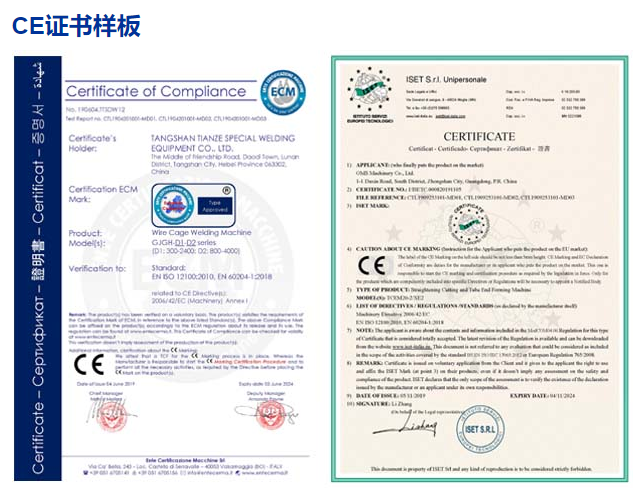
Why is the certificate issued by your company in the DoC format rather than the CoC format??
The main difference between the CoC and DoC in the two types lies in the certifying authority.
CoC Certificate: Certificate of Compliance - Issued only by Notified Bodies (NBs) within the EU.
DoC Certificate: Certificate of Originnformity Self-Declaration of Conformity Certificate → Typically a self-declaration by the product manufacturer.