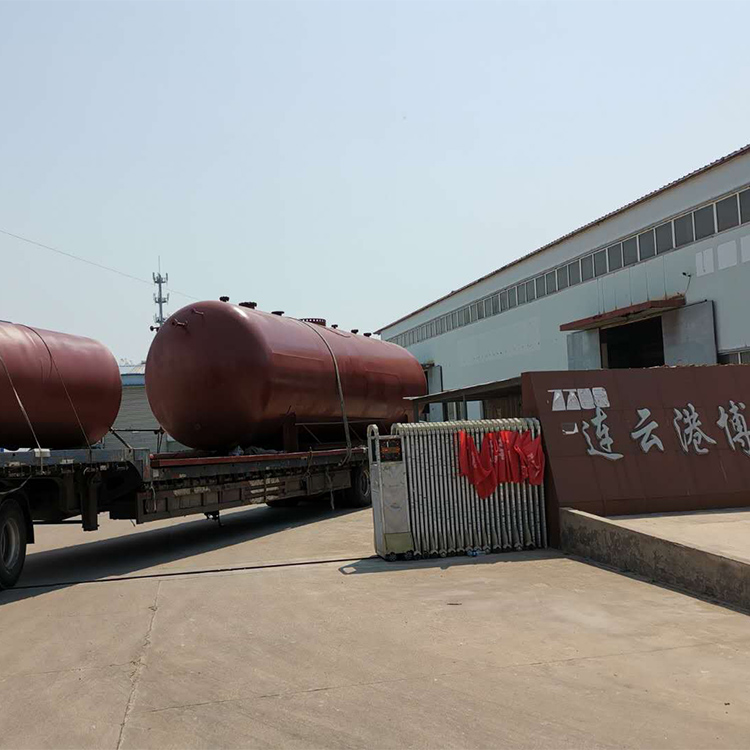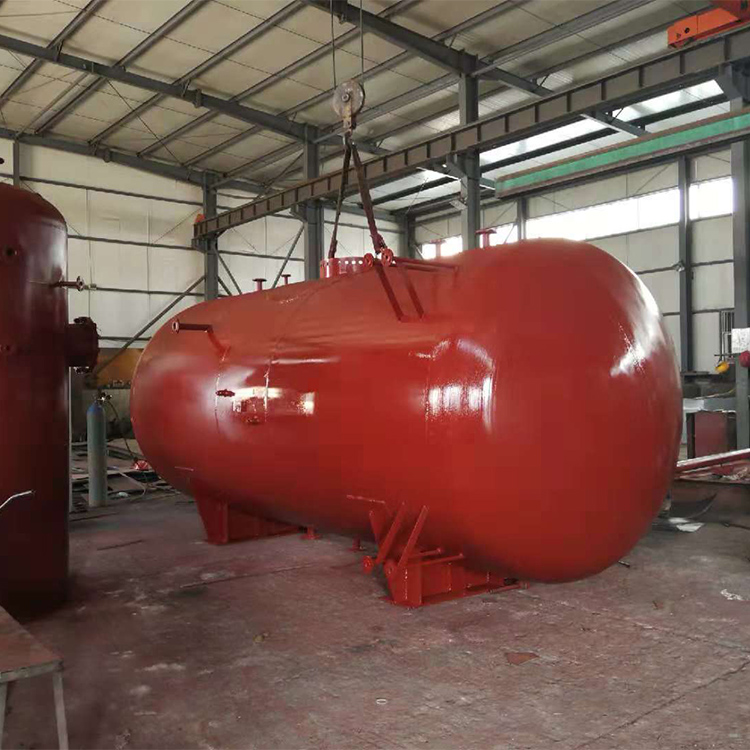













The Rotating Film Deaerator is a replacement for the Spray Filled Deaerator, producing a state-of-the-art thermal deaerator. The principle of the Rotating Film Deaerator involves replenishing water through a film-forming tube, which is then spirally ejected at a specific angle to exchange heat with the steam, thereby deoxygenating. It heats the water to the saturation temperature corresponding to the deaerator's working pressure, removing dissolved oxygen and other gases from the feed water, and preventing and reducing corrosion in the boiler feed water pipes, economizers, and other auxiliary equipment.
1. Application: The deaerator is one of the key equipment in the boiler heating system, protecting the oxygen corrosion of the boiler feed water pipes, economizers, and other auxiliary equipment.
2. Advantages: The spiral membrane deaerator has high pressure reduction and deaeration capacity, low gas consumption, and the oxygen content in the feed water after deaeration meets 100% of the qualified rate.
Deaerators are one of the key equipment in boilers and heating systems. If the deaeration capacity of a deaerator is poor, it can cause severe corrosion to the boiler's feedwater pipes, economizers, and other auxiliary equipment. The economic loss caused by this can be several to hundreds of times the cost of the deaerator. Therefore, the National Power Department has established some standards for the oxygen content of deaerators, namely, the oxygen content of the feedwater for atmospheric deaerators should be less than 15 mg/L, and for pressure deaerators, it should be less than 7 mg/L.
Oxygen Removal Principle, Gay-Lussac's Law
At constant pressure, for a given mass of gas, an increase of 1°C in temperature results in a volume increase equal to 1/273 of its volume at 0°C; or, at constant pressure, the volume of a given mass of gas is proportional to its thermodynamic temperature. Discovered in an experiment by the French scientist Gay-Lussac, hence the name. Applies to ideal gases and is approximately applicable to real gases under high temperature and low pressure.
Henry's Law states that, at a constant temperature and low total vapor pressure, the concentration of a solute in a solution is directly proportional to its partial pressure in the gas phase. Dalton's Law of Partial Pressures asserts that, at constant temperature and volume, the total pressure of a mixture of gases is equal to the sum of the partial pressures of the individual components, and the partial pressure of each component gas is equal to the pressure it would exert if it occupied the entire volume alone.