










Daily maintenance of submersible pumps. Check for any damage to the power cord daily and prohibit the use of pumps with leaks. Inspect the pump body for damage daily to ensure the motor does not leak electricity during operation. After operation, promptly clean off debris attached to the pump and rinse it clean. To ensure the normal operation of the submersible electric pump, it is necessary to comply with the following requirements. Before using the submersible electric pump, the motor's insulation resistance must be checked with a megohmmeter, with the value not being less than 50MΩ.
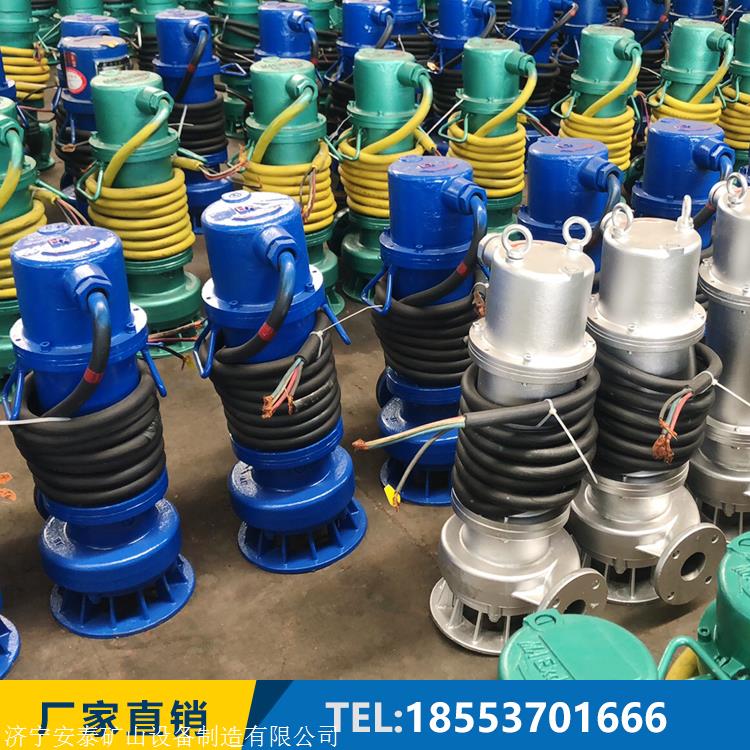
Submersible Pump Operating Conditions
The flow rate at the electric pump outlet must not exceed the rated value (when used within the specified head range).
● Transports lightly polluted water with a solid content (by volume) not exceeding 1%.
● Diving depth not exceeding 5 meters; please declare if exceeding 5 meters at the time of order.
● Water temperature not exceeding 40℃;
● pH level between 5 to 9.
Submersible sludge pumps are primarily used for conveying industrial wastewater and urban domestic sewage, with a significant advantage of being able to discharge pulp, long fibers, and other impurities (hence also known as "clog-free submersible sewage pumps"). They are widely used in urban sewage treatment plants, stormwater ponds, pumping stations, flood control and drainage systems. In 1956, Sterbery-Flygt of Sweden developed the "submersible sludge pump," which approximately halved the cost of wastewater stations. China introduced and began producing "submersible sludge pumps" from Germany in the late 1980s, mainly including the WQ, QW, and AS series products. (Statistics show that around 1995, the domestic annual production of "submersible sludge pumps" was about 50,000 units.)
◆ Specification Selection
Submersible pumps of different specifications have varying application ranges.
The flow rate and head specified on the label of any submersible pump are the rated operating conditions for that pump, which are typically the optimal points for high efficiency use.
In use, as the flow rate and head change, the efficiency of the submersible pump and the motor power also correspondingly vary, which has a certain impact on the economy and reliability of using the submersible pump.
If the lift height is too low, the electric motor may overheat, and prolonged operation could even damage the motor; if the lift height is too high, the pump flow rate will decrease, and efficiency will drop.
Submersible pumps typically operate normally within a flow range of 0.7 to 1.2 times the rated flow.
Therefore, users must consider the appropriate application range when selecting and using submersible pumps, especially for high-head submersible pumps. Avoid operating them at excessively low lift points, as this not only wastes electrical energy but may also damage the submersible pump.
Submersible pumps are essential equipment for deep well water lifting. In use, the entire unit is submerged in water to extract groundwater to the surface, serving for domestic water supply, mine rescue, industrial cooling, agricultural irrigation, seawater lifting, ship loading adjustment, and can also be used for fountain landscapes.
Hot water submersible pumps are used for hot spring bathing and can also be applied for extracting groundwater from deep wells. They are also suitable for water lifting projects in rivers, reservoirs, and canals. Primarily used for agricultural irrigation and water supply in high mountainous areas for humans and livestock, they can also be employed for central air conditioning cooling, heat pump units, chilled water pump units, urban and industrial drainage, railway, mining, and construction site drainage. The general flow rate ranges from 5 to 650 m3/h, and the lift can reach up to 10-550 meters.
Selecting a submersible pump before use is crucial. It should be determined based on the actual water source conditions, as well as requirements for operating hours and pump flow rate. Firstly, the pump's head must be greater than the difference between the intake and outlet; secondly, the pump's flow rate must meet the requirements for drainage and irrigation.
Safety Precautions for Repairing Explosion-Proof Submersible Pumps
Proper dismantling methods required.
Before disassembly, mark the seams between the front and rear end caps and the base with a chisel. Since the motor's assembly at the factory is quite reasonable, if it's not reassembled in the original manner, it may cause slight inaccuracies resulting in the shaft not being as flexible. During disassembly, carefully observe the extent of the winding burnout and preliminarily analyze the cause of the burnout. Pay attention to easily noticeable issues like minor scoring and ball bearing breakage. If there is severe rust, avoid forceful hammering; instead, use gas welding to heat the seam area, gently tapping with a hammer while heating, and use a puller or chisel to remove it, taking advantage of the principle of thermal expansion.
When disassembling and repairing a damaged winding, pay attention to protect the iron core and the plastic sheath. Inappropriate methods may cause the iron core to swell and become damaged, potentially causing the motor to generate electromagnetic effects when powered, resulting in vibration of the iron core and the winding itself. This can easily lead to insulation paper and electromagnetic wire insulation damage. The method for removing the wires is to cut them with a diagonal pliers at one end and pull them out with a pair of pliers from the other end.
Explosion-proof exhaust structure features
Explosion-proof sewage pumps are strictly designed and manufactured in accordance with the coal industry standard MT/T671-2005 "Explosion-proof Submersible Pumps for Coal Mines" and the national execution standard of the People's Republic of China GB3836-2000 "Electrical Equipment for Explosive Gas Environment."
The explosion-proof sewage pump operates smoothly due to the significant role of the motor. Let's delve into its performance features below!
The motor employs a Y-type dry explosion-proof three-phase asynchronous motor, featuring high starting torque, excellent operational performance, low noise, compact size, light weight, and easy maintenance. It also boasts excellent explosion-proof structural properties and a high protection rating. Suitable for use in environments with explosive gases such as methane or coal dust, including mining faces and tunnels with explosion hazards, and is often paired with water pumps.
Explosion-proof sewage pumps are a combined electrical drainage equipment of pump and motor, featuring an aesthetically pleasing appearance, simple structure, excellent sealing performance, stable performance, long lifespan, and ease of installation and use. They can operate continuously underwater for an extended period and are widely used for automatic drainage in coal mine vertical shafts, inclined shafts, and bottom silt areas. The built-in electric pump effectively extends the lifespan by allowing water to flow through the motor's sandwich layer. The external electric pump utilizes a double-channel large flow impeller design, ensuring smooth operation, strong sewage-ejecting capability, anti-tangling, and no clogging. Additionally, they are characterized by small size, light weight, and ease of carrying.












