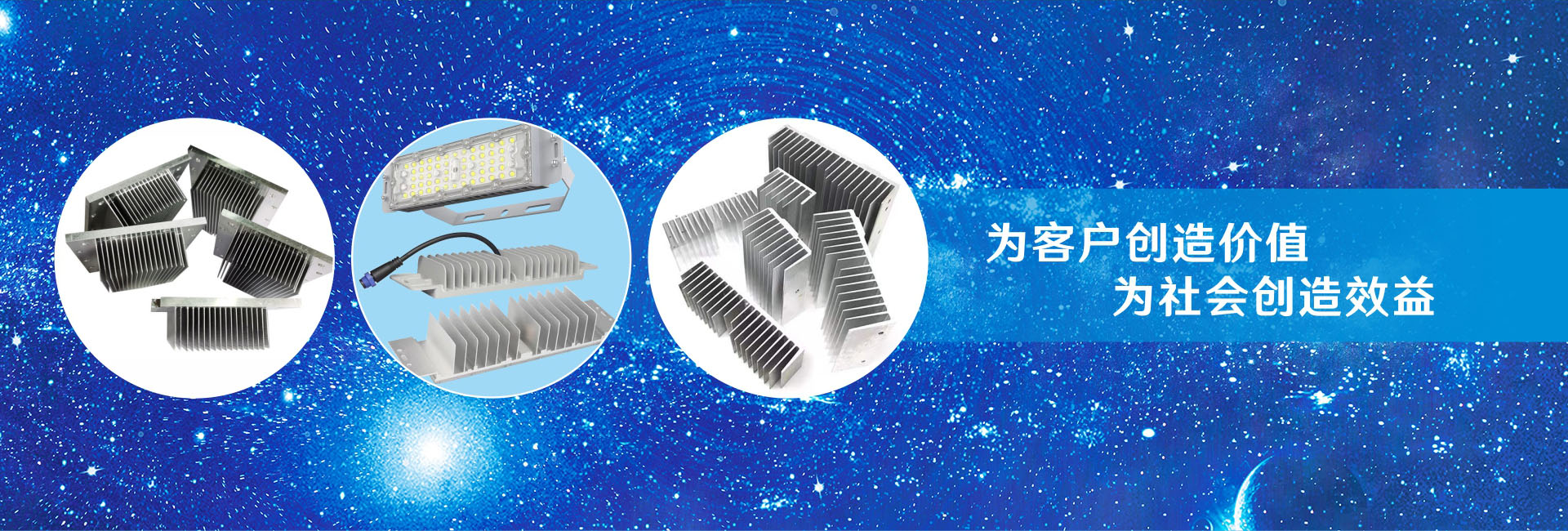
Insertion Radiators, Extruded Radiators, Electronic Radia...

Aluminum alloy is widely used in heat dissipation equipment due to its light weight, aesthetic appearance, excellent thermal conductivity, and ease of forming complex shapes. The aluminum alloy profiles for heat dissipation mainly include three types: flat and wide, comb-like or spiny; circular or elliptical with outwardly radiating fins; and tree-like.
Their common characteristics include: short spacing between fins, with adjacent fins forming a groove with a large depth-to-width ratio; and a significant difference in wall thickness, where the fins are thin and the base plate thickness at the root is large. This presents considerable difficulty in the mold design, manufacturing, and consumption of heat dissipating materials.
The profile radiators with smaller local dimensions and symmetrical shapes are relatively easy to manufacture. Most radiator profiles are flat and wide, with larger外形 dimensions and some being asymmetric. The slots between the fins have a significant depth-to-width ratio, making them more challenging to produce. Manufacturing these radiators requires coordination among casting ingots, molds, and extrusion processes to ensure smooth production.
Alloys used in extruded profile heat exchangers must have excellent extrudability and thermal conductivity, with common types including 1A30, 1035, and 6063. Currently, the 6063 alloy is widely used due to its superior extrudability, thermal conductivity, and mechanical properties.


b2b.china9.net © Zhongshang 114 Hebei Network Technology Co., Ltd.Address: Room 6009, Oriental New World Center, No.118 East Zhongshan Road, Qiaoxi District, Shijiazhuang City, Hebei ProvincePlatform Service Hotline: 4006299930