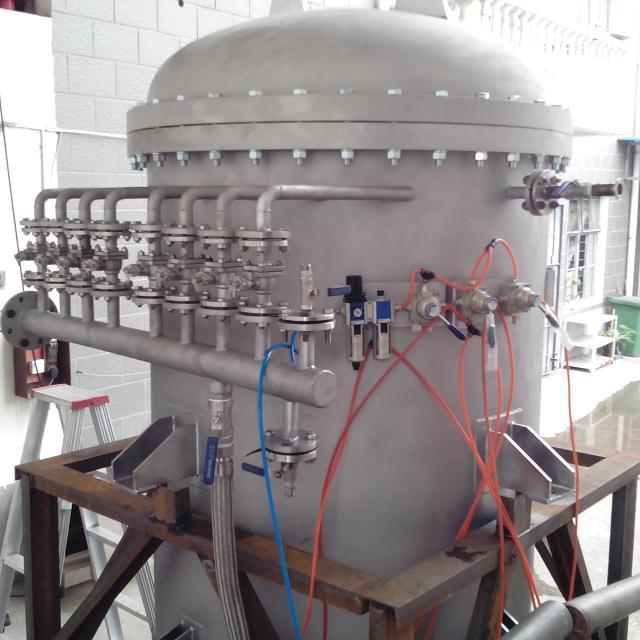
Regeneration Process Method for Titanium Rod Filter Cartridges and Stainless Steel Powder Sintered Filter Cartridges?
- Physical Regeneration Process: This process is suitable for filtration media with low particle impurities and a lighter degree of clogging in titanium filter cores. Examples include ozone disinfection filtration and air filtration.
Reverse Flush: Use pure water (deionized water) for reverse flushing for 15 minutes with a pressure less than 0.4 Mpa, or use clean air (steam) for reverse flushing with a pressure less than 0.4 Mpa.
2. Ultrasonic Cleaning: Place the titanium rod into the ultrasonic cleaning tank, remove after 60 minutes of cleaning, then rinse with deionized or distilled water for 15 minutes. Dry and sterilize before use.
- Chemical Processing Technology
Titanium Rod Filter Core Filter — This process is suitable for cases where the titanium filter core is severely clogged and the filter medium composition is complex (such as decarburization filtering, protein-containing medium filtering, and high viscosity medium).
Alkali washing process:
Firstly, for new usage or extended shutdown during holidays, soak the alcohol solution in 1% NaOH for 30 minutes before use. Rinse the solution with tap water before submerging it into the alkaline solution. After soaking, rinse the solution with deionized water both internally and externally for at least two rounds, with each rinse lasting no less than 30 minutes at a water pressure of 0.2-0.3 Mpa. Continue rinsing until no floating particles are present (inspected by light). The pH should be neutral upon completion.
2. Pickling Process:
- The Cleaning Solution Recipe: 5% chromic acid (anhydrous), 1000g of distilled water, add concentrated acid (industrial grade) to 2000ml.
- Method: Dissolve heavy chrome acid crystals or fine powder in hot water (60-80 degrees), then slowly add concentrated acid (94%-96%) until sufficient, starting with a slow pace and stirring continuously. Once the volume reaches 1200ml and the heavy chrome acid is completely dissolved, with the color turning from brownish red to deep red, you can increase the speed slightly until all the acid is added. If there is still undissolved material after all the acid has been added, reheat the mixture until it dissolves, then let it cool and seal it for later use.
- Please note the following during the configuration process:
- The cleaning fluid can remove general dirt, greases, and metallic particulate impurities adhering to the vessel walls, as well as kill microorganisms and destroy heat sources. It is essential to rinse the alkali cleaning fluid before immersion, otherwise, fatty acids may precipitate and stain the filter elements.
- If the brownish-red cleaning solution turns green, it indicates a decrease in its oxidizing ability and should not be used anymore.
- If the acid concentration is reduced to below 85%, the cleaning ability will significantly decrease. Therefore, it is not advisable to add too much water to the formula.
- When adding cleaning solution, slowly pour it into the chromic acid solution while stirring. Never add water to the acid, as it may cause an explosive reaction due to sudden heat, potentially leading to personal injuries.
- Do not mix cleaning fluid with alcohol to avoid explosion.
- The cleaner is easily absorbent and can be sealed for storage and future use.
- After the cleaning solution is prepared, dilute it by a factor of two before use, maintaining a concentration of 2.5% to 3%.
- Titanium Rod Filter Core Filter Cleaning Steps:
- Remove the filter element.
- Rinse the inside and outside walls with injection water or filtered distilled water for 3 minutes, at a temperature of around 60 degrees.
- Using compressed air (Note: No oil or mist particles are allowed in the air) to dry and clean water droplets.
- Soak in cleaning solution (at a concentration of 2.5% - 3%) for approximately 15 minutes before removing.
- Rinse both inside and outside with deionized or distilled water for about three times, with a water pressure of 0.3-0.35 Mpa and a temperature below 80 degrees; room temperature is also acceptable.
- Using hot steam to dry the residual water of the components, then directly placing them into the steam sterilization cabinet for sterilization for over 40 minutes.
- Less rinse with distilled water, bake at a constant temperature of 112 degrees for over one hour.
- Place in a sterile box for sealed protection.
- Each shift, soak and inspect before use daily.
1. Verification of liquids is conducted using injection water or filtered distilled water.
2. The liquid level is 5-10mm above the surface of the components.
3. Pressure: 0.2-0.3 Mpa (no oil mist allowed in the gas)
4. Observe the pore distribution and bubble point pressure after venting.
5. Bubbles are not permitted at the threaded mouth and sealing head area.
No bubbles are allowed at the weld joint between the head plate and the filter element.
7. Rotate the center axis 360 degrees and observe the entire circumference in a horizontal plane during operation.
8. Document the inspection process and fill out the inspection forms meticulously.
9. Note the batch number and usage date, and keep a record.