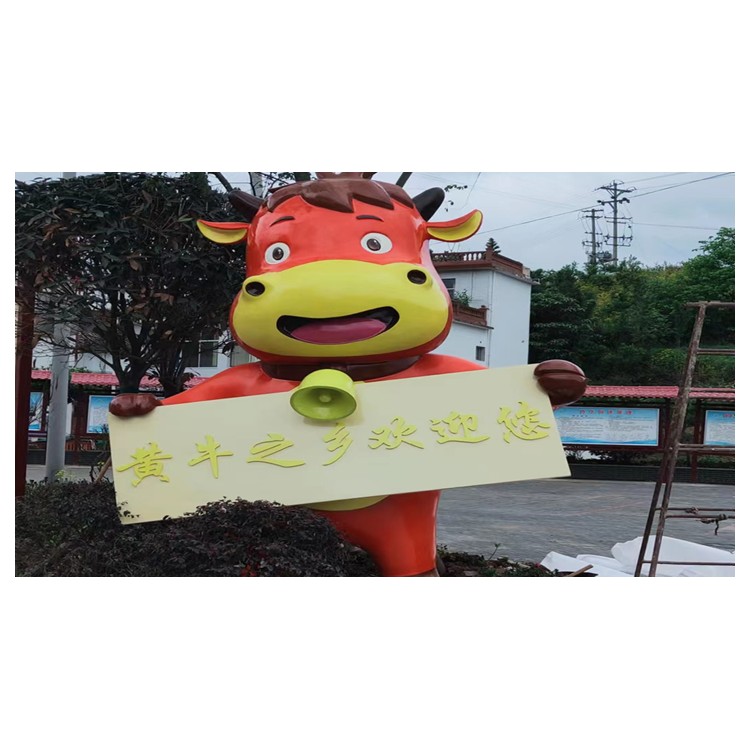
Fiberglass sculptures, fiberglass corrosion protection, fiberglass enclosures
13219000823


Product Recommendation
So popular, you can often find them in parks or shopping malls. Many people may not know how glass fiber reinforced plastic sculptures are made. Today, let's talk about the manufacturing process of glass fiber reinforced plastic sculptures.
Step, frame weldingA complete sculpture framework is composed of a wooden base and angle steel supports. Once the supporting frame is securely fastened, the general shape of the sculpture is formed using reinforced steel; then, on this foundation, fine iron wire and wooden crosses are wrapped around to hold the subsequent large clay in place and prevent it from falling. The balance of the sculpture frame is crucial; it determines the final shape of the sculpture and is the key foundation for its success.
In the evolution of postmodern fine arts, the creation of abstract expressionist sculpture has always emphasized the interpenetration of mass and void, considering form, structure, and space from an internal perspective. The mutual replacement of these elements keeps the sculpture in a state of balance, constantly evolving. Today's figurative sculpture creation also shares this characteristic. Sculptors must consider the relationship between form and space before creating works, which is fundamental and a necessary condition for the maturity of the artwork.
Step Two, Apply Mud
The clay hanging process is a satisfying endeavor, with large, moderately soft pieces of clay gradually taking shape on the sculpture stand. During the clay hanging, if the clay is too soft, the sculpture is prone to collapse, and if it's too hard, it's difficult to proceed with further detailing. Finding the right balance is a process of accumulated experience. Soft sculptures often exhibit a lack of structure despite having volume. The form is established through the addition and subtraction of clay, and the detailed shaping takes the most time in the overall sculpture creation.
Life drawing, a sculptural technique born during the Renaissance, is one of the foundational methods in academically-oriented art education. By the 1980s, China's academically inclined sculptors had become part of a select few worldwide upholding classical realism. Today, Chinese academically inclined sculpture has several major directions, with figurative realism being a robust school. The creation through clay modeling ensures the practicality of realism. Wittgenstein once said, "The human body is an image of the human soul." Sculptural forms extracted from life are one way for figurative sculptors to express emotions and create ideas.
Three Steps to Cast a石膏MoldTo insert inserts into the finished clay sculptures, which serve as the mold lines for the separated molds; then, apply plaster evenly, typically at least three layers, to ensure each layer is solid and the mold is sturdy; afterward, wait for the plaster to solidify and dry at room temperature. Generally, inserts can be made from iron or aluminum sheets, or locally sourced materials, such as cutting inserts from aluminum cans.
Four steps: demolding and de-moldingAfter the plaster mold hardens, open the mold, clean the mud inside the mold to prepare for the subsequent glass fiber casting. The plaster outer mold needs to be broken after the glass fiber casting to retrieve the glass fiber inner mold. Demolding and mud removal are major projects for a large-scale work. Mud removal is a great relief after the work is completed, as it involves extracting the finished mud, a process that feels like a release, eagerly awaiting the next step.
Five Steps to Manufacturing Glass Reinforced Plastic (GRP) Internal Molds
Glass fiber sculptures cast on gypsum molds typically use the hand-laid-up process. After the mold is cleaned and prepared, apply a layer of resin followed by a layer of glass fiber mat. Confirm the timing for the next step as needed, and then wait for the glass fiber reinforced plastic to cure after laying it out.
Sculpture exists in three-dimensional space, with its own volume. It not only occupies space but also strives for longevity over time. However, glass fiber reinforced plastic, as a material, still faces issues like aging with current technological methods. It falls behind metals like copper in terms of timelessness. Therefore, when manufacturing glass fiber reinforced plastic, it is best to opt for high-quality materials available in the market.
Six-Step Polishing Process for Fiberglass SculpturesUnsaturated polyester resins have a certain shrinkage rate after curing, resulting in a rough surface and the formation of bubbles, which require re-polishing. Polishing begins during the casting process, a time-consuming task that doesn't immediately show results. The precision of the work is largely achieved through polishing and adjustment. The clay is soft, but when cast into fiberglass, it becomes rigid, and many forms still need to be completed on a hard surface, akin to another sculpting process. Fiberglass is constantly refined in complex creations. Polishing is a form of spiritual cultivation.
Seven steps: coloring and varnishingArtists have unique coloring styles and techniques, much like painting, where each brushstroke can convey a distinctly different state and emotion. Sculptural surface coloring varies with materials; ancient Greek bronze sculptures were often cast using the lost-wax method, ensuring detailed and structural integrity. As artists began to create emotional forms and structures with bronze, the role of coloring on the sculpture's surface became minimal. For glass-reinforced plastics, coloring is a condition for the creation of realistic sculptures, differing only in the simplicity or complexity of the surface effect. Sculptural works express their inner essence through their outer appearance, and coloring can effectively maintain the sensory characteristics of the sculptures, "It doesn't need to be explained, it can be felt."
The full functionality of glass fiber sculptures is closely related to their exterior protective layer. Generally, after the sculptor has painted the work, a protective layer is added, which can be either a varnish or paint. This layer not only enhances the work's functionality but also preserves the color and details of the sculpture's surface.
Step Eight, InstallationInstallation typically involves considering the on-site function of the artwork and the environment in which the sculpture is placed. The size of the sculpture, the combination of its components, the base's acceptability, the stability of the artwork, and so on. The installation and placement of sculptures in an exhibition are the final and crucial steps in an artist's creative process. A good artwork is a form of secondary creation within the exhibition space. The setting of the artwork's context guides viewers to form a guided self-awareness in the presence of the artwork at the exhibition site, further understanding the artist's work. This is one of the important meanings of contemporary art, that the artwork is not merely displayed or arranged; the connection between the object and space, and with people, at the exhibition site mutually constructs an on-site experience.
Contact us

Service Hotline
13219000823
Company Telephone
13219000823

WeChat Number
13219000823

Address
Chengdu, Pidu District, Juntong Town, Renyi Village, Group 6
b2b.china9.net © Zhongshang 114 Hebei Network Technology Co., Ltd.Address: Room 6009, Oriental New World Center, No.118 East Zhongshan Road, Qiaoxi District, Shijiazhuang City, Hebei ProvincePlatform Service Hotline: 4006299930