



 通过中商114认证
There are many different types of bearings and ball bearings, but this week we will focus on angular contact ball bearings. These bearings are described as containing inner and outer ring raceways that move relative to each other in the direction of the bearing shaft.
Therefore, these bearings can withstand combined loads, such as radial and axial loads acting simultaneously. Next, we will delve deeper into angular contact ball bearings, as well as the different types available and their applications.
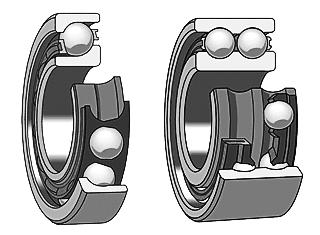
Angular ball bearing
Angular contact ball bearings, due to their internal design, can withstand high radial axial loads and achieve high speeds. They can only bear unidirectional axial loads because of their asymmetry caused by manufacturing.
These bearings are almost always mounted in a set that includes two or more opposing pre-tensioned units with rigid or elastic shims. Typically, both the inner and outer raceways, as well as the balls, are made of chrome steel.
In adverse working conditions, ball bearings may develop ceramic balls, forming a hybrid bearing.
The Differences and Similarities Between Single and Double Row Angular Contact Ball Bearings
Above, it is noted that angular contact ball bearings are almost always mounted in a pair of opposing pre-tensioned units that include two or more rigid or elastic shims.
To achieve this, there are two different methods: using double-row angular contact ball bearings, which can offer some cost savings, or you can match multiple single-row bearings.
Multiple single-row angular contact ball bearings offer greater performance and design flexibility in many situations. It all depends on your judgment and the effective method for your specific case.
Widespread selection of angular contact ball bearings
Over 550 single-row, precision angular contact ball bearings are available with bore sizes ranging from 10mm to 280mm.
Standard contact angles are available at 15, 20, 25, 30, and 40 degrees. Custom angles for special applications are also available.
Other options include ceramic and special SV30 stainless steel materials. These options will ensure maximum performance enhancement.
Angular bearing series
Many angular contact ball bearing manufacturers offer three or more size series to accommodate higher speeds or greater loads than standard.
Common series names include: ISO18 series for high-speed and low-load bearings, ISO19 series for high-speed and low-load bearings, ISO 10 series for high-load and low-speed bearings, and ISO 02 series for both high-load and low-load bearings, as well as D and low-speed bearings.
Angular Ball Bearing Applications
As previously mentioned, angular contact ball bearings are suitable for applications requiring high precision and high-speed performance.
Many bicycles use angular ball bearings in headphones. This is due to the forces on the bearing in radial and axial directions.
High-speed applications include turbines, dental equipment, and jet engines.
