Graphite and Graphite Products Processing, Import and Exp...

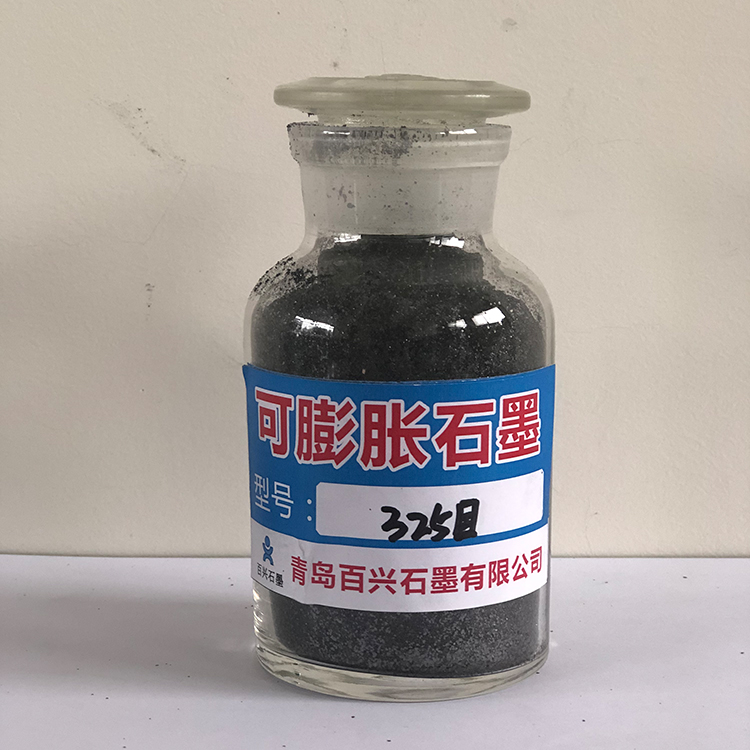
Due to graphite being a non-polar material, it is difficult to intercalate using polar organic or inorganic acids alone, and generally, an oxidizing agent is required. The chemical oxidation method typically involves soaking natural flake graphite in a solution of the oxidizing agent and intercalating agent. Under the action of strong oxidizing agents, the graphite is oxidized, transforming the neutral reticular macromolecules of the graphite layers into positively charged macromolecules. Because of the repulsive force between the positively charged macromolecules in the layers, the distance between the graphite layers increases, allowing the intercalating agent to insert between them, forming expanded graphite. Below, the Baixing Graphite team introduces the expansion volume and sulfur content of expanded graphite:
In the preparation process of expanded graphite via chemical oxidation, an oxidizing agent needs to be selected. Oxidizing agents used in the chemical oxidation method generally fall into two categories: solid oxidants and liquid oxidants. Solid oxidants include KMnO4, KClO4, NaClO3, (NH4)2S2O7, etc., while liquid oxidants include H2SO4, HNO3, HClO4, H2O2, etc. Solid oxidants typically react vigorously, posing hazards, are expensive, have a high ash content in the product, and can pollute the environment. Liquid oxidants like H2SO4 and HNO3 can worsen the operational environment and contaminate water quality, while H2O2 has a slower reaction rate with less pollution.
In the case of expanded graphite, both expansion volume and sulfur content are key product targets, generally aiming for high expansion volume and low sulfur content. The sulfur content of expanded graphite can cause corrosion in equipment during use. Traditional expanded graphite often uses H2SO4 as an oxidizing agent and intercalating agent, resulting in a high sulfur content (such as 3% to 4%), which is not suitable for the usage requirements of flexible graphite and other important fields. Therefore, in recent years, low-sulfur and sulfur-free expanded graphite, especially sulfur-free expanded graphite, have become significant directions in the research and development of expanded graphite. Researchers have made substantial efforts and achieved breakthroughs. Moreover, traditional expanded graphite typically needs to expand at temperatures above 900 to 1000°C to reach an expansion of over 200 times. In some application areas, lower expansion temperatures that reach an expansion of over 200 times are preferred. Thus, low-temperature expanded graphite has recently emerged as a new direction in the research and development of expanded graphite.


b2b.china9.net © Zhongshang 114 Hebei Network Technology Co., Ltd.Address: Room 6009, Oriental New World Center, No.118 East Zhongshan Road, Qiaoxi District, Shijiazhuang City, Hebei ProvincePlatform Service Hotline: 4006299930