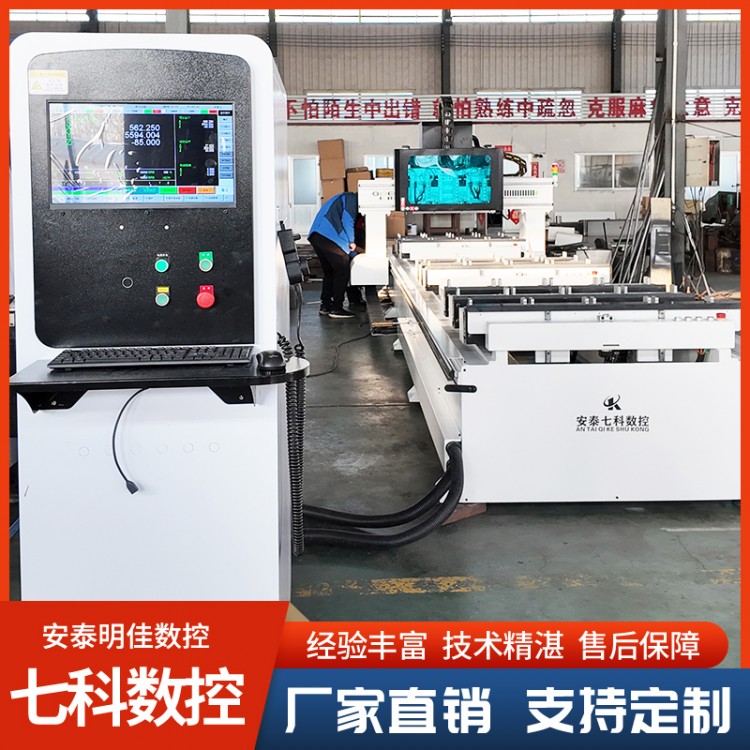
Numerical Control Cross-Cut Saws, Numerical Control Moldi...


Product Recommendation
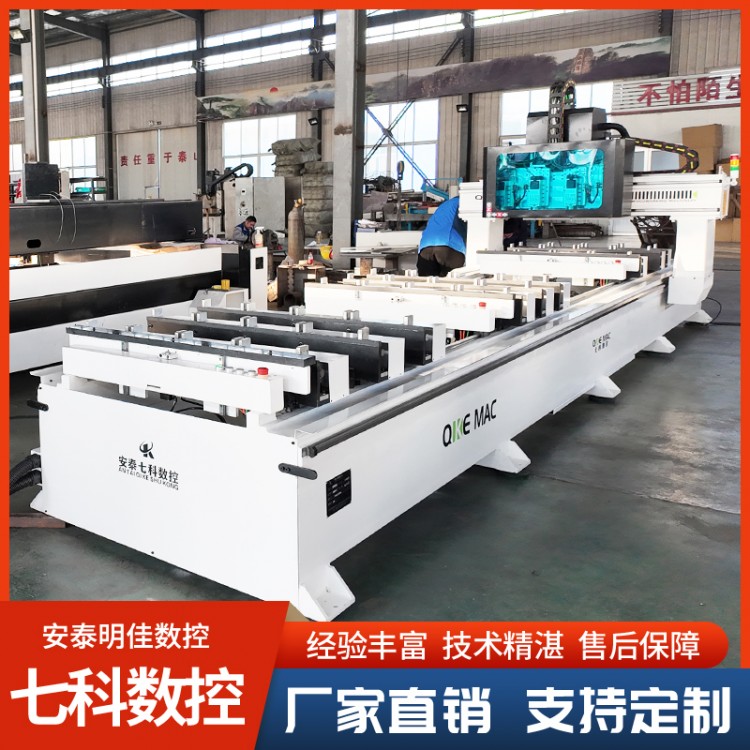
Here are some methods to enhance the precision of the CNC tenon and groove machine's worktable movement:
1. Mechanical Component Maintenance and Adjustment
Track Maintenance
Regular cleaning of the guide rail surface is essential to remove dust, chips, and other impurities, preventing them from increasing friction between the rail components. Additionally, select the appropriate lubricant based on equipment requirements and apply it regularly to maintain smooth operation. For instance, use high-quality rail oil and lubricate it at prescribed intervals, such as once a week.
Precision Adjustment: Regularly inspect the straightness and parallelism of the guide rail. If wear or a decrease in precision is detected, restore it by adjusting the installation shims of the guide rail or using professional guide rail adjustment tools. For high-precision CNC tenon and mortise machines, the straightness error of the guide rail should be kept within a very small range, such as no more than 0.02mm per meter.
Lead Screw Maintenance and Adjustment
Verify Lead Screw Accuracy: Regularly inspect the axial runout and radial跳动 of the lead screw. Exceeding the permissible range of lead screw accuracy will directly affect the accuracy of the worktable movement. Tools like micrometers can be used for testing, typically requiring that the axial runout does not exceed 0.01mm and the radial跳动 does not exceed 0.015mm.
Tension Adjustment: Properly adjust the preload of the screw. Appropriate preload can reduce the clearance of the screw, enhancing transmission accuracy. However, excessive preload can also increase the wear on the screw and the motor's load, necessitating a reasonable adjustment based on the screw specifications and equipment requirements. For instance, in the case of ball screws, the preload can be adjusted to an appropriate level through the use of a double nut, minimizing the clearance during both clockwise and counterclockwise rotations.
2. Calibration and Compensation
Position Sensor Calibration
Regular Calibration: Position sensors, such as photoelectric encoders and glass scales, are crucial for accurate worktable positioning. Regular calibration of these sensors ensures the accuracy of the feedback position information. The calibration process typically requires professional calibration tools and equipment, following the manufacturer's calibration procedures. For instance, with photoelectric encoders, the zero position and pulse count accuracy must be calibrated to ensure that each pulse signal corresponds to the actual movement distance of the worktable.
Compensation Settings: Many CNC systems offer error compensation features. Set the corresponding compensation parameters based on the measured worktable movement error data. For instance, by measuring the errors of the worktable at different positions using a laser interferometer, and then inputting these error data into the CNC system, the system will automatically compensate during the worktable's movement to enhance positional accuracy.
Reverse Clearance Compensation: Due to gaps existing between mechanical transmission components (such as screw nuts, couplings, etc.), the worktable will generate reverse clearance errors when changing its direction of movement. The reverse clearance compensation function of the numerical control system can measure and compensate for this error. The specific operation involves setting the reverse clearance compensation parameters in the numerical control system, with the compensation value typically obtained through actual measurements, such as using a micrometer to measure the gap values during the worktable's forward and reverse movements, and then inputting this value into the numerical control system for compensation.
3. Optimizing CNC system parameters
Optimizing Speed and Acceleration Parameters: Properly set the workbench's movement speed and acceleration parameters. Overly high speed and acceleration settings can cause vibrations and overshoot during start-up, stop, and speed changes, affecting movement accuracy. Based on the equipment's mechanical properties and processing requirements, find the appropriate speed and acceleration combination through testing and adjustment. For instance, when performing high-precision mortise and tenon processing, it is advisable to reduce the workbench's movement speed and acceleration to ensure smooth and accurate movement.
Setting Interpolation Precision: During complex curve or multi-axis联动 machining, CNC systems utilize interpolation algorithms. Optimizing interpolation precision parameters can enhance the accuracy of the worktable's movement trajectory. Different CNC systems offer various interpolation methods (such as linear interpolation, circular interpolation, etc.) and precision settings. Choose the appropriate interpolation method and set a reasonable precision level based on the actual tenon and groove shapes and precision requirements. For instance, when machining high-precision circular tenon grooves, select high-precision circular interpolation and appropriately increase the interpolation precision parameters.


b2b.china9.net © Zhongshang 114 Hebei Network Technology Co., Ltd.Address: Room 6009, Oriental New World Center, No.118 East Zhongshan Road, Qiaoxi District, Shijiazhuang City, Hebei ProvincePlatform Service Hotline: 4006299930