
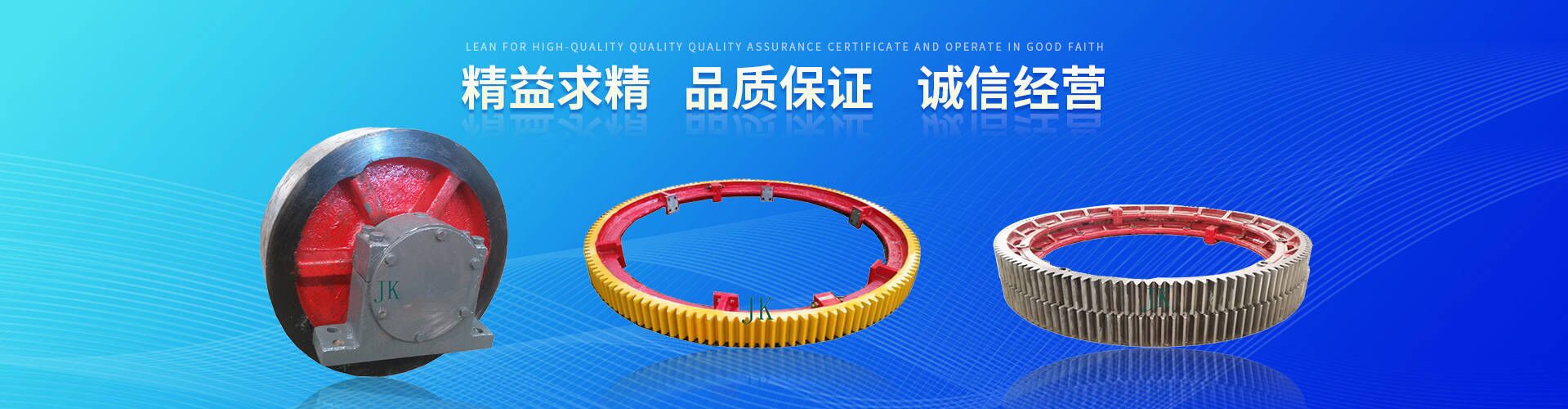


Sintering Kiln Tire, also known as a roller ring, serves to transfer the entire weight of the cylinder (including refractory bricks, internal equipment, and material weight) to the support wheel, allowing the cylinder to rotate smoothly on the support wheel. Therefore, the tire must possess adequate strength and durability. Additionally, the tire acts as a component to enhance the radial rigidity of the cylinder, and it should have sufficient rigidity.


Based on the different cross-sectional shapes of the kiln tire, they can be categorized into the following types:
Rectangular roller for rotary kiln
Its cross-section is a solid rectangular shape, as shown in Figure (A), with a simple structure and easy-to-maintain manufacturing quality. Generally, it has a longer service life than box belt drives and is more widely used; however, it has relatively lower stiffness, inefficient material usage, and poor heat dissipation conditions.


2. rotary kiln box-type belt
The cross-section is hollow box-shaped, with good thermal conditions, high rigidity, and reasonable material utilization challenges. The structure integrating the rim with the cylinder prevents "necking thermal stress" between the rim and the cylinder. It also maximizes the rim's reinforcing effect on the cylinder, and reasonably utilizes the rim material, simplifying manufacturing and installation, and facilitating operation. The rim is typically mounted on the cylinder using a sliding fit, with the pad and baffle configurations as shown in Figure C. The rim is not directly mounted on the cylinder segments but is placed on a pad, creating a natural ventilation channel between the cylinder and the rim. This not only enhances heat dissipation but also reduces the thermal conduction of the kiln body to the rim, resulting in smaller temperature differences between the inner and outer edges of the rim. When the thermal regime inside the kiln changes, the temperature difference variation is minimal, thereby reducing the temperature stress on the rim. During kiln operation, the rim and cylinder will slide relative to each other along the axial direction, causing wear. In this case, the pad acts as a protective layer for the cylinder. On both sides of the rim, baffles or retainers are used to limit the radial movement of the rim along the cylinder axis.
