
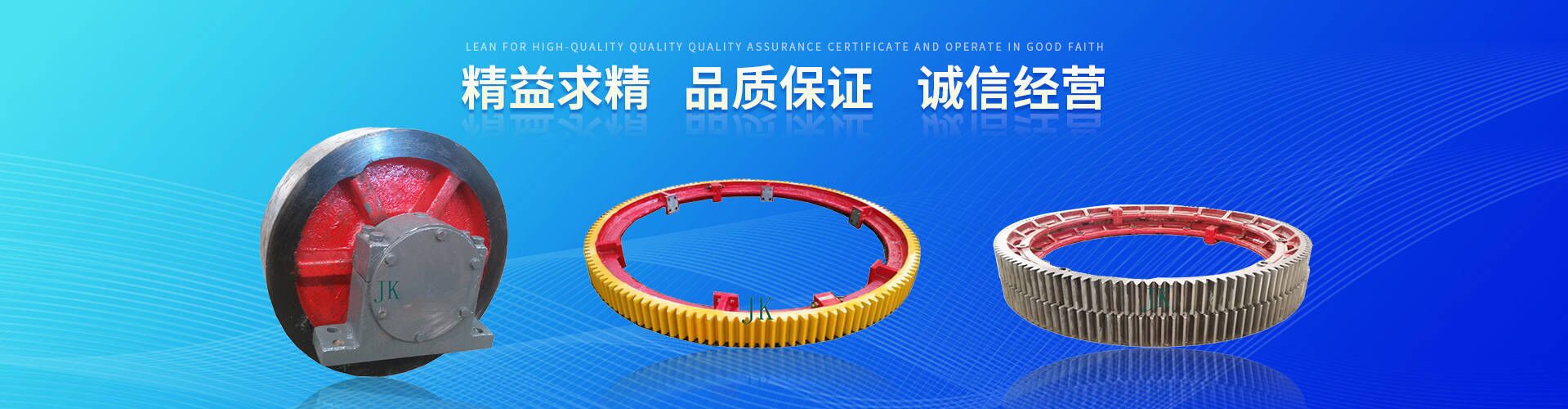


Rotary Kiln Structure Overview: The rotary kiln is mainly composed of parts such as the kiln drum, transmission unit, support unit, idler wheel unit, kiln head sealing unit, kiln tail sealing unit, and kiln head hood.


Large Gear Ring Assembly: A large gear ring is fixed on the kiln cylinder to transmit torque. The gear ring is connected to the kiln cylinder via a tangential spring plate, which allows for sufficient space for heat dissipation between the gear ring and the kiln cylinder. This connection structure also reduces the impact of kiln cylinder bending and deformation on meshing accuracy and serves as a shock-absorbing buffer, benefiting the longevity of the kiln lining. Transmission Device Type: The transmission system employs single or double transmission, powered by one or two main drive motors. The main drive system consists of a main motor, main reducer, and a small gear, along with auxiliary transmission equipment. The power supply for the auxiliary transmission equipment is a safety power supply or an onboard generator, facilitating installation, maintenance, refractory material drying, and kiln operation in case of main power failure, as well as preventing kiln cylinder bending and deformation during the cooling process. The auxiliary motor is equipped with a brake to prevent the kiln from reversing under the influence of uneven weight of materials and kiln skin after the motor stops.
The large gear ring transmission system of the rotary kiln is a crucial component of the rotary kiln equipment. Proper alignment and smooth operation of the gears are essential for the normal production of the entire kiln. The large gears of the rotary kiln are made of cast steel or alloy steel, precision machined, featuring high precision, good quality, wear resistance, and strong load-bearing capacity. No matter how high the gear quality or hardness, there will be some degree of wear during use. How can we reduce the wear on the large gear ring? Let's take a simple look together.
Key factors include ensuring the material requirements for large sprockets are met, requiring tempering of the blanks, normalizing to adjust the microstructure of the gears for increased hardness, and improving product processing technology and precision. This will reduce defects such as eccentricity, pitch error, and tooth shape error to a minimum, ensuring superior sprocket performance, reducing wear, and extending its service life.
To properly install, first ensure that the large sprocket maintains concentricity with the large gear and the rotating kiln cylinder during installation. The parallelism and concentricity between the small gear axis and the large gear axis should be maintained, as well as the tooth side and top clearances across the full width of the teeth. Minimize the overlap as much as possible to ensure normal equipment operation and avoid excessive wear.
The mutual rotation of gears also causes friction, ensuring proper use will reduce the frequency of friction, thereby minimizing wear.
In terms of lubrication, an artificial regular oiling method is employed to ensure the correct brand and quality of lubricant. The oiling must be thorough and even. The large gear ring of the rotary kiln is sealed with a gear cover to minimize the wear caused by dust, fine material particles, and floating particles on the large gear ring, thereby increasing the oil film area and reducing friction. Therefore, special attention must be paid to lubrication. Wear is inevitable, but the best choice lies in high-quality products and proper usage. If the gear ring wears out, it can be resurfaced. If both sides are severely worn, it is essential to prepare in advance to avoid any impact on production.
