
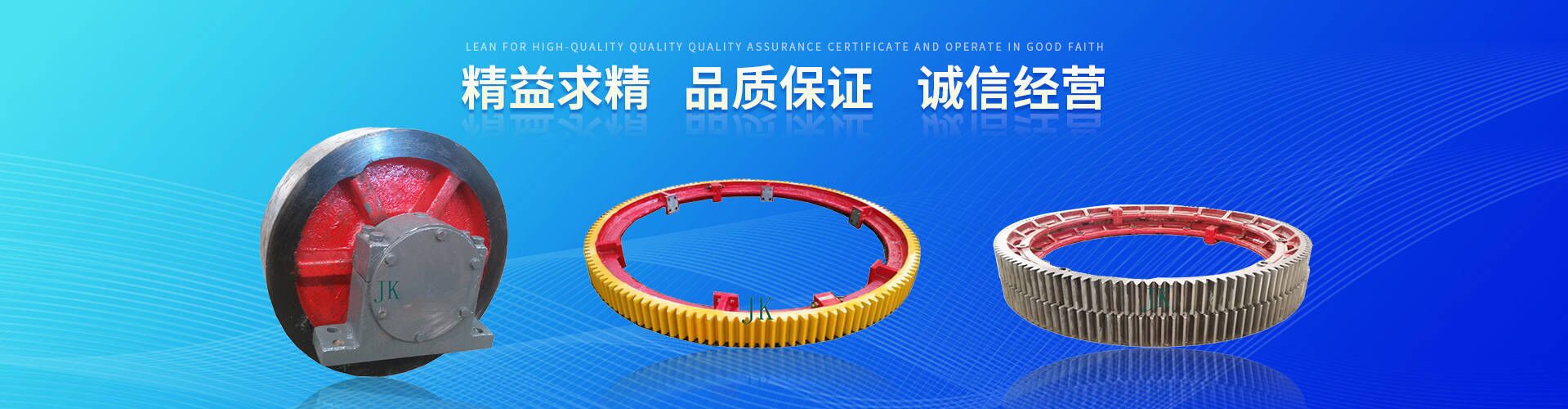


Detailed introduction to the sizes and gears of drying machines, a full range of drying machine accessories available, reliable quality, competitive prices. Our factory is equipped with comprehensive processing equipment and boasts strong technical strength. We cast and process various types of drum drying machine gears, drying machine cast steel rings, and single/twin drum drying machine idlers and guard wheels.

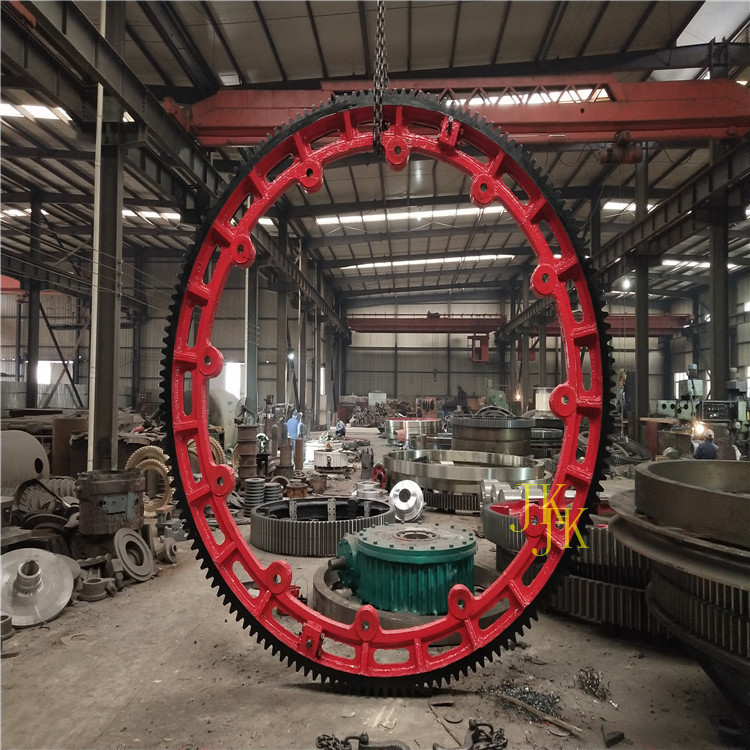
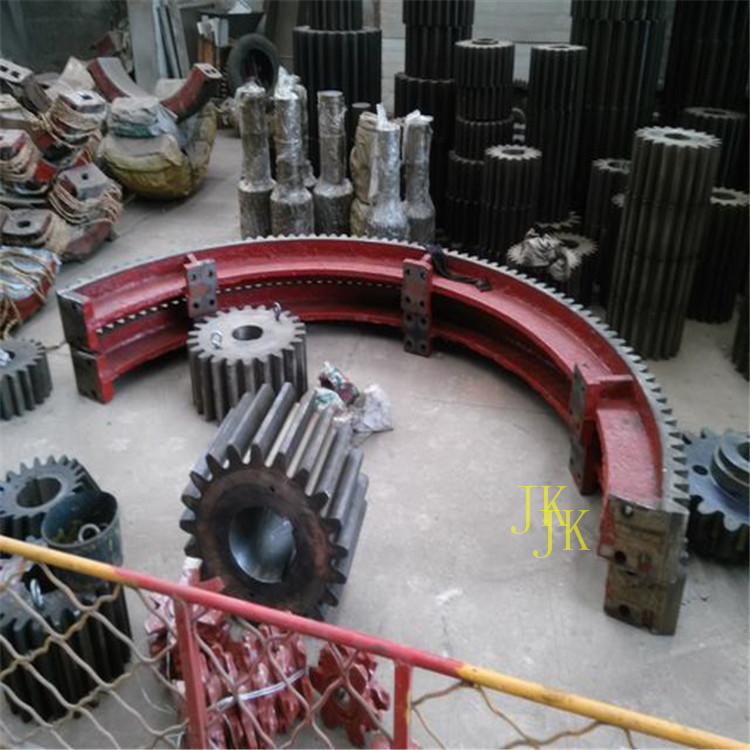
This article provides a superficial analysis of the modulus of the large and small gears of the dryer, the assembly of the small gear of the dryer, the lubrication of the large and small gears of the dryer, and the technical requirements for machining the large gear ring of the dryer, based on years of production and sales experience. For inquiries, please contact us in person or via email for business discussions. The large gears of the dryer come in various types. Each manufacturer designs different types of large gears for dryers based on their production and load-bearing capabilities. Generally, they can be divided into flange-connected and spring-plate-connected types, with the flange-connected type being less commonly used, typically found on smaller dryers.
Spring plate-connected dryer large gears, due to their structural characteristics, play a buffering role in transmission and are widely used in practice. Therefore, when replacing the large and small gears of a dryer, it is first necessary to check the dryer's specifications and whether the large gear is a standard part. Many manufacturers sell standard parts, but if it's not a standard part and there is no drawing, it is essential to find a professional to accurately measure the external diameter, internal diameter, pitch, width, and number of teeth of the large gear of the dryer. Look for a professional manufacturer with design and production capabilities to custom process. The gear modulus of the dryer is the ratio of the pitch t between the same side of the adjacent gear teeth to the circumference π (m=t/π), measured in millimeters. Modulus is a basic parameter of the modulus gear system. The larger the modulus, the taller and thicker the teeth, and if the number of teeth in the gear is fixed, the radial size of the wheel will also be larger. The modulus series standards are formulated based on design, manufacturing, and inspection requirements. The size of the modulus determines the size of the individual tooth shape, not the size of the gear, and is unrelated to the pressure angle. Modulus and pressure angle are considered by designers when designing the service life of gears, which is an equal strength design, so the size of the pressure angle needs to be considered. For equal life design, the modulus size of the driving and driven gears needs to be considered; fewer driving teeth mean a larger modulus and thicker tooth shape, while more driven teeth mean a smaller modulus and thinner tooth shape. In the past, the lubricating oil used for the large and small gears of the dryer was 460 or 680 mineral oil and 220 or 320 asphaltic gear oil. The former has good low-temperature performance but poor adhesion, severe leakage, and the gear surface is not easy to form a protective film, causing the gear surface to become bright and worn; the latter has good adhesion but poor low-temperature performance, making it difficult to add in winter, and over time, the gear surface may have some pitting due to the presence of a small amount of sulfur in the asphalt. The assembly of the dryer's small gear: Correctly position the small gear assembly according to the centering plate, ensuring the error between the transverse centerline of the large gear is less than 2mm. Adjust the top clearance between the large and small gears, with a clearance of 0.25 modulus (standard clearance) plus the thermal expansion amount of the large gear. Pay attention to measuring and determining the top clearance at the large gear's radial跳动. Adjust the contact accuracy between the large and small gears, ensuring the contact marks on the gear surface are not less than 70% along the gear length and not less than 40% along the gear height. The installation of the dryer's transmission unit: Install the reducer and motor sequentially with the small gear as the reference, and the associated couplings. Ensure that all transmission axes are parallel to the longitudinal centerline with an error of less than or equal to 0.05%. Cast the related foot bolts, ensuring that no displacement or movement occurs in any of the transmission components during the casting process. Technical requirements for the dryer's large gear (large gear ring): 1. The casting of the large gear must use alkaline open hearth steel or electric furnace steel, not converter steel. Castings must be inspected in accordance with relevant regulations, and the results of all inspection activities serve as exchange conditions; 2. The drawings of the large gear of the dryer do not specify the casting fillet size R=5-10mm; 3. The cast gear ring of the dryer must not have casting defects that affect strength. After repairing defects by welding, the castings must be heat treated to eliminate internal stress. The hardness of the weld area must not exceed the hardness of the base metal but must not be less than 10% of the hardness of the base metal; 4. The gear surface and bosses of the large gear are not allowed to be recast, but individual defects less than 5mm deep and 3mm wide are permitted; 5. Before processing the castings of the large gear, heat treatment must be performed to eliminate internal stress, with the hardness after heat treatment being HB=170-210; 6. The mating surface of the gear ring of the dryer must be processed first, followed by the assembly of the two halves into one; 7. After the large gear is assembled into an integral unit, the tooth shape and other parts are processed; 8. The mating surfaces of the two halves of the large gear ring must be at the midpoint of the gear, with the pitch tolerance at the mating point of the assembled gear ring being ±0.11mm; 9. The wall thickness deviation of the processed wheel rim, spoke, and other parts must be within 10% of the nominal size; 10. When processing the large gear, a division circle line is marked on the side of the gear teeth; 11. When turning the top round and end face of the large gear ring of the dryer, a sharp line is also drawn at the same time to ensure that the spring plate installation hole aligns with the top round; 12. After installation and alignment, the spring plate is matched, and corresponding markings are made. All components of various types and specifications of dryers are cast and processed in strict accordance with technical requirements. The large gears, support wheels, belts, and small gears of the dryer are all processed and produced by our factory, ensuring genuine factory products with no intermediary links. Standard dryer parts are available, and stock supply is available. Special models can also be customized according to customer requirements. This not only ensures suitability and quality but also guarantees price advantages, making the purchase of large gear rings and other dryer parts from our factory an ideal choice.


