Environmental equipment, instruments and meters, robots, ...

Sensor Calibration Meters: Classification
The primary function of the transformer calibrator is to test the technical performance of voltage and current transformers used in field applications or laboratory settings. To achieve this, the transformer calibrator must be integrated with related equipment to form a complete transformer calibration system. Due to the close technical relationship between the performance specifications of the transformer calibrator and the related equipment, a basic understanding of the transformer calibration system is essential for correctly studying and comprehending the overall concept of the transformer calibrator.
China's transformer testing instruments can be generally divided into three generations:The.A Generation of Electrician's Verification InstrumentsThe system is cumbersome to operate and the wiring is complex.No content provided for translation..The second-generation tester utilizes more advanced electronic circuits, offering greater convenience than its predecessor. However, it requires manual switching of range positions during the measurement process, and displays limited information during testing.Please provide the Chinese content to be translated into American English..The third-generation verification instruments are mostly equipped with single-chip microcontrollers, enhancing the level of intelligence in the instruments. Some of the instruments feature computer communication interfaces, thereby improving office automation.
Here's a brief introduction,The.Key Features of the Third-Generation Transformer Calibration Instrument:
⑴ Utilizing a microcontroller to implement functions such as measurement, control, and display.
The computer interface enhances office automation and reduces the intensity of manual labor.
Large screen display, offering a user-friendly interface, and providing comprehensive measurement information.
④ Can automatically perform transformer measurement and switch between current and voltage load boxes.
⑸ Equipped with robust error capture measures, capable of promptly notifying users of error messages.
The instrument can reach level 2 accuracy. Currently, most calibration meters on the market use a 90° phase shift method based on resistance and capacitance for data measurement. This method is susceptible to environmental temperature and power frequency variations. Once these conditions change, the measured data can be significantly affected.
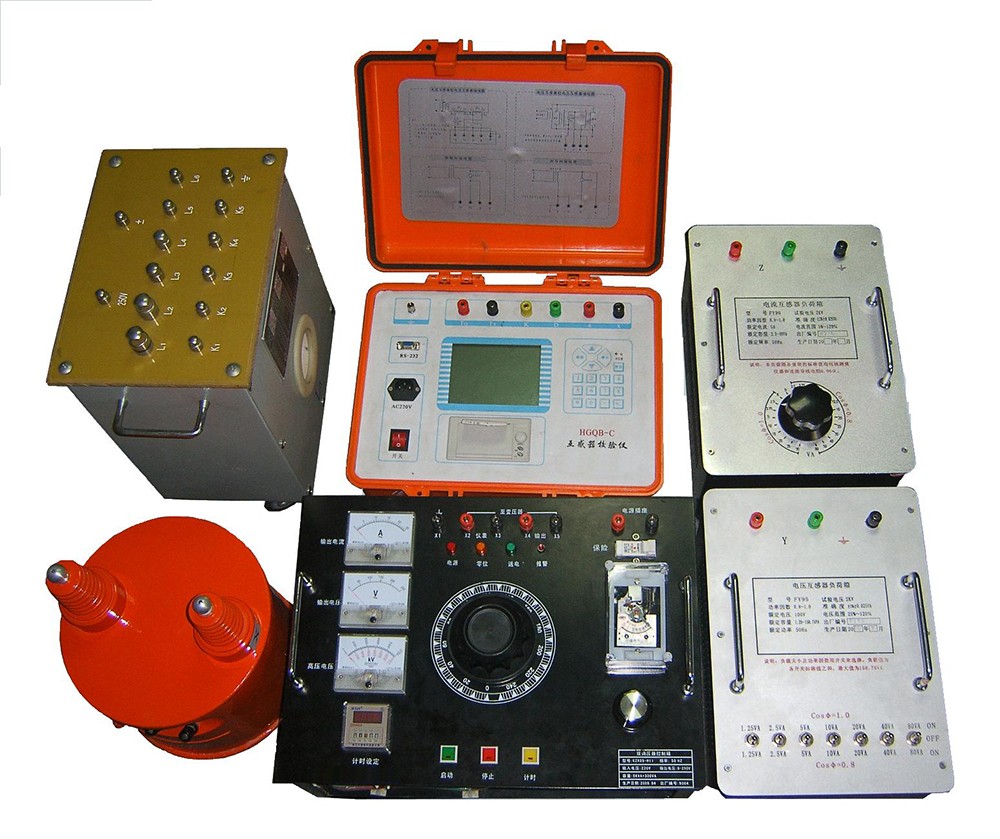
Transformer Calibration Instrument utilizes a unique circuit principle andDSP technology avoids the aforementioned issues.
The transformer calibrator, from the perspective of its measurement principle, can be divided into two categories: direct comparison and difference measurement.
Early transformer calibrators were primarily designed based on the direct comparison principle, involving the direct comparison of the secondary voltage or current of the standard transformer with that of the transformer under test. This is achieved by inputting these values into a transformer calibrator, where they are measured through circuits such as resistive voltage dividers, capacitive voltage dividers, and magnetic potential comparators. The resulting difference in voltage or current is then processed to determine the ratio and phase differences between the transformer under test and the standard transformer.
The advantage of this transformer ratio meter is that the ratio between the standard transformer and the transformer under test does not need to be equal. As long as the rated primary voltage or current of the standard transformer is greater than or equal to the rated value of the transformer under test, direct calibration can be performed, making it convenient to use.
This current transformer calibrator has the drawback that it cannot verify secondary loads less thanVA's transformers; secondly, the inherent error of this transformer calibrator is directly added to the error of the standard transformer, as the component errors of the transformer calibrator limit the accuracy class of the transformer being tested. For instance, a transformer calibrator's measurement error limit is ±0.05% due to its component limitations, even if a higher-accuracy standard transformer is used, it can only be used to calibrate transformers below the 0.5 accuracy class. Therefore, this drawback limits the application scope of the direct comparison transformer calibrator.
The transformer tester based on the differential principle sends the secondary voltage or current of the standard transformer and the transformer under test into the differential circuit of the transformer tester, then the differential section sends it to the measurement section for comparison with the secondary working voltage or current of the transformer, providing the ratio difference and phase difference of the transformer under test against the standard transformer.
Since this transformer tester is only used to measure the difference between the standard transformer and the transformer under test, the error of the transformer tester is merely the error of the difference between the two transformers, hence its impact on the measurement results is naturally much smaller. Generally speaking, regardless of the level of transformer being tested, as long as the standard transformer meets the specifications and the error limit of the transformer tester does not exceed...±2% is all it takes. This not only makes the transformer tester easy to manufacture but also reduces costs, while greatly expanding its range of applications. The transformer tester is a differential type of testing instrument.
Transformer Error Checker, a novel automated detection instrument, utilizes advanced electronic technology to directly decompose the error signals of transformers and, after appropriate calculations, displays the transformer's percentage points, phase error, and orthogonal error simultaneously in digital form. The instrument is easy to operate, offers clear readings, rapid measurement, reduces power consumption, and lessens labor intensity; it is compact, lightweight, easy to carry, and suitable for on-site testing.The test was conducted at a fixed current (voltage) of 5%; additionally, it is required that our company be able to produce a verification instrument for S-class current transformers and voltage transformers with a secondary voltage of 100/3V, which can measure the error of current transformers at 1% of the rated working current. During the detection process, the instrument can conveniently perform self-calibration at any time to ensure accuracy; key components are imported for stable and reliable quality, widely used in departments such as metrology and power supply, as well as by transformer manufacturers, making it an ideal instrument for transformer detection.
Transformer Calibrator, and Accuracy Grade Checker0.01 to 10 levels, rated secondary currents of 5A and 1A current transformers, and rated secondary voltages of 100V, 100/150V (100/3V, 220V) voltage transformers. Measurement results are displayed digitally, and an RSC232 interface can be provided for users to easily connect to computers.
During the calibration of transformers, the instrument can measure the active and reactive components of the impedance or admittance of the secondary circuit of the transformer under test at any time.
During the calibration of transformers, the instrument automatically indicates polarity. In case of incorrect polarity, the instrument automatically disconnects the differential current (differential pressure) circuit, ensuring the safety of the input circuit. It also emits an alarm to alert the calibration personnel.
The equipment can be used as an AC potential meter in a rectangular coordinate system for measuring small AC currents or voltages.
Equipment can be isolatedPT and control box are used together to measure the secondary voltage drop of the voltage transformer.
During the calibration of current transformers, the instrument can be calibrated using a standard current transformer or a standard voltage transformer as the reference, or with a two-stage current transformer, two-stage voltage transformer, or an inductive potential divider as the proportional standard.
Equipment can be inspected periodically using the whole or component method.
Welcome to choosing our company's equipment. Although the equipment is very user-friendly, please still take the time to carefully read through this manual while using the instrument.


b2b.china9.net © Zhongshang 114 Hebei Network Technology Co., Ltd.Address: Room 6009, Oriental New World Center, No.118 East Zhongshan Road, Qiaoxi District, Shijiazhuang City, Hebei ProvincePlatform Service Hotline: 4006299930