Environmental equipment, instruments and meters, robots, ...

Overview
This series of instruments can detect technical indicators such as insulation strength of the tested equipment or materials, and is widely used in the voltage resistance testing of electrical equipment, appliances, transformers, power cables, electric meters, motors, power outlets, cable lines, and more. It is suitable for the voltage resistance testing of household appliances such as televisions, fans, recorders, refrigerators, washing machines, microwave ovens, and hair dryers, as well as for electronic integrated machines like instruments and meters. It provides testing methods for the implementation of national safety standards, thus highlighting its importance. It has become an indispensable instrument equipment for scientific research institutions, metrological testing departments, and the electronic industry in detecting electronic instruments and household appliances, etc. It complies with...GB4706.1Standard.
This series of instruments boasts an aesthetically pleasing design and user-friendly operation. The output voltage is clearly and accurately displayed on a digital panel, offering a straightforward and intuitive interface. The entire unit is technologically advanced with a well-organized layout, characterized by high accuracy, excellent reliability, and easy maintenance.
Usage Instructions
Warning: Under no circumstances should the instrument be directly short-circuited with the terminal when it has high-voltage output and is unloaded, as this may pose a danger and cause damage to the instrument.
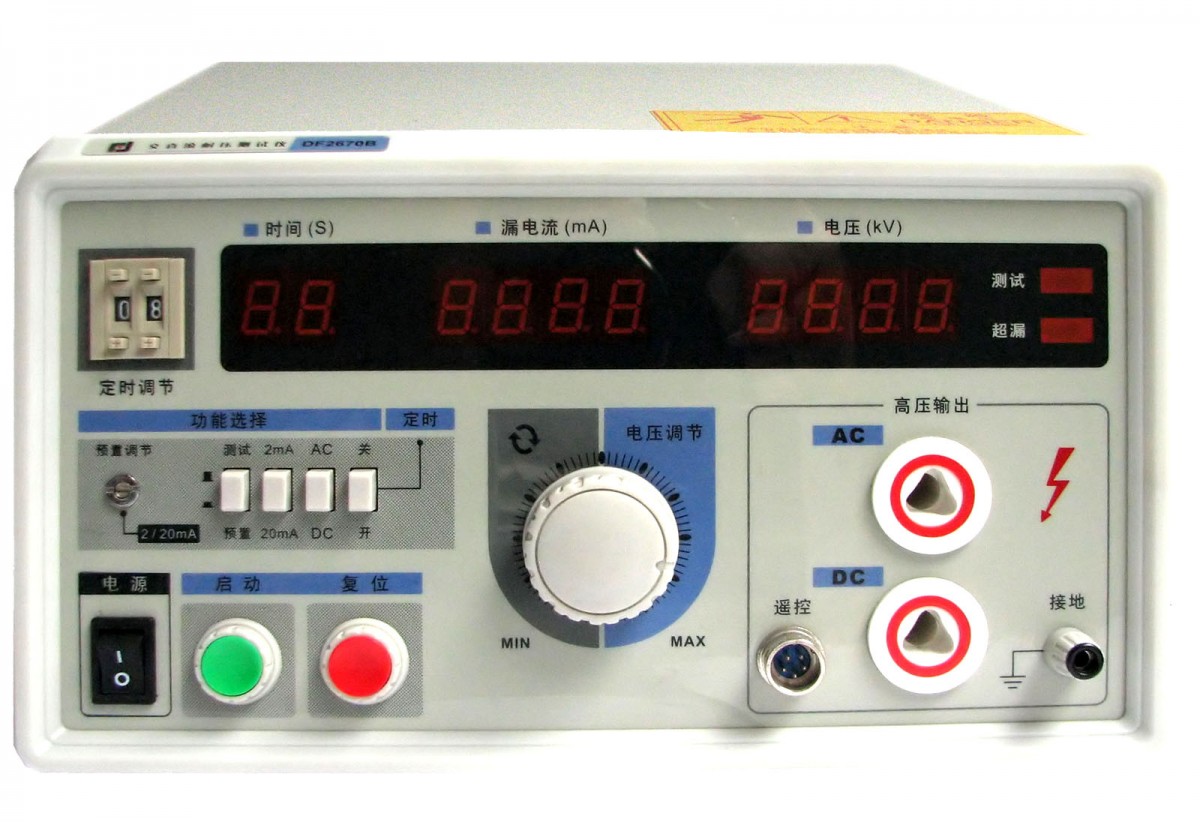
1.During instrument testing, the "timer" on the instrument must be selected as non-00"Status must be confirmed; otherwise, the circuit will not be able to initiate the test due to self-locking."
2Power Supply: Ensure the "Voltage Adjustment" knob is set to0Power on the switch after positioning.
3Set test voltage: After activation, adjust the voltage control knob, then press the reset button once the desired test voltage is reached.
Set leakage current preset value: Press the leakage current selection button, turnThe "preset adjustment" knob sets the leakage current value to correspond with the leakage current reference value required for the measured item.
5.Connect the object to be measured: Ensure the output voltage meter indicates0In the absence of the "Test" light, first connect the test end wire (black) to the item being tested, then attach the high-voltage probe to the item.
6Test:
(1Manual Testing:
aPush the timed button switch out (i.e., not timed), press the "Start" button, the "Test" indicator light illuminates, and the test voltage is applied to the item being tested.
bAfter the test is complete, press the "Reset" button to disconnect the output voltage.
cIf the current passing through the item under test exceeds the set leakage current limit, the instrument will determine the item as "non-compliant" and automatically disconnect the high-voltage output, emit a "limit exceeded" alarm, illuminate the over-leakage indicator light, and sound an alarm. Pressing the "reset" button will clear the alarm signal.
(2Scheduled Testing:
aFirst, set the test voltage according to the manual testing method, then press "Reset."
bPress the timer button and adjust the timer to the desired test time.
cPress the "Start" button, the "Test" light illuminates, applying high voltage to the item under test, initiating a timed test. Once the timer expires, the instrument automatically resets, disconnecting the test voltage. If the item passes the test, the instrument does not produce an alarm signal.
dIf an "out-of-limit" signal occurs during testing, proceed according to the manual testing procedures.cPlease refer to the operation instructions.


b2b.china9.net © Zhongshang 114 Hebei Network Technology Co., Ltd.Address: Room 6009, Oriental New World Center, No.118 East Zhongshan Road, Qiaoxi District, Shijiazhuang City, Hebei ProvincePlatform Service Hotline: 4006299930