Environmental equipment, instruments and meters, robots, ...

Insulation Resistance Tester
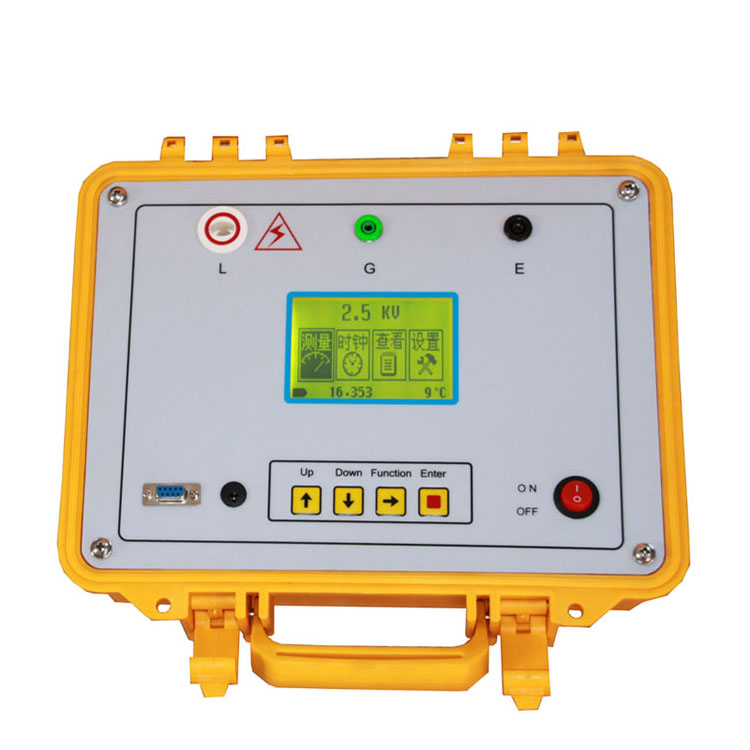
***The Insulation Resistance Tester is specifically designed for laboratory or on-site insulation testing. It includes a high-precision microcurrent measurement system and a digital step-up system. Measurement can be conducted simply by connecting a high-voltage line and a signal line to the test sample. The measurement is automated, with results displayed on a large-screen LCD and stored for future reference.
1. Adopted32-bit microcontroller control, full Chinese operating interface, easy to operate.
2. Automatically calculates the absorption ratio and polarization index, and stores them automatically.15-second, 1-minute, and 10-minute data per minute for easy analysis.
3. High output current, short-circuit current≧The product boasts a strong anti-interference capability, capable of meeting the operational requirements at ultra-high-voltage substation sites.
4. The automatic discharge has been tested and the discharge process is being monitored in real-time.
5. Comes with a rechargeable battery and charger; operates continuously when fully charged.6 to 12 hours.
6. Please provide the Chinese content that needs to be translated.RS232 Serial Port, featuring the capability to operate instruments with a computer. (Optional)
Accuracy: ±(10% + 5 characters)
Measurement Range: 0.1M~400GΩ
Test Voltage: Scope Defined: 0.5Kv ,1KV,2.5KV,5KV,10KV
Short-circuit Current: ≧5mA
Measurement Time: 1 minute to 10 minutes (depending on the measurement method)
Battery Power Supply180-270VAC, 50Hz/60Hz ±1% (Mains or generator power)
Work Environment: Temperature-10 to 40°C, relative humidity 20% to 80%.
1. L terminal:"L" represents the high-voltage output terminal, known as the line terminal, which is connected to the measured line end via high-voltage cables, such as to the motor winding or the core of a cable.
2. G Terminal:The "G" is referred to as the shield terminal, used for measuring the volume resistance of insulating materials or cables in the three-electrode method, and it is connected to the shielded loop terminal of the three-electrode setup.
3. Terminal E:"E" is referred to as the ground end, connected to the ground or neutral terminal of the item being tested. For example, the metal shell of an electric motor, the iron core of a transformer, and the shielding layer of a cable.


b2b.china9.net © Zhongshang 114 Hebei Network Technology Co., Ltd.Address: Room 6009, Oriental New World Center, No.118 East Zhongshan Road, Qiaoxi District, Shijiazhuang City, Hebei ProvincePlatform Service Hotline: 4006299930