Environmental equipment, instruments and meters, robots, ...

The design concept of this prototype vehicle is based on the vehicle-mounted platform, focusing on the testing mission and environment. Through task configuration and scheduling, it achieves testing and detection functions. The key technical features of this prototype vehicle are distributed integration, which serves as the technical means to realize it.
The integration of the prototype vehicle's distributed system can be summarized as:"Three integrations into one module," meaning: control integration, power integration, wiring integration, and detection unit modularization. Distributed refers to the spatial separation of various testing resources, allowing for flexible adaptation to both testing site conditions and laboratory calibration environments.
所谓 integration refers to the integration of control and functions, as well as the scheduling and control of task configurations through comprehensive control software, completing the functional combination of various test tasks.
Integrated Control: Refers to all suitable detection units for integration within the vehicle, where all controls except for power-on and wiring operations can be achieved on the central control platform. Data utilization, analysis, management, and storage are handled through a comprehensive system software.
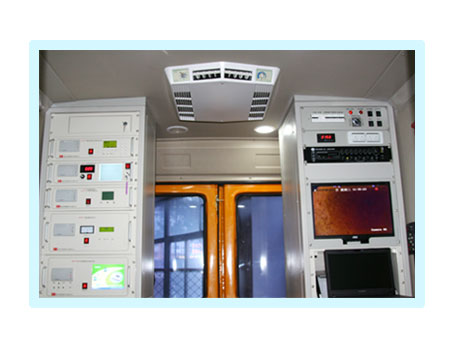
Power Integration: High-quality test power sources are fundamental to electrical testing. On the basis of vehicle-mounted platforms, it not only eliminates the weight restriction of transportation but also allows numerous instruments with power source requirements to operate together on the vehicle. With a set of high-quality, high-power, and digital comprehensive test power sources, configured through software task groupings, it replaces the previously separate internal test power sources of individual instruments. This not only significantly reduces the weight and volume of the original standalone instruments but also greatly enhances the power source quality and application range, thereby elevating the depth and quality of electrical testing.
Cable Integration: It refers to the centralized use of numerous detection units (instruments) on test vehicles, achieving comprehensive integration and reuse of the many test cables; implementing mobility and intelligence for the collection and release of test cables; thereby reducing the number of cables, minimizing the workload of wiring, unwiring, and cable management, and improving the efficiency of on-site operations.
Modular Detection Unit Integration: This refers to the comprehensive integration, amalgamation, and reorganization of the functions of related detection units. It standardizes the appearance, size, and structure, utilizes racks and tracks for easy boarding and alighting, maintains good mobility, and achieves the modularization of both function and structure for the detection units.
The traditional testing process, with its numerous steps, lengthy preparation time, and complex operations, is no longer adaptable to the current demands for power supply safety, quality, and emergency preparedness. In contrast, the testing vehicle's testing process significantly reduces the number of steps, eliminates the need for preparation time, and operates simply, allowing for rapid response to various emergencies. Due to the high mobility and robust protection capabilities of the testing vehicle, it is an essential component for modern power supply security enterprises.No content provided for translation..Selected。


b2b.china9.net © Zhongshang 114 Hebei Network Technology Co., Ltd.Address: Room 6009, Oriental New World Center, No.118 East Zhongshan Road, Qiaoxi District, Shijiazhuang City, Hebei ProvincePlatform Service Hotline: 4006299930