



- AllProduct Category
-
Integrated Distillation Apparatus
Sulfur Dioxide Distillation Apparatus
Fully Automatic Micro Pipette Dispenser
Fully Automatic Liquid-Liquid Extraction Apparatus
Fully Automatic Nitrogen Blow-Down Instrument
Anaerobic Incubator
Three-Gas Incubator Chamber
Rocking Bed Oscillator
Sample Pre-Processing Equipment
Low-Temperature Constant-Temperature Bath Series
Drying Oven Culture Chamber
Centrifuge Series
Medical Microbiology Series
试验箱
全自动封膜仪



详情描述
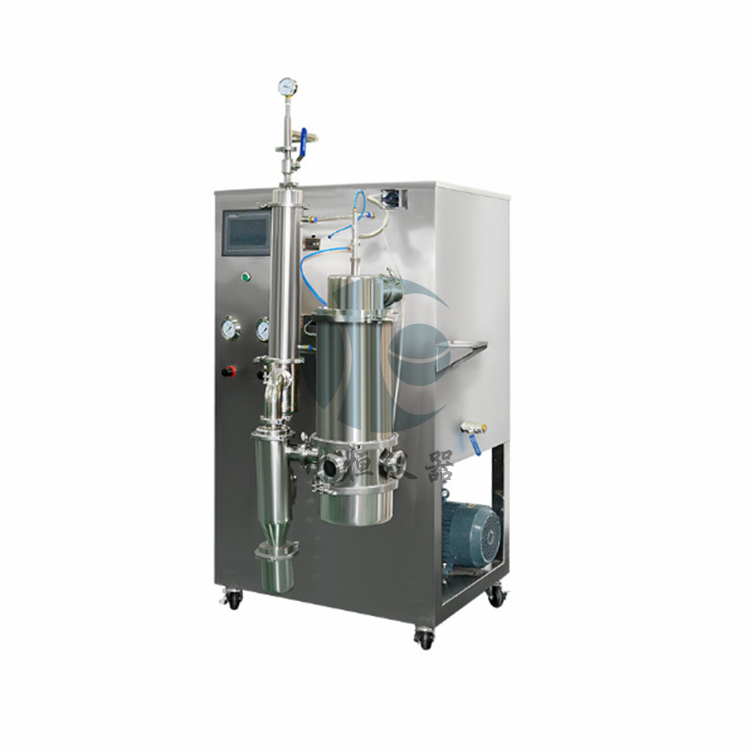
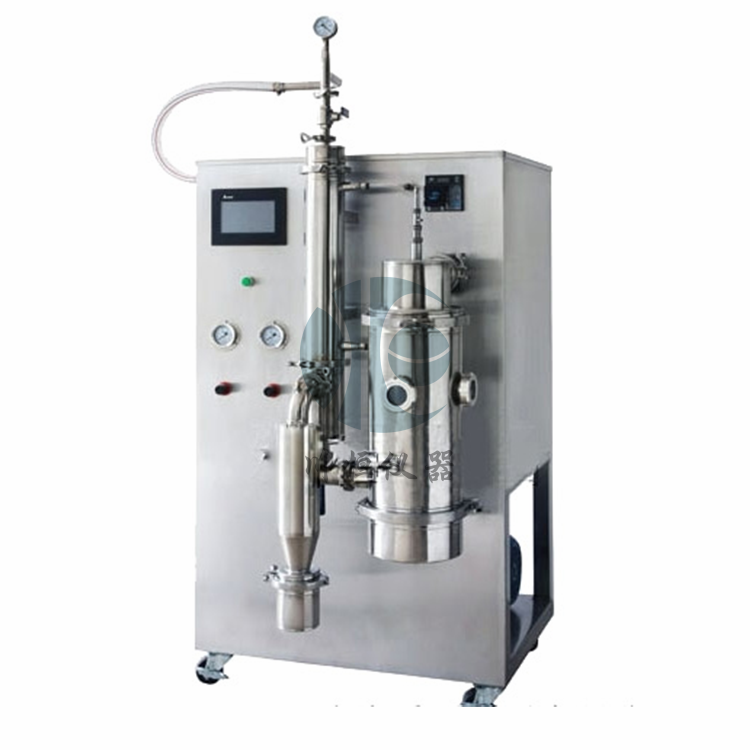
Laboratory Low-Temperature Spray Dryer, mainly used in university, research institute, and food/pharmaceutical/chemical industry laboratory production of trace particle powders. It has a broad applicability to all solutions such as emulsions and suspensions. The laboratory low-temperature spray dryer dries in a vacuum environment, achieving instantaneous drying of materials under low-temperature vacuum, providing a convenient and safe drying method for thermosensitive materials.
Technical Specifications:
Material Handling Quantity: 50-1500ml/h (varies with the solid content of the material)
2. Real-time PID temperature control technology with heating and temperature control accuracy of ±1℃.
3. Nozzle diameter: available in 0.7mm, 1.0mm, 1.5mm, and 2mm, with customization options according to customer requirements.
4. Total Power: 5.8KW/380V
5. Dimensions: 850 mm (Length) × 1000 mm (Width) × 1650 mm (Height)
6. Vacuum Degree: 0.05~0.06 MPA
7. Instant spray drying is achieved at specific low temperatures (50~80℃), effectively preserving the chemical structure and biological activity of substances that are prone to oxidation, volatility, and heat sensitivity.
8. Other requirements can be customized non-standard according to customer specifications.
Key Features:
1. Equipped with a color LCD touch screen for operation control, featuring a full Chinese interface, PID temperature control for heating, a combination of automatic and manual control, with built-in memory function for ease of operation.
2. Equipped with an imported oil-free air compressor, the particle size of the powder spray is normally distributed, has excellent fluidity, and operates at a very low noise level, meeting national laboratory noise standards.
3. The entire experimental process is conducted in a vacuum environment, significantly reducing the drying temperature of materials and overcoming the challenge of spray drying heat-sensitive materials. To meet users' requirements for adjusting various parameters within the experimental range, a real-time PID temperature control technology is adopted in the design of the drying temperature control, ensuring accurate temperature control across the entire temperature range with a heating and temperature control precision of ±1°C.
4. The atomizer is a concentric atomizer, with various sizes available. Ensure that the atomization process does not result in any eccentricity that causes the spray to hit only one side of the bottle wall. The atomizer can be moved up and down after installation to facilitate adjusting the atomization position and improving the spray drying effect.
5. Feed quantity can be adjusted via a feed peristaltic pump, with a rated processing capacity that is adjustable. Sample volume: 50-2000ml.
6. The two-fluid spray atomization structure is precision-manufactured from stainless steel material, featuring a compact design and requiring no auxiliary equipment.
7. Equipped with a nozzle cleaner (pin cleaner), it automatically clears blockages in the nozzle, and the frequency of the pin can be automatically adjusted.
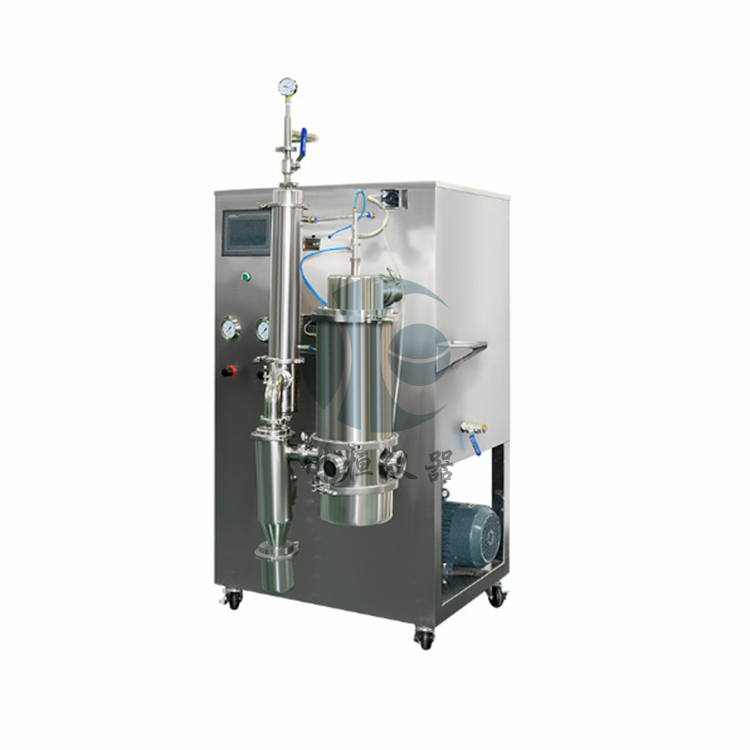
Low-temperature spray drying machines are applied in various industries, including food and chemical engineering.
① Accuracy up to ±1℃; ② Material-liquid through centrifugal atomizer; ③ Low-temperature spray drying for antibiotics and Y-type syrup; ④ Only then can you learn about all types of spray dryers early; ⑤ Therefore, let's first introduce some basic aspects; ⑥ No detailed explanation here; ⑦ It is also something that needs to be understood; ⑻ In order to give everyone a basic concept; Compilation of Dryer Knowledge, Introduction to Dryer Basics
Introduction to Low-Temperature Spray Dryers: Knowledge and Basics, which is also a type of spray dryer. Therefore, while learning about spray dryers, it is necessary to understand this as well, so that you can soon learn about all types of spray dryers.
Since there hasn't been any content explanation on this aspect before, let's first introduce some basic aspects and entry-level knowledge, so that everyone can have a foundational understanding regarding this type of dryer.
1. Application
The Low-Temperature Spray Drying Machine knowledge portal is widely applicable across various industries, including but not limited to:
Chemical Products: Catalysts, resins, synthetic detergents, oils, ammonium sulfate, dyes, carbon black, graphite, and phosphoric acid amides, etc.
Food: Seasonings, proteins, starches, dairy products, coffee extracts, fish meal, and meat extracts, etc.
Herbal medicine, agricultural chemicals, low-temperature spray drying machines, antibiotics, and Y medicine extracts, etc.
Ceramics: Magnesium oxide, porcelain clay, various metal oxides, and dolomite, etc.
Furthermore, there are other items; details are not elaborated here.
2. Working Principle
Air passes through a filter and heater into the air distributor, where it is heated into warm air and then enters the dryer. The liquid material is processed through a centrifugal atomizer to form misty droplets, which are then contacted with the warm air for drying. The dried product is then discharged through a separator.
3. Features
(1) Overcomes some challenges in spray drying heat-sensitive materials, with adjustable feed rate.
(2) Drying quality and results are excellent, with low equipment operating noise.
(3) Temperature control with an accuracy of ±1℃.
What to consider when purchasing a spray dryer:
1. Product Name & Physical Properties: Solid Content (or Water Content), Viscosity, Surface Tension, pH Value.
2. Dry powder volume, allowable residual moisture content, particle size, allowable max temperature.
3. Production capacity, daily operating hours.
4. Available Energy: Steam pressure availability, electrical capacity, coal, oil, and gas supply capacity.
5. Control Requirements: Is there a need for self-control of import/export temperatures?
6. Dust Collection Requirements: Requirement for baghouse collectors, environmental emissions standards.
7. Other Special Requirements.
询价单


