




- AllProduct Category
-
Integrated Distillation Apparatus
Sulfur Dioxide Distillation Apparatus
Fully Automatic Micro Pipette Dispenser
Fully Automatic Liquid-Liquid Extraction Apparatus
Fully Automatic Nitrogen Blow-Down Instrument
Anaerobic Incubator
Three-Gas Incubator Chamber
Rocking Bed Oscillator
Sample Pre-Processing Equipment
Low-Temperature Constant-Temperature Bath Series
Drying Oven Culture Chamber
Centrifuge Series
Medical Microbiology Series
试验箱
全自动封膜仪



详情描述
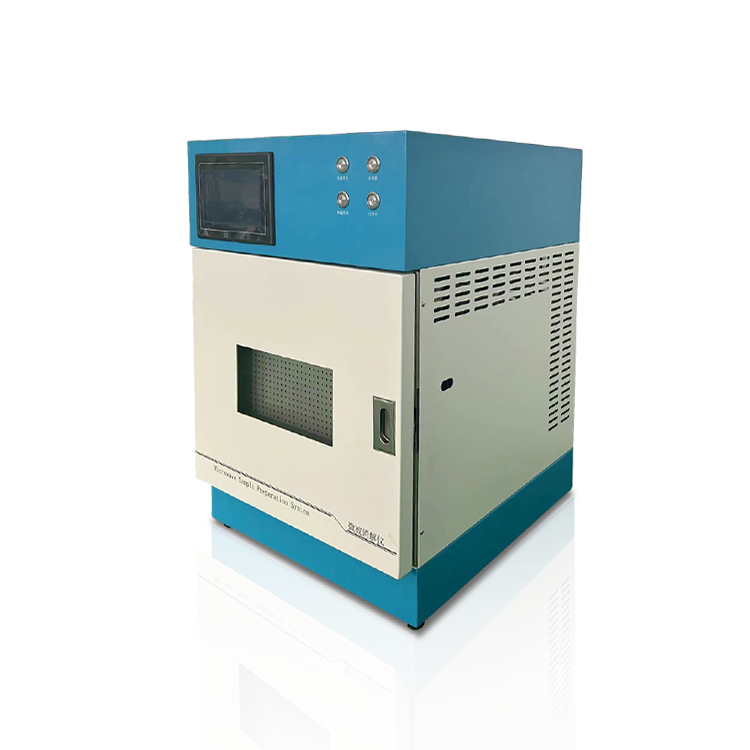
High-Throughput Fully Automatic Microwave Digestion System CNWB-6
Key Features:
High-throughput intelligent microwave digestion instrument utilizes non-pulsed continuous automatic frequency conversion control of microwave, extending the instrument's lifespan and uniformity of electromagnetic waves. The self-locking buffer explosion-proof furnace door ensures the safety of the operator and the integrity of the furnace door structure in case of abnormal reaction. The tight seal between the furnace door and the cavity ensures microwave leakage meets national standards. The instrument employs a dual-control system of temperature and pressure to control the pressure and temperature of synthesis experiments, with real-time display. If the pressure inside the vessel exceeds the set protection value, the microwave heating will automatically stop. The safety explosion-proof film has a dual insurance function; when the pressure inside the vessel exceeds the pressure the explosion-proof film can withstand, the film breaks first, releasing the gas to prevent damage to the vessel and harm to the human body.
Microwave Digestion System features a touch-sensitive intelligent panel, intelligent sensing buttons, contactless touch technology, with high sensitivity and fast response, resistant to acidic gas corrosion for safety and reliability. The digestion rotor rotates continuously in one direction within the furnace cavity, eliminating uneven micro-slope heating due to back-and-forth rotation caused by rotor stoppage, reducing motor impact, and extending service life.
Over 20 years have passed since the development of microwave digestion systems, with approximately 20,000 domestic models scattered across the vast regions of China. What started as a simple modification of household microwave ovens has rapidly evolved into laboratory microwave digestion workstations/systems. Currently, domestic microwave digestion systems come in a variety of types, with significant performance differences and varying applications.
Primary Functions and Application Areas: Microwave digestion of samples in high-temperature, sealed containers for acid dissolution not only reduces the sample processing time but also achieves advantages unattainable by traditional sample processing methods, such as the minimum acid usage, the lowest background values, and complete recovery rates.
Microwave digestion instrument exhibits overheating phenomena.
Microwave heating can lead to overheating (above boiling point). When using an electric furnace, heat is conducted from the outside to the inside through the walls of the container, making it easy for bubbles to form on the wall surface, thus overheating is less likely. The temperature remains at the boiling point due to the large amount of heat absorbed during vaporization. In contrast, in a microwave field, the "heating" method is entirely different, with energy directly converted within the system. Since there is a lack of a "core" for bubble formation within the system, overheating can easily occur in closed containers with some low-boiling-point reagents. This demonstrates that reagents in sealed sample tanks can provide higher temperatures, which is beneficial for sample digestion.
Microwave Digestion Instrument Technical Specifications
Top-mounted explosion-proof furnace cavity door design, ensuring operators are shielded from microwave radiation, and significantly enhancing the lifespan and safety of the furnace cavity.
Disintegration tank with "on/off" type quantitative pressure relief function, ensuring safe disintegration process without the need for conventional consumables such as explosion-proof membranes.
Full touch screen operation, real-time display of temperature and pressure change curves, always keep abreast of the reaction status.

Microwave Digestion Instrument Performance Features and Application Fields
1. In terms of digestion, microwave-assisted chemical digestion is faster, processing a batch of samples 10-100 times quicker than the general electric hotplate method.
2. Excellent dissolution effect; uses high-pressure sealed tanks while microwave heating, ensuring thorough dissolution of samples, especially effective for difficult-to-dissolve samples.
3. The samples are digested in a sealed digestion tank, significantly reducing the loss of volatile elements. Consequently, the analytical results are more accurate.
4. Microwave digestion uses fewer reagents, reducing the blank value and background of the sample.
5. The entire dissolution process is conducted under sealed conditions, ensuring that the acid reagents do not contaminate the environment, which is beneficial for environmental protection and personal health.
6. Energy-saving effect is extremely significant, achieving approximately 80% energy savings compared to traditional methods.
7. The parallelism and reproducibility of samples from the same batch are good, avoiding errors caused by manual operations.
Application Fields
Can be applied to various sample pretreatment tasks in analytical chemistry, such as dissolution, extraction, and protein hydrolysis. Additionally, microwave organic synthesis is gaining popularity and is poised to replace traditional synthesis methods. More and more laboratories are adopting microwave sample processing systems to replace time-consuming, labor-intensive, and heavily polluting methods for the preparation of samples for instruments like atomic absorption spectrometers, atomic fluorescence spectrometers, inductively coupled plasma emission spectrometers, inductively coupled plasma mass spectrometers, high-performance liquid chromatographs, and gas chromatographs.
High-Throughput Fully-Automatic Microwave Digestion System CNWB-6
Technical Specifications:
Model | CNWB-4 | CNWB-6 | CNWB-8 | CNWB-12 | CNWB-16 |
Host specifications | Power: 220-240 VAC, 50/60Hz, 8A; Microwave Frequency: Professional microwave source/2450MHz | ||||
Microwave Output Power: 0~1600W, automatically continuously adjustable. Microwave Output Characteristics: Non-pulse continuous automatic frequency conversion control, automatic output from 0 to 100. | |||||
Microwave Cavity: 52L, 316-grade full stainless steel cavity, 6-layer corrosion-resistant and high-temperature Teflon coating; corrosion-resistant, high-temperature resistant. | |||||
Ducting and Cooling Systems: The furnace cavity is equipped with a high-power exhaust system, allowing various reactions to be conducted continuously for extended periods in a well-ventilated, safe, and easily observed environment. The furnace cavity ventilation uses acid-resistant, high-volume centrifugal fans with an exhaust capacity of not less than 5 m³/min. The cavity features wind-cooling functionality, continuously cooling the reaction vessel, with temperature and pressure displayed in real-time. | |||||
Control System Parameters | Control Method: Touchscreen design, 8-inch TFT-LED (800)480 Color Display, long-distance direct reading of reaction process, real-time display of closed reaction tank temperature and pressure, with real-time temperature-pressure curve display. | ||||
Temperature Control Range: 0~300℃; Temperature Control Accuracy: ±0.5℃ | |||||
Temperature Control System: Utilizes contact-based temperature control for precise and error-free regulation, featuring a high-precision platinum resistance temperature sensor; real-time detection, control, and display of the temperature and curve inside the microwave digestion reactor. | |||||
Pressure Control System: Utilizes non-contact pressure control method for precise and error-free pressure regulation. It features real-time detection, control, and display of pressure and curves within the microwave digestion reactor; Pressure control range: Optional from 0~6MPa, 0~10MPa, or 0~15MPa; Pressure control accuracy: 0.01MPa. | |||||
Pressure Protection: Overpressure automatically adjusts/stops microwave emission and triggers an automatic alarm. | |||||
Reactor Vessel Specifications | Temperatures up to 300°C and pressures up to 1500 psi. | ||||
Outer container made of imported PEEK aerospace material; inner container material: PTFE; inner container reaction volume: 75ml. | |||||
High-pressure digestion tank batch processing capacity: 4 samples per batch. | High-pressure digestion tank batch processing capacity: 6 samples per batch. | Batch processing capacity for high-pressure digestion vessels: 8 samples per batch. | High-pressure digestion vessel batch processing capacity: 12 samples per batch. | High-pressure digestion vessel batch processing capacity: 16 samples per batch. | |
询价单


