





















Shandong Zhongjie Special Equipment (formerly Heze Boiler Factory Co., Ltd.) was established in 2001, located at No. 2218 Jinnan Road, Economic and Technological Development Zone, Heze City. With a registered capital of 50 million yuan and total assets of 500 million yuan, the company operates seven business centers: boiler manufacturing, deep-freezing containers, pressure vessels, central air conditioning, engineering installation, international trade, and Internet of Things. It has three factory sites on Jinnan Road, East Changjiang Road, and Bohai Road, covering a total area of 200,000 square meters, with the main workshop spanning 83,000 square meters. The company currently employs 710 staff, including 247 engineers and technicians, and 82 intermediate-level technicians. Recognized as a "High-tech Enterprise" by the Science and Technology Department in December 2016, it was named a "Shandong Specialized and New Enterprise" by the Ministry of Industry and Information Technology in June 2021, a "Shandong Deer Enterprise" in June 2022, and a "Specialized and New Small Giant Enterprise" by the Ministry of Industry and Information Technology in August 2022.
Under China's "Regulations for the Safety Supervision of Pressure Vessel Technology," carbon dioxide storage tanks are classified as Category II pressure vessels. According to these regulations, pressure vessels are categorized as follows:
- Category I pressure vessels: Pressure vessels with working pressures of 10 MPa (Megapascals) or higher, such as steam boilers and pressure vessels.
- Category II pressure vessels: Pressure vessels with working pressures between 0.1 MPa and 10 MPa, such as air compressors and liquefied gas storage tanks.
- Category III pressure vessels: Pressure vessels with working pressures between 0.05 MPa and 0.1 MPa, such as storage tanks.
- Category IV pressure vessels: Pressure vessels with working pressures below 0.05 MPa, such as gas cylinders.
Based on this classification, carbon dioxide storage tanks typically have working pressures above 0.1 MPa, thus falling under Category II pressure vessels. It should be noted that specific classification criteria may vary depending on different regions' laws and standards. When using and managing carbon dioxide storage tanks, it is essential to comply with the relevant regulations and standards.
Carbon dioxide storage tanks can be categorized into various types and structures based on their design and usage:
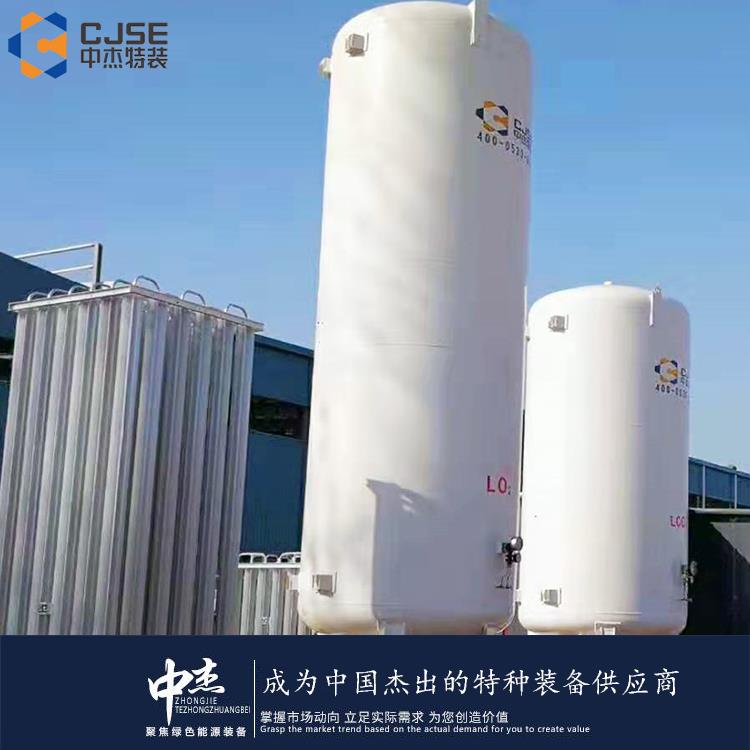
- Vertical Tanks: Commonly used carbon dioxide storage tanks, with a cylindrical shape and vertical placement. They typically have larger capacities and are used for large-scale storage and supply.
- Horizontal Tanks: Another common type, with a rectangular or cylindrical shape and horizontal placement. They are suitable for smaller-scale storage and supply, ideal for limited spaces.
- Spherical Tanks: A specialized type of carbon dioxide storage tank with a spherical shape. They offer high strength and pressure-bearing capabilities, suitable for high-pressure storage and transportation.
- Vertical Tanks: Smaller capacity carbon dioxide storage tanks with a cylindrical shape and vertical placement. They are typically used for small-scale storage and supply, such as commercial and residential use.
- Underground Tanks: A unique structure where the carbon dioxide storage tank is buried underground. They save space, reduce visual impact, and offer enhanced safety and environmental protection.
These tanks are usually constructed from pressure-resistant materials (like carbon steel or stainless steel) with certain thermal insulation properties and accessories such as safety valves, pressure gauges, and level indicators. The interior often features baffles or partitions to separate different liquids or gases. Additionally, they are equipped with safety systems like pressure maintenance systems, leak detection systems, and fire detection systems.
Low Temperature Carbon Dioxide Storage Tank Related Knowledge
1. Structure of Low Temperature Carbon Dioxide Storage Tank
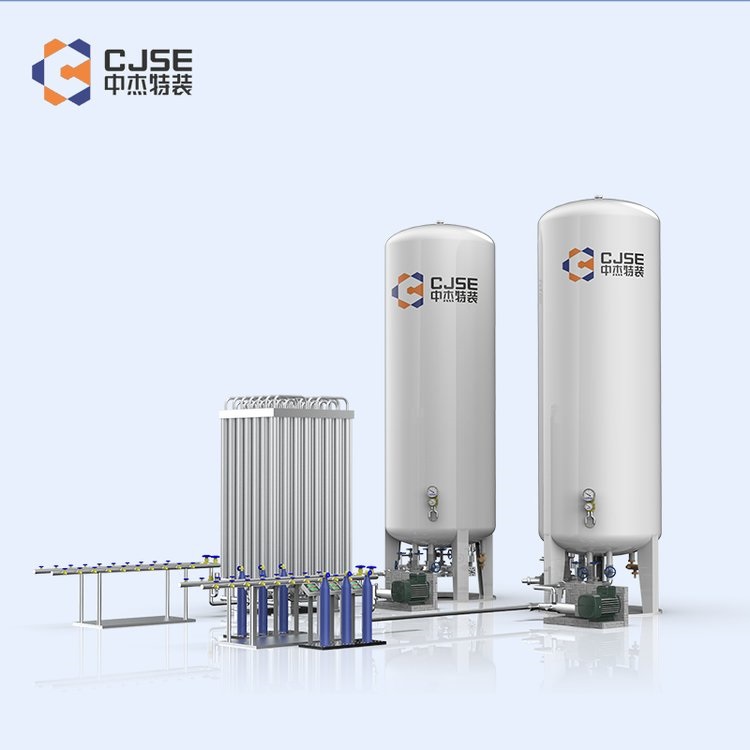
The low temperature carbon dioxide storage tank is typically a double-layered cylindrical structure. The inner cylinder is made of 6MnDR alloy steel, while the outer cylinder is constructed from Q245R or Q345R pressure vessel steel plate. The piping is made of austenitic stainless steel, and the insulation space is filled with high vacuum sintered sand or layered with insulation materials. The storage tank is equipped with valves for operation, which are arranged for ease of use. Pressure gauges and level indicators are also installed to monitor the internal pressure and liquid level of the low temperature carbon dioxide storage tank.
2. Key Features of Low Temperature Carbon Dioxide Storage Tank
(1) The storage tank is equipped with a connection for filling tanker trucks, allowing liquid supply to vaporizers, tankers, and pumps.
(2) Both the inner and outer cylinders of the storage tank are equipped with safety devices to ensure safe operation for the user.
(3) The insulation material of the low temperature carbon dioxide storage tank is specially treated to provide a longer vacuum life. Additionally, the tank is equipped with a vacuum gauge for measuring the insulation space vacuum level when necessary.
3. Transportation of Low Temperature Carbon Dioxide Storage Tank
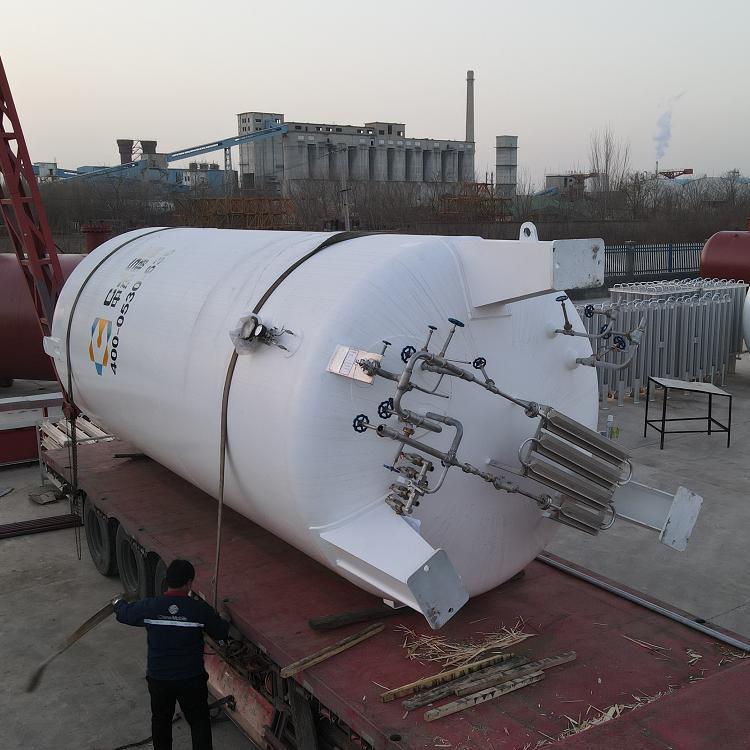
(1) During road transportation, the storage tank should be securely fastened to the vehicle and travel at moderate speeds. Collision with other objects is prohibited.
(2) After the storage tank arrives, the unloading crew should work with the equipment supervisor to develop a scientific and reasonable unloading plan.
4. Installation of Low Temperature Carbon Dioxide Storage Tank
(1) Once the storage tank arrives at the installation site, it can be positioned when installation conditions are met. During the installation process, collisions and impacts are prohibited, and special attention should be given to the explosion-proof equipment on the outer cylinder and the vacuum valve, which should not be touched.
(2) A gas-tightness test should be conducted on the inner cylinder system using nitrogen to the working pressure. After checking that valves, pipes, flanges, etc., have no leaks, the installation is complete.
(3) The installation dimensions of the low temperature carbon dioxide storage tank are specified in the supply materials. When considering filling or emptying liquids with tanker trucks, the vehicle's travel path should be taken into account.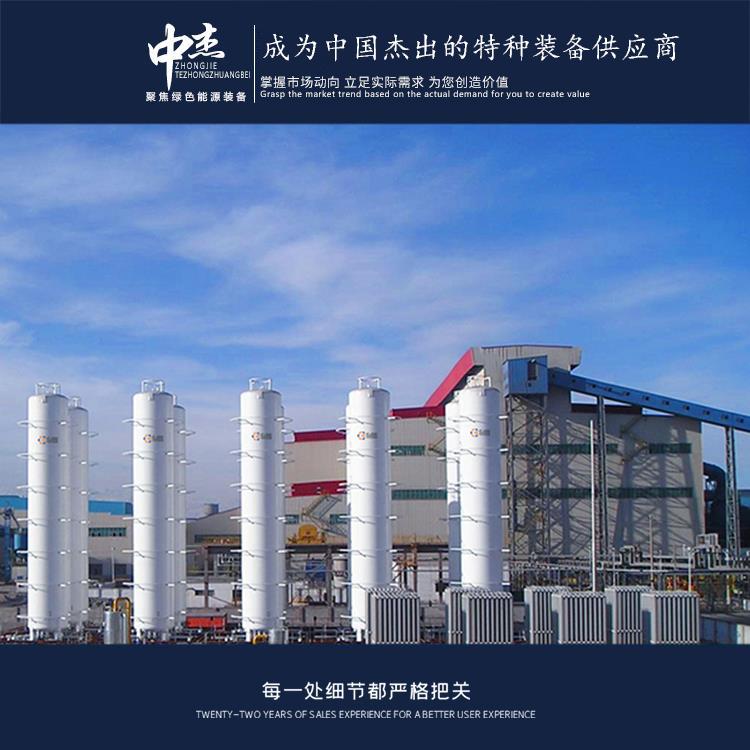
Carbon dioxide tanks are equipment used for storing and transporting CO2 (carbon dioxide). They are typically sealed containers with specialized design and structure to ensure safe storage and use of CO2. Here are some common details about carbon dioxide tanks: Storage Form: CO2 is gaseous at room temperature but can be compressed into a liquid under high pressure for easier storage and transportation. Carbon dioxide tanks are usually used for storing liquid CO2. Storage Pressure: These tanks commonly store high-pressure CO2, typically around 20-25 bar, which helps maintain the liquid state. Storage Capacity: The capacity of carbon dioxide tanks can vary greatly, from small ones of a few thousand liters to large ones of tens of thousands. The capacity choice depends on specific application needs. Safety: CO2 is colorless, odorless, and non-toxic, but it can be dangerous if inhaled at high concentrations. Therefore, appropriate safety measures, such as ventilation and protective gear, must be taken when using carbon dioxide tanks to ensure the safety of operators. Applications: Carbon dioxide tanks are widely used in various fields, including food and beverage industry, construction, fire extinguishing, and gas supply. They are used for storing and providing CO2 to meet diverse industry requirements. It is important to note that the design, manufacturing, and use of carbon dioxide tanks must comply with relevant regulations, standards, and safety guidelines. When using these tanks, follow the operation manual and safety guidelines, and cooperate with local regulatory bodies and individuals to ensure the tank's safety and reliability.
Shandong Zhongjie Special Equipment, welcome customers to visit our factory for business discussions.
WeChat Official Account

Scan to follow Official Account



















