







Offer SIL Certification, SIL Grading, and other consulting services - Shenzhen ZhongNuo Testing Technology Co., Ltd.
SIL certification, also known as Functional Safety Certification, focuses on the product's safety functions. Obtaining SIL certification is to verify if this safety function can be reliably and safely implemented.
For instance, with a lighting fixture, we are concerned with its lighting function, whether its light intensity can reliably and safely meet our requirements.
The standard for SIL Safety Integrity Level certification primarily includes:
1. IEC61508—Establishes fundamental safety requirements for both the operational and fault prediction capabilities of conventional systems. These requirements encompass general safety management systems, specific product design, and process design that meets safety requirements, aiming to prevent both systematic design failures and random hardware failures.
2. IEC61511 - A functional safety standard specifically for safety instrumented systems in the process industry, which was introduced by the International Electrotechnical Commission (IEC) as a domain standard following the foundational functional safety standard IEC61508. In China, the harmonized standard for IEC61511 is GB/T 21109.
3. ISO 13849-1 – Comprehensive safety assessment from components to systems. This standard also provides designers with more quantifiable design implementation methods.
4. IEC62061 – Standard in the electrical system field.
5. IEC61326-3-2—specifies additional requirements for immunity levels of safety-related equipment, including low probability end conditions that may occur at the site.
6. ISO 26262 – Primarily focused on specific electrical devices, electronic equipment, and programmable electronic devices in the automotive industry, these are specialized components for automotive applications. It aims to enhance the functional safety of automotive electronics and electrical products.
The content of the SIL (Safety Integrity Level) assessment includes:
1. System Evaluation
– Risk Analysis, refer to risk classification chart (ASIL/SIL/PL)
Review of specifications and safety requirements
Concept and Design Analysis
- Verification and Confirmation
2. Software and Tool Assessment
- Testing of development tools and other communication protocols
Structural Analysis
3. Hardware Assessment
Probability Analysis
Failure Analysis
4. SIL Certification
Components and Systems SIL Certification
- Safety Process SIL Certification
- Granting of system, semiconductor, development tools, and process testing symbols
5. Additional Services
Risk Applicability and Risk Analysis
- Test and evaluate hardware and software for security during the development process
Conceptual Assessment (Initial Inspection)
Functional Safety Management (FSM)
Safety, Reliability, and Availability Analysis
- Qualified Assessment Meeting Relevant Safety Standards
These services are aimed at manufacturers of components, subassemblies, and systems for the automotive industry (including electric), elevators, power plants, machinery, and process sectors. They support the fulfillment of due diligence obligations and ensure the correct application of the standard, contributing to enhanced safety levels and helping to minimize residual risks. Standards IEC61508 and others can be integrated into existing quality management systems in a beneficial manner. The implementation of regulations and provisions contained in the standards provides a reliable foundation for decision-making, particularly regarding safety structures, testing procedures, and tools. Development outputs can be verified at an early stage, while also reducing development time and costs. Additionally, certification enhances the image and raises the company's profile in the competitive market.
As the public awareness of industrial accidents and their impact on society grows, more and more companies recognize the importance of safety.
In modern process industries, due to the complexity of processes and the multitude of equipment, any failure can have severe consequences for employees, the public, equipment, or the environment.
The SIL certification process involves helping businesses fully leverage their proven engineering practices and safety technologies (IEC61508 and IEC61511) to prevent the recurrence of industrial accidents. This is because these experiences and technologies are based on a wealth of actual experience and lessons learned.
With the issuance of the IEC 61508 and IEC 61511 series standards, a systematic functional safety assessment and testing process can effectively address this issue.
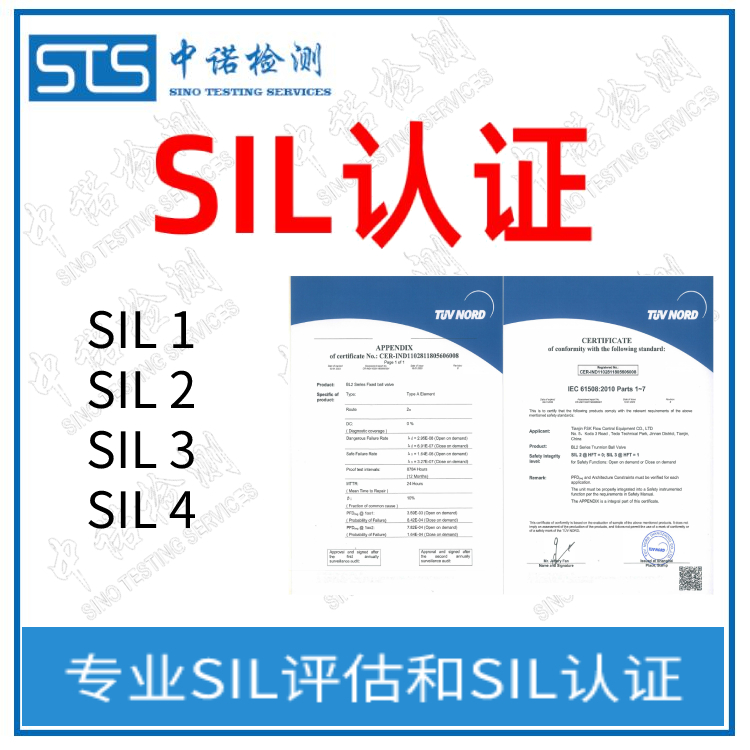
SIL certification is a third-party assessment, verification, and certification based on standards such as IEC 61508 (GB/T 20438), IEC 61511 (GB/T 21109), IEC 61513, IEC 13849-1, IEC 62061, and IEC 61800-5-2, which evaluate and confirm the Safety Integrity Level (SIL) or Performance Level (PL) of safety equipment. Functional safety certification primarily involves document management (FSM) assessment for the development process of safety equipment, hardware reliability calculation and evaluation, software assessment, environmental testing, and EMC electromagnetic compatibility testing. SIL certification is divided into four levels: SIL1, SIL2, SIL3, and SIL4, encompassing both product and system levels, with SIL4 being the most stringent.
WeChat Official Account

Scan to follow Official Account