







Flat Panel Acoustic Chamber
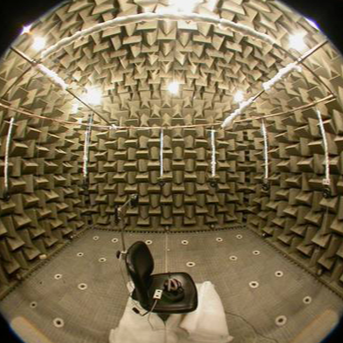
An anechoic chamber is not only a specialized laboratory for acoustic testing but also a crucial component of the testing system. In fact, it is also one of the acoustic testing devices, with its acoustic performance indicators directly affecting the accuracy of the tests. The primary use of an anechoic chamber is to test the sensitivity, frequency response, and directivity of noise-canceling transmitters and receivers, among other electroacoustic properties. The frequency range of these transmitters and receivers must ensure clear language communication, typically around 200-4000Hz.
The acoustic design criteria are as follows, based on the purpose of the anechoic chamber and the existing room conditions:
(1) The designed soundproof room is a semi-soundproof room.
(2) Acoustic design achieves the baseline noise index.
(3) Acoustic design achieves free field performance criteria, requiring measurement errors within ±1dB or with special requirements such as measuring sound source direction.
(4) Acoustic design achieves aerodynamic performance.
(5) Vibration isolation design achieves complete isolation of low-frequency vibrations generated around the anechoic chamber.
Soundproofing and vibration isolation
Through on-site data collection and field inspections, identify the low-frequency noise sources and environmental noise near the proposed acoustic chamber location. Based on the collected data, analyze and determine the design scheme. To enhance sound insulation and vibration isolation, it is generally adopted to use a "room within a room" soundproofing structure that is completely separate from the existing building.
(II) Floating Ground
To isolate solid sound caused by impacts, an isolated floor with an elastic cushion layer is used for vibration damping. This involves laying a 15cm thick (compressed to 10cm) glass wool insulation board as the vibration damping cushion layer on the existing ground surface. Above this, a 20cm thick reinforced concrete floor is placed, leaving a 5cm gap from the exterior wall to prevent rigid connection with it. This design isolates the transmission of solid sound between the building interior and the outdoors.
(Wall) Partition
A 24cm thick brick wall is constructed as an interior wall on the floating ground, leaving a 20cm gap between it and the exterior wall. The brick joints must be filled with mortar to prevent sound leakage through the gaps.
(Acoustic) Soundproof Ceiling
To accommodate construction and reduce the weight of the soundproof flat roof, a double-layered steel wire mesh cement plastering method is used, with a 10cm air layer in between. This type of soundproof flat roof is characterized by high sound insulation and light weight. To maximize the effective height of the soundproof room, the beams supporting the floor are designed to partially protrude downward.
Soundproof Door/Absorptive Door
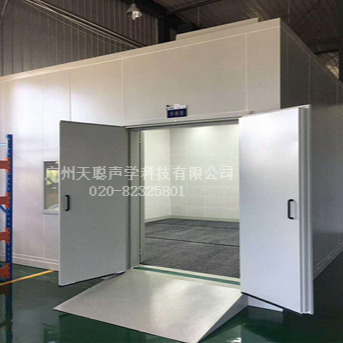
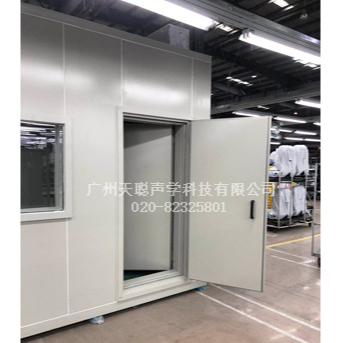
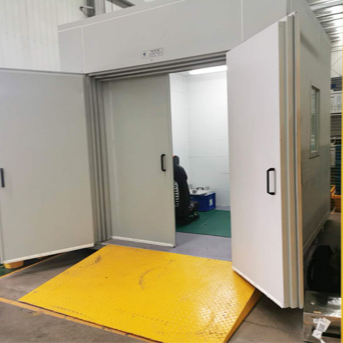
The acoustic chamber door features both sound insulation and absorption capabilities. It is composed of insulation doors and absorption doors, installed on the partition wall between the instrument room. It includes two sets of single-leaf steel composite structure insulation doors and absorption curtains on the interior wall. Its unique design significantly reduces the space occupied by traditional sliding absorption doors and is also easy to operate. Due to the use of flat absorption layers in the acoustic chamber design, the absorption layers adjacent to the wall are installed inwardly, leaving an opening to accommodate the curtain position.
(Six) Flat Absorbing Layer
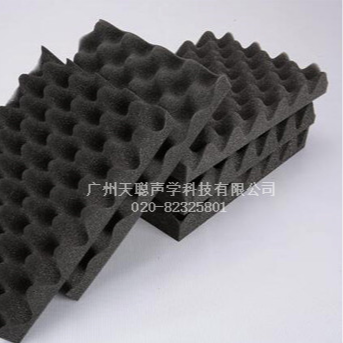
The design of the flat sound-absorbing layer is a determining factor for the acoustic characteristics of the anechoic chamber and the lower frequency limit of the tests. To maximize the effective space, the length of the flat panel is determined by the cutoff frequency and the 1/4 wavelength theory, with the specific calculation method being L = 1/4 * (340/Fc). Here, Fc represents the cutoff frequency, 340 is the speed of sound in air, measured in m/s; and L is the theoretical length of the sound-absorbing material to reach the cutoff frequency. Constructed with a steel wire frame, internally filled with environmentally friendly formaldehyde-free sound-absorbing and noise-reducing material, and cut using custom molds, the panels are filled as a whole to ensure uniform and aesthetically pleasing shapes of each sound-absorbing body, free of broken cotton and cotton waste. This guarantees that the sound-insulating cotton does not leak out, with the inner layer using a new high-thread-count white glass cloth for overall套裁; the outer layer employs porous sound-absorbing steel plate.
For more details, please contact: 020-82325801, 82323025.
Please send any relevant size requirements and other documents to our email: dacooo@163.com.
Or, for inquiries, add WeChat ID: dacooo1. Remember to note the consultation content!