



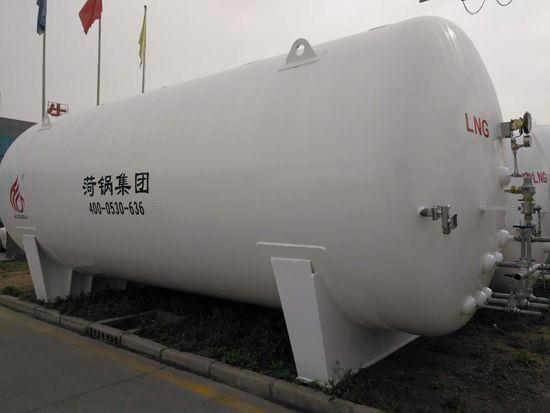


















LNG Natural Gas Storage Tank, Liquid Low-Temperature Container
Low-temperature liquefied natural gas storage tank equipment is widely used in various industries of the national economy, including industry, agriculture, national defense, and scientific research. The application of natural gas storage equipment is increasingly widespread, primarily due to its advantages over traditional steel cylinders, such as convenient transportation, energy savings, safety and reliability, purity assurance, and versatility. China's low-temperature storage tanks are developing towards high quality, a variety of types, and large capacity.
Low-temperature liquid storage tanks are high-vacuum insulated stainless steel pressure vessels, designed for the storage, transportation, and use of liquefied natural gas, liquid oxygen, liquid nitrogen, liquid argon, or carbon dioxide. These low-temperature containers are manufactured according to GB18442 standards and are used for reliable and cost-effective transportation and storage of low-temperature liquids, as well as for on-site storage and supply of low-temperature liquid gases across a wide range of applications.

Manufactured fixed pressure vessels comply with the following regulations and standards:
1. TSG 21-2016 "Technical Supervision Regulation for Safety Supervision of Fixed Pressure Vessels"
2. ASME Section I, Parts 1-4 - 2011 "Boilers and Pressure Vessels"
3. NB/T47014-2011 "Welding Process Evaluation for Pressure Equipment"
4. NB/T47015-2011 "Code for Welding Procedure for Pressure Vessels"
5. GB/T25198-2010 Pressure Vessel End Cover.
6. NB/T47013-2015 Non-Destructive Testing of Pressure Equipment
7. NB/T47016-2011 "Mechanical Property Test of Welding Joints for Pressure Equipment Products"
8. JB/T4711-2003 "Coating and Packaging for Pressure Vessels"
9. GB/T18442-2011 "Fixed Vacuum Insulation Low-Temperature Pressure Vessel"

A low-temperature storage tank is a pressure vessel used for storing various low-temperature liquids, such as natural gas tanks, LNG tanks, liquid oxygen tanks, liquid argon storage vessels, and low-temperature liquid nitrogen tanks. Therefore, its safe operation should take into account factors such as the gas risk characteristics, low-temperature maintenance effects, surrounding environmental conditions, and characteristics of the pressure vessel. So, what are the specific operational rules for low-temperature storage tanks? Let's find out together below.
1. Types of facilities and fire separation
Low-temperature storage tanks are classified as Class B, with the minimum fire resistance grade of two. The fire separation between low-temperature storage tanks should not be less than half the diameter of the larger tank among the adjacent two tanks. There is no limit to the fire separation between oxygen storage tanks with a volume of 50 m3 or less and their operational buildings. The separation between nitrogen and argon storage tanks should meet construction and maintenance requirements and should not be less than 2 meters.
2. Lightning and Static Electricity Protection
The low-temperature storage tank area must have lightning and static electricity grounding devices. A qualified unit should be invited to inspect the grounding resistance regularly each year. The equipment, pipelines, and flange and threaded joints on the low-temperature storage tank should be connected with metal wire bridges, with the bridging resistance being less than 0.03Ω.
Establish strict systems for the distribution, collection, and on-site handling of low-temperature steel materials, which are crucial quality assurance methods for the manufacturing of low-temperature pressure vessels. Particularly in the production site, as low-temperature steel can easily be mixed with general steel, failure to strictly manage it can leave significant safety hazards. Low-temperature steel and welding rods should be handled separately in designated storage areas. After technical briefings, construction personnel and handlers must be familiar with the identification of low-temperature steel and welding rods to prevent confusion with other types of steel. Records must be kept for material in and out of the storage, and unused materials should be promptly re-labeled. The surface quality of low-temperature steel requires high standards, and during storage and transportation, the surface should be protected, and color-coded labels should be used for identification. Cutting and material preparation should be under the supervision of material handlers and immediately relabeled with color codes. Steel plates and semi-finished products should be stored on shelves by batch number and standards. Pre-formed materials should be stored using cradles or supports, and it is strictly prohibited to place low-temperature steel materials, especially welding materials, directly on the ground. The distance from the support to the ground and walls should not be less than 300mm. The welding rod storage area should comply with relevant welding material handling regulations, with the temperature not below 10℃ and relative humidity not exceeding 60%, and proper records should be maintained. Welding rods should be dried for 2 hours at the specified temperature before use and then stored in a constant-temperature drying cabinet (100-150℃).
In the pressure vessels currently used in petrochemical enterprises, low-temperature pressure vessels account for a significant proportion. Due to their lower operating temperatures, the brittleness of the container materials increases correspondingly. Under the effect of tensile stress on the pressure-bearing elements, brittle fractures may occur suddenly at stress levels below the material's yield strength or below the allowable stress. Such fractures are characterized by either no or only minimal plastic deformation before and after the event, without overall yielding, making them difficult to detect during routine production and posing a greater safety threat to petrochemical production. Therefore, for low-temperature pressure vessels, there is a need for an increased level of requirements in all stages from design, material selection, manufacturing to inspection, compared to non-low-temperature pressure vessels.

LNG natural gas storage tank, liquefied low-temperature container
Product Description
Brand He Guo Group Model CFW-100/0.8
Material: Stainless Steel, Diameter: 3400mm
Application Range -162℃ Volume 100,000L
Heat Exchange Area - See drawing m² | Ambient Temperature - See drawing °C
Wall Thickness: 10/12mm, Outer Dimensions: 3424*16442mm
Origin: Shandong, Heze
60 Cubic Meters LNG Tank Price, Factory Supplying 30 Cubic and 60 Cubic Meters LNG Tanks
3. LNG Tank Fault Inspection and Handling 3.1 Daily Inspection
3.1.1 Are the level gauges and pressure gauges functioning properly?
3.1.2 Are the stop valves, regulating valves, and safety valves in normal working condition?
3.1.3 Tank, piping, and valves for any leaks.
3.2 Regular Inspections
3.2.1 The pressure gauge should be calibrated annually and accompanied by a certificate of compliance with a lead seal.
3.2.2 The safety valve should be calibrated annually and sealed with lead.
3.2.3 Low-temperature liquids should be analyzed every three to six months as needed for operation.
3.3 Fault Handling
Occurred fault
Original Cause
Handling Measures
1. Abnormal inner cylinder pressure
(Adjust or Reduce)
A pressure gauge distortion
B tank vacuum reduced
Valve Operation Error
A Pressure Gauge
B-weight vacuum extraction
C conforms to the manual's operation requirements
2 Level Gauge Distortion
Improper operation of the liquid level gauge valve
B Level Gauge is damaged.
Reoperate as per requirements
Replace with new level gauge
3 External tank frosting
A vacuum failure
B-laminate leakage
C Pearl-like sand settling down
A re-evacuate the vacuum
B Pressure Test Leak Check and Vacuum Extraction
C-balance interlayer re-install pearlescent sand and then vacuum again
Note:
1. If the user needs to evacuate or re-install pearlescent sand in the sandwich, they must first empty the inner cylinder's liquid and wait until it returns to room temperature before proceeding.
2. Should users encounter issues that are difficult to handle, they may contact our after-sales service department promptly. We offer a three-package quality guarantee for our products. For products beyond the warranty period and non-our company products, we also provide repair services.
4. Important Notes
4.1 The vacuum valve is sealed before the product leaves the factory. After the storage tank is delivered to the customer's site, the customer must ensure the protection of all pipeline valves during installation, especially the vacuum valve, and strictly prohibit any collision or opening of the vacuum valve.
4.2 Do not empty the liquid in the storage tank unless it will be unused for a long period, to prevent the inner cylinder from overheating and requiring recooling when refilling, which would cause unnecessary losses.
4.3 Low-temperature liquid storage tanks are used for storing liquid nitrogen, liquid oxygen, and liquid argon. However, when switching to another liquid, the original liquid must be completely drained and purged before refilling with the new liquid.
Note:
1. The fill valve opens when the liquid is nearly full, closes when liquid starts to flow, and stops the inflow. For the first filling, start from the top and then proceed to the bottom.
2. Open during disposal of residual liquid.
3. Open the vent valve when the container pressure is too high.
4. The container automatically opens when over-pressurized. Normally, only one is in use. If the working one fails, the other is immediately activated to ensure the safe operation of the storage tank. The damaged safety valve is then repaired and inspected, and upon passing, it is promptly reassembled.
5. The inner cylinder automatically starts after the pressure-increasing valve is opened for the need of pressure increase.
6. The level gauge is often turned off during normal use.
7. Burst upon overpressure; must be replaced immediately if a burst occurs.

Natural Gas Storage Tank Price - 100 Cubic Horizontal LNG Storage Tank Direct From Manufacturer - Price Discount - High Vacuum Level


供应液化天然气储罐制造商-专业生产液化天然气储罐哪家质量好-液化天然气储罐批发价-液化天然气储罐价格



















