



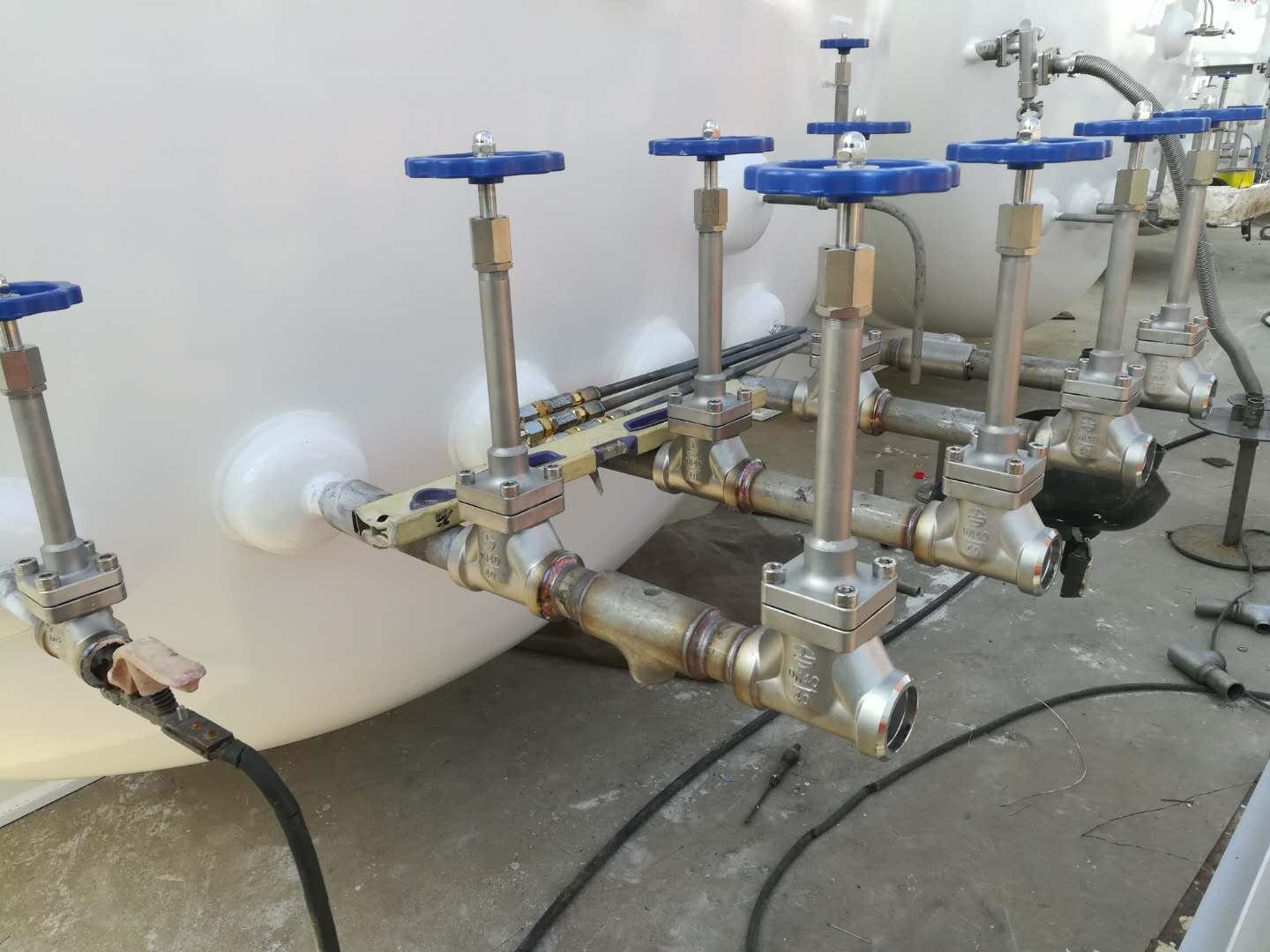

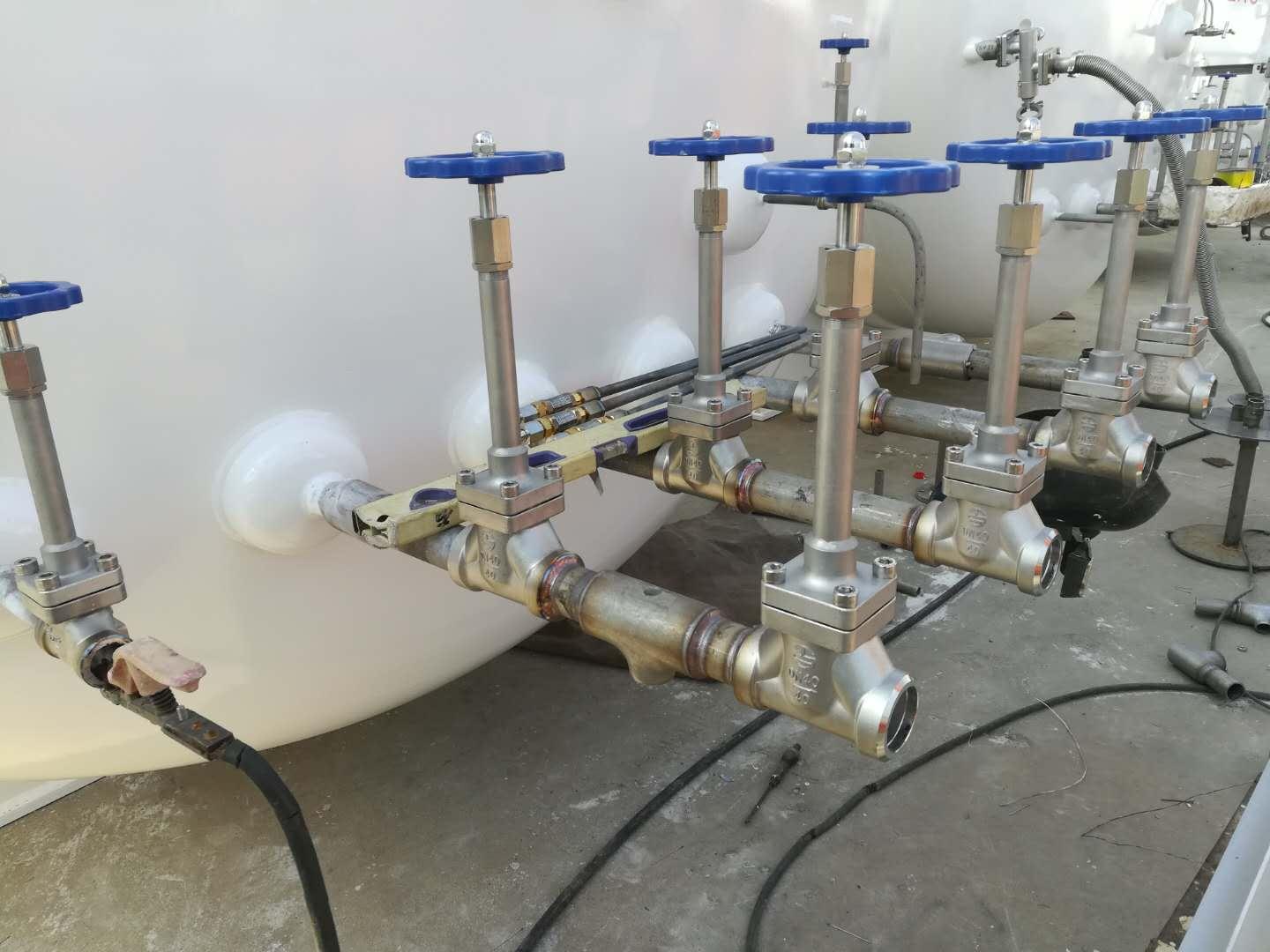
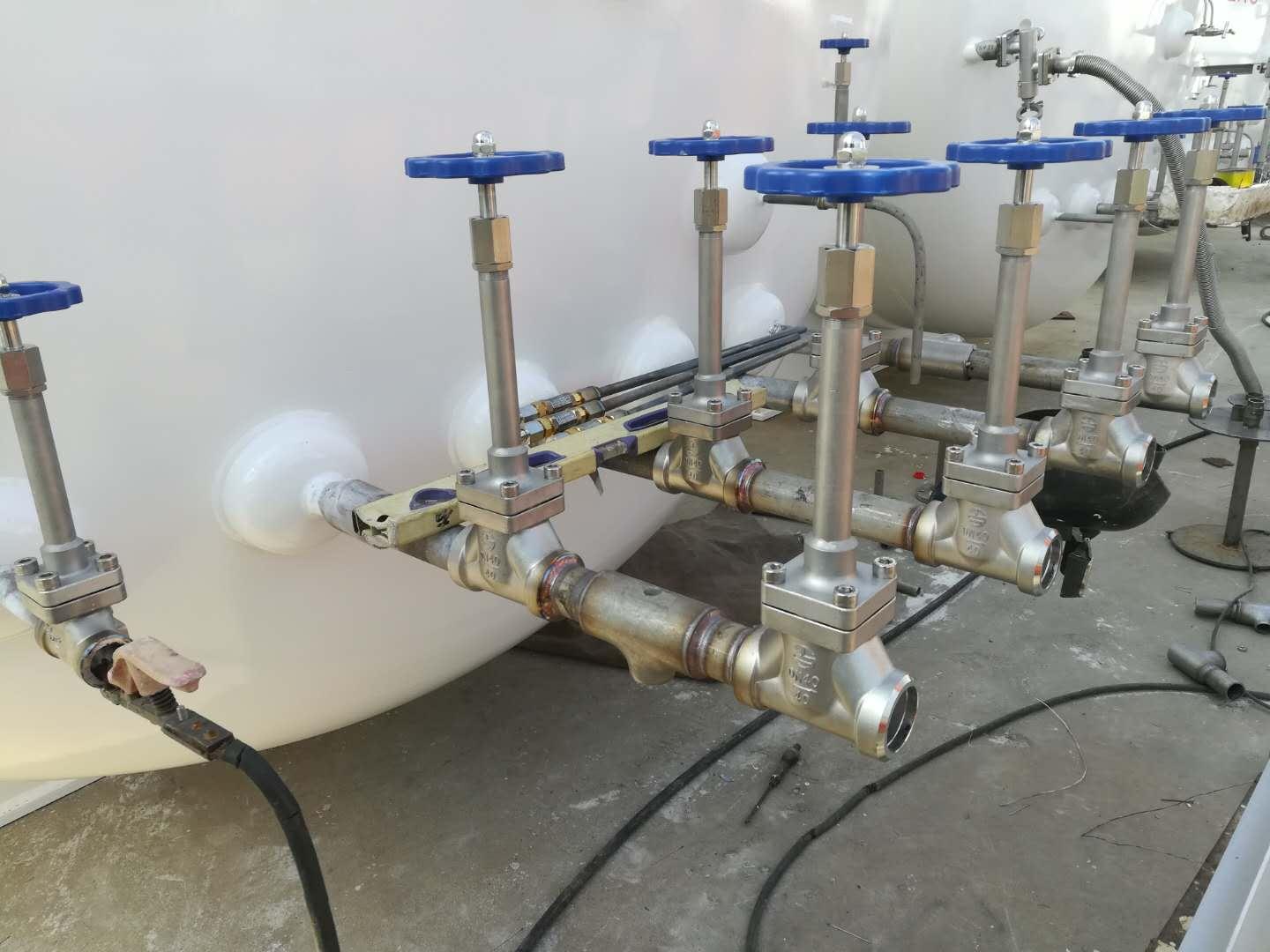



















Low Temperature Valve Fault Handling
Common issues with low-temperature valves: leakage at the handwheel stuffing box; leakage at the valve cover nut; internal leakage of the valve; leakage at the valve-pipe connection.
When there is a leak at the gland of the handwheel or at the valve cover nut, tighten with a wrench when the tank is not pressurized. Absolutely no tightening under pressure is allowed.
Valve internal leakage is usually caused by solid particles in the valve core or wear from frequent opening and closing. Both inlet valves and outlet valves are typically dual valves, with one in reserve. When internal leakage is detected, shut off the reserve valve and repair the leaking valve. First, loosen the valve cover nut with a wrench, remove the valve rod, and dry the valve disc and cover rod with a hairdryer; then clean the valve body sealing surface and the valve disc sealing gasket, and wipe away any frost or water. If the valve disc gasket shows unevenness, cracks, or grooves, replace it immediately with a spare gasket. If wear marks are found on the valve body sealing surface, smooth them with metallographic sandpaper (if unavailable, use the back of fine wood sandpaper). Before reassembling, carefully remove dust and frost or water, and tighten the valve cover nut.
When leakage is detected at the valve and pipe connection, please have a qualified unit perform the repair. During the repair, drain the liquid completely and empty it, and replace the oxygen equipment to ensure oxygen content is less than 21%. Before welding, set the valve to a semi-open position and loosen the valve cover nuts. After welding, retighten the nuts and conduct an air tightness test on the pipeline.
Differential Pressure (Level) Gauge Fault Handling
Common issues include malfunctioning indicators and trembling pointers.
1) Failure of the indicator includes the pointer not returning to zero and the pointer remaining fixed at a specific value. If the former is the case, it is usually due to improper use, i.e., the combination valve of the differential pressure (level) gauge is not in a balanced state before filling, causing the pointer to not return to zero. Open the combination valve after liquid enters through the lower inlet. If the deviation between the pointer and zero is minimal, you can loosen the screw fixing the indicator needle, move the pointer to zero, and then tighten the screw.
2) Pointer tremble is usually caused by gas leakage in the gauge tube, so be careful to inspect the gauge tube, the combination valve of the level gauge, and the related joints of the pressure gauge. Additionally, if overfilling of the liquid causes a differential pressure (level) gauge, the liquid entering the upper tube may also exhibit tremble.
(4) Summary of Fault Handling Methods
Potential faults during use, their causes and solutions are listed in the table below.
Troubleshooting Methods
Fault Phenomenon Cause Solution
During use, internal pressure
An Abnormal Increase Occurred a. The turbocharger's inlet valve is not closing tightly, causing internal leakage. The turbocharger's inlet requires grinding and inspection.
b. The pressure gauge reading is inaccurate. Inspect or replace the pressure gauge.
Pressure (Level) Gauge Indication Unreliable a. Pressure (Level) Gauge Failure. Inspect and repair the pressure (level) gauge.
b. Leak at the upper and lower pipes of the differential pressure (level) gauge. Leak repair.
c. Leaking at the differential pressure (level) gauge connection. Repair and clear the leak.
Evaporation rate exceeds design
Value, sweating and frosting at the top a. Air phase vent valve not tightly closed, internal leakage. Valve grinding and maintenance required.
b. Degradation of vacuum level. Re-pump the vacuum.
c. Top pearl sand has settled, pearl sand not fully packed. Refill pearl sand, re-purge vacuum.
Leakage of liquid or gas from the valve cap or joint. a. Sealing packing not tightened. Tighten the gland nut.
b. Seal ring damaged. Replace the seal ring.
c. Seal surface damage. Repair or replace parts.
d. Weld Seam Leak - Repair welding (but should be done according to repair welding requirements).
LNG stands for Liquefied Natural Gas, a premium natural gas product primarily composed of methane. Natural gas is characterized by its high calorific value, low pollution, and ease of storage and transportation, making it one of the quality energy sources chosen by modern society. LNG is produced by purifying and processing natural gas from gas fields, removing all impurities, and then cooling it to approximately -162°C at atmospheric pressure, condensing it into a safe, colorless, odorless, and non-toxic low-temperature liquid. It boasts high purity, safety, storage efficiency, and flexible transportation. Its volume is about 1/600th of the same amount of gaseous natural gas, and its weight is approximately 45% of the same volume of water.
Safety Advantages of LNG
Due to its excellent physical and chemical properties, it is safe: with a high ignition point at 590°C, narrow combustion range of 5-15%, lighter than air and easy to disperse. LNG will rapidly heat up and vaporize upon leakage, and the gas density of the natural gas after vaporization is approximately half that of air, making it highly volatile but non-flammable and non-toxic. Methane has a relatively stable chemical nature and can burn quietly in air without supporting combustion.
Due to excellent storage conditions, the tank material maintains mechanical strengths such as tensile and compressive under low-temperature operating conditions, as well as physical properties like low-temperature impact toughness and thermal expansion coefficients, making it suitable for operation in低温 environments. The tank foundation can withstand low temperatures directly contacting LNG. The insulation material is non-flammable and has enough durability to withstand the impact force of fire-fighting water, and the safety protection system is reliable. The vehicle-mounted LNG is stored in insulated containers at pressures ranging from 0.05 to 0.5 MPa, offering higher safety compared to the storage pressure of 20 MPa for CNG. The low-temperature vehicle-mounted cylinders have undergone rigorous inspections including high-temperature tests, impact tests, and vehicle simulation tests by the National Quality Supervision and Inspection总局. Even in the event of an accident, LNG leakage is unlikely to occur.
Economic Advantages of LNG
High calorific value and economic. Compared to coal, natural gas, and liquefied gas, LNG has a higher calorific value and a relatively stable price that is less affected by international fluctuations. LNG's calorific value is 12,000 kcal, while good coal only has about 8,000 kcal (per kilogram). LNG vehicles with the same displacement can save about 20% in fuel costs compared to gasoline and diesel vehicles, and their maintenance costs can also be reduced by about 10%. Although there is a price difference of about 80,000 yuan between LNG heavy trucks and diesel trucks, the operational advantage is significant due to lower fuel expenses. The driving range equivalent to 1 cubic meter of LNG (after gasification) is equivalent to 0.95 liters of diesel (Number 0). Calculations show that a trailer can save about 80,000-140,000 yuan in fuel costs annually. Dump trucks can save about 100,000 yuan in fuel costs annually.
Advantages of LNG Transportation
Low temperature, high gas-liquid expansion ratio, and high energy efficiency make it easy to transport and store. Natural gas is piped, ensuring a continuous supply, with simple and easy-to-operate equipment. It is straightforward and convenient for long-distance transportation, and cost-effective. With the rapid development of the global natural gas industry, liquefied natural gas (LNG) has become a significant part of international natural gas trade. Compared to a decade ago, the global LNG trade volume has doubled, showing a strong growth momentum.
Convenience advantages of using LNG
Convenient due to the LNG refueling time. LNG refueling takes even less time than gasoline. Long-distance LNG buses equipped with two tanks can safely travel over 1,000 kilometers, with each refueling taking only about 3-5 minutes.
Convenient due to LNG's power performance. The power performance of LNG is not inferior to diesel vehicles, offering longer driving range. A LNG truck equipped with two 450-liter gas cylinders can travel 800-1000 kilometers.
Due to the well-developed LNG industry chain. China has established a complete technical and industrial chain for LNG vehicles. The core technology for natural gas engines and cryogenic vehicle tanks is mature, with vehicle assembly, spare parts production, and maintenance technologies all meeting international standards.
Clean and environmentally friendly advantages of LNG
LNG is considered the cleanest fossil fuel on Earth, offering significant environmental benefits.
Clean due to the chemical properties of the main component of natural gas. Compared to coal as a fuel, it can significantly reduce emissions of carbon dioxide, carbon monoxide, sulfur monoxide, sulfur dioxide, dust, and other hydrocarbon compounds and nitrogen oxides, as well as coal slag and other pollutants. This is beneficial for greatly improving environmental quality, bringing about substantial social benefits.
Cleaned due to the liquefied natural gas production process. In the process of converting natural gas into liquid after deep cooling, the first step is to remove mechanical impurities and free liquid droplets from the natural gas through a gas-liquid separator; then, by using a raw gas heater, the gas is sufficiently contacted with MDEA to absorb CO2 and H2S from the natural gas; followed by carbon, water, hydrocarbon, and mercury removal processes; a dust separator is also used to remove dust from the natural gas, among other impurity removal steps, resulting in LNG at -162 degrees. Data shows that using an engine that burns LNG reduces overall emissions by about 85% compared to gasoline or diesel, with hydroxides in vehicle exhaust reduced by 72%, carbon monoxide by 97%, nitrogen oxides by 39%, carbon dioxide by 24%, sulfur dioxide by 90%, and noise by 40%. It is lead and benzene-free, and virtually free of sulfides.


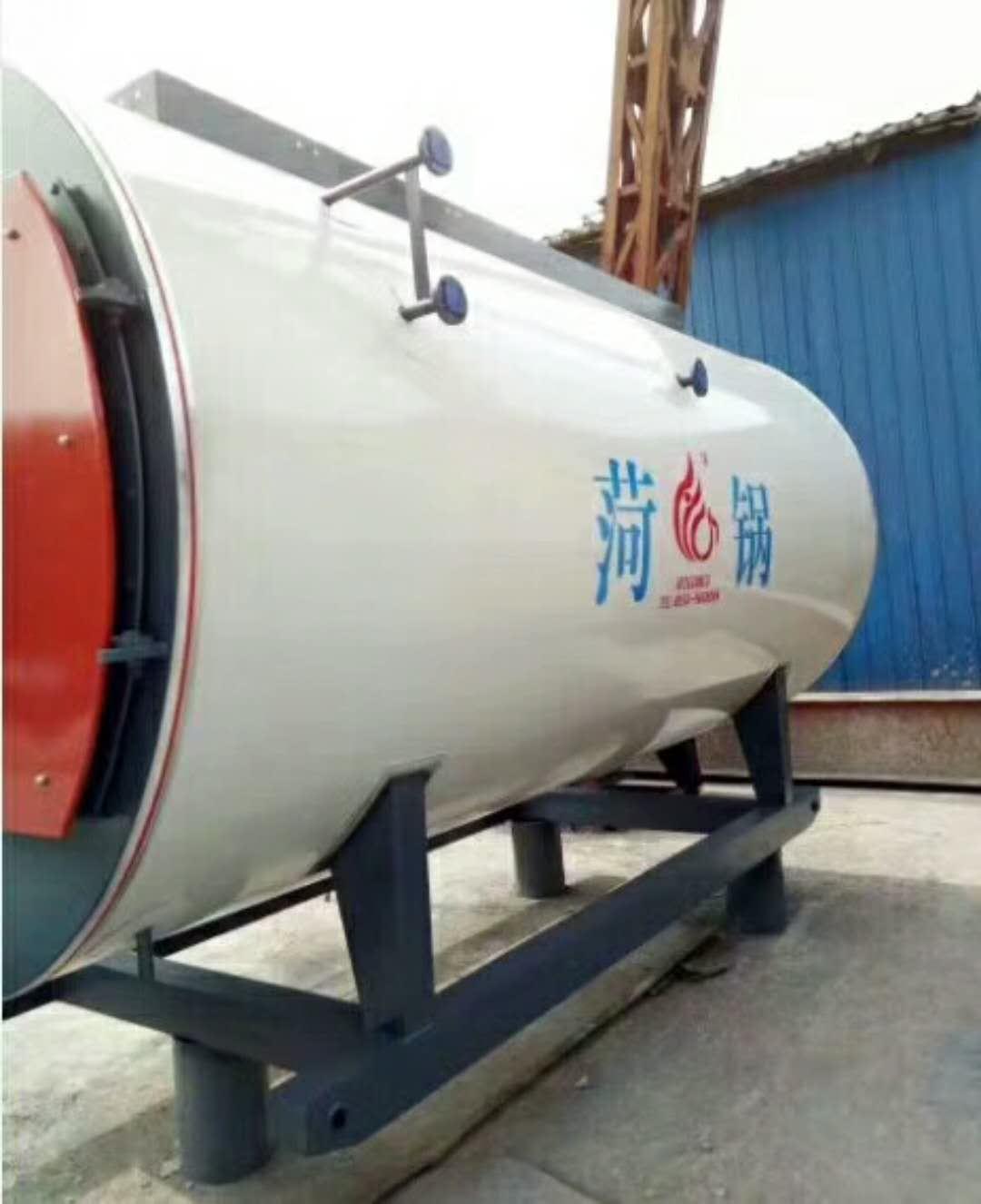
Professional Manufacturer of LNG Tank Models - Renowned LNG Tank Fabrication Factory - Specialized LNG Tank Wholesale - Supply LNG Tank Models



















