

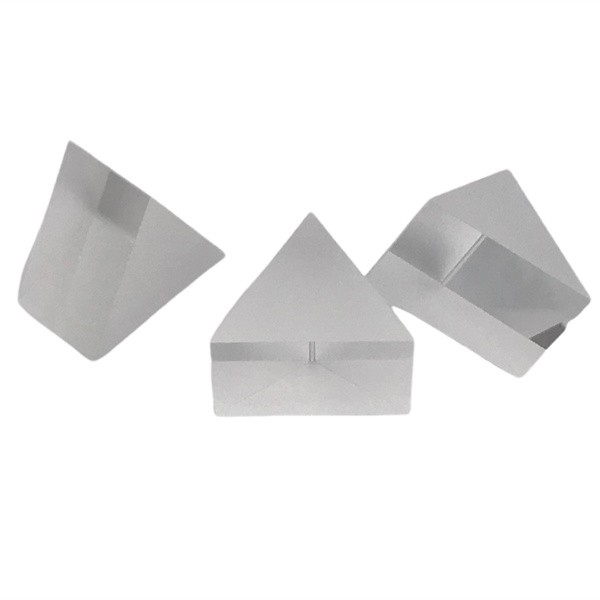





Spectroscopic slabs (or prisms) are core components in optical systems, their working principle can be summarized into the following key points:12
I. Basic Optical Phenomena
- Reflection and Transmission
- When incident light encounters the surface of a spectroscopic film, part of the light is reflected and the other part transmitted. The ratio of this split is determined by the surface coating characteristics, for instance, a neutral spectroscopic film can achieve 50% reflection and 50% transmission without selectivity to wavelengths.
- Interference and Multilayer Film Design
- Birefringent Spectral Filters - Achieve wavelength selectivity through the stacking of multiple dielectric films, utilizing the interference effect of light. For example, short-pass filters reflect short-wavelength light and transmit long-wavelength light, while long-pass filters do the opposite.
II. Core Categories and Characteristics
- Structure TypeFlat Plate Spectral FilterSimple structure, low cost, suitable for space-limited environments
- Cubic SpectrometerHigh stability, commonly used in precision optical systems
- Function TypePolarized Beam Splitter (PBS)Separate P-polarized light (transmitted) from S-polarized light (reflected)
- Non-polarized beam splitter (NPBS)Maintain the polarization state of the incident light, splitting only according to a fixed ratio.
- Bichromatic diffraction gratingSeparate light by wavelength (e.g., reflect red, transmit green, blue; transmit red, green, reflect blue, etc.)
III. Key Parameters
- Reflectance/TransmittanceLight energy distribution ratio at a specific wavelength
- Angle toleranceStability of performance with variations in the incident angle
- Bandwidth CharacteristicsNarrowband (high resolution) and Broadband (suitable for wide spectrum)
Section 4: Typical Applications
- Diffractive gratings are widely used in laser technology (beam control), excitation light separation, wavelength decomposition, and optical communication (signal routing) fields. Their low absorption characteristics make them indispensable in high-efficiency optical systems.