







Provide SIL certification, SIL grading, and other consulting services - Shenzhen Zhongnuo Testing Technology Co., Ltd.
SIL Certification Level Pre-Assessment Submission Document List
Product User Manual
2. Product Safety Feature List
3. Product Safety Manual
4. Failure Mode and Effects Analysis (FMEDA) Excel File
5. Quality Management System Certificate (ISO9001)
6. Product Photos (including front and side views of representative models)
7. Product Design Documents (drawings, material reports, calculations, etc.)
8. Additional Information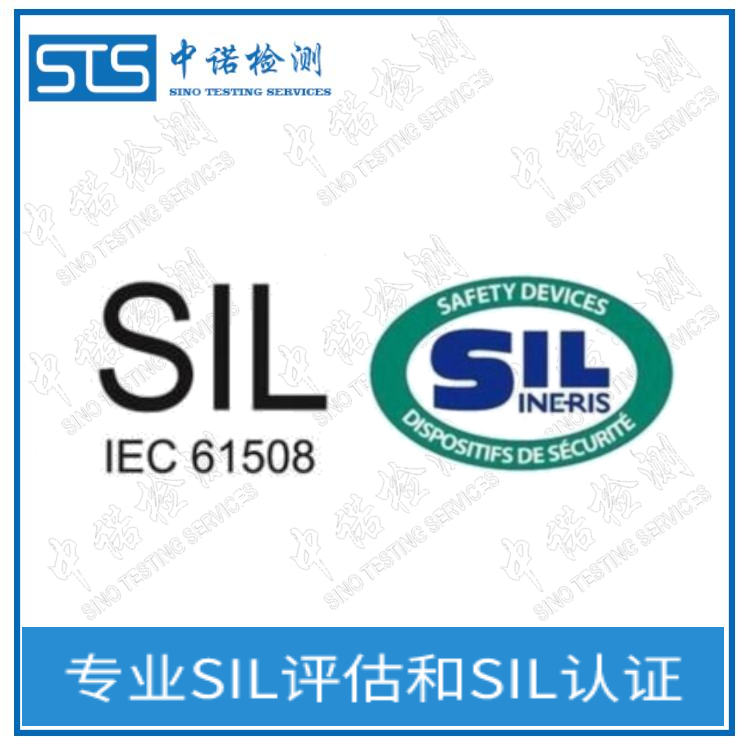
Safety Integrity Level (SIL), also known as SIL, is differentiated by the probability of dangerous failure occurring per hour.
There are four SIL levels defined in the international IEC standards, with SIL 4 indicating a high level of integrity and SIL 1 representing a low level. For each safety integrity level, specific design specifications are provided to reduce design errors.
The safety level required in the production process is assessed and determined by a specialized production technology company. Generally, for processes with high safety requirements, the required safety level is SIL 3.
The standard for SIL Safety Integrity Level certification primarily includes:
1. IEC61508 sets the fundamental safety requirements for both the operational and fault prediction capabilities of conventional systems. These requirements encompass general safety management systems, specific product design, and process design that meets safety requirements, aiming to prevent both systematic design failures and random hardware failures.
2. IEC61511 - A functional safety standard specifically for safety instrumented systems in the process industry, which is a domain standard released by the International Electrotechnical Commission (IEC) following the foundational functional safety standard IEC61508. In China, the coordinating standard for IEC61511 is GB/T 21109.
3. ISO 13849-1 - Comprehensive safety assessment from components to the entire system. Additionally, this standard provides designers with more quantifiable design implementation methods.
4. IEC62061 - Standard for the electrical system field.
5. IEC61326-3-2 – Specifies additional requirements for the electromagnetic interference immunity levels of safety-related equipment, including low-probability-of-occurrence end conditions at the site.
6. ISO 26262 – Primarily focused on specific electrical devices, electronic equipment, and programmable electronic devices within the automotive industry, these components are specially designed for automotive applications. They aim to enhance the functional safety of automotive electronics and electrical products.
The significance of obtaining SIL certification for products
1. The impact of SIL certification on the product:
We guarantee the accuracy of the product's specific functions.
(2) Enhances the industry acceptance and recognition of the product;
(3) Certified products offer enhanced safety, boosting the product's competitiveness.
(4) Customers typically believe: Certified = Acknowledged = The.
2. The cumulative impact of SIL certification on the enterprise:
Enhance corporate safety experience and proficiency.
(3) The corporate R&D process is more standardized and verifiable.
(4) Enhanced safety guarantees are in place when injuries occur.
(5) Throughout the certification process, ensure the company maintains a high level of R&D.
If a project, system, or product receives SIL certification, its quality and safety are also recognized, enhancing the company's market competitiveness while greatly bolstering customer confidence in the product. Therefore, SIL certification is necessary for a product that significantly impacts life and property safety.
SIL certification is a third-party assessment, verification, and certification based on standards such as IEC 61508 (GB/T 20438), IEC 61511 (GB/T 21109), IEC 61513, IEC 13849-1, IEC 62061, and IEC 61800-5-2, which evaluate and confirm the Safety Integrity Level (SIL) or Performance Level (PL) of safety equipment. Functional safety certification primarily involves document management (FSM) assessment for the development process of safety equipment, hardware reliability calculation and evaluation, software evaluation, environmental testing, and EMC electromagnetic compatibility testing. SIL certification is divided into four levels: SIL1, SIL2, SIL3, and SIL4, covering both product and system levels, with SIL4 being the most stringent.
WeChat Official Account

Scan to follow Official Account