

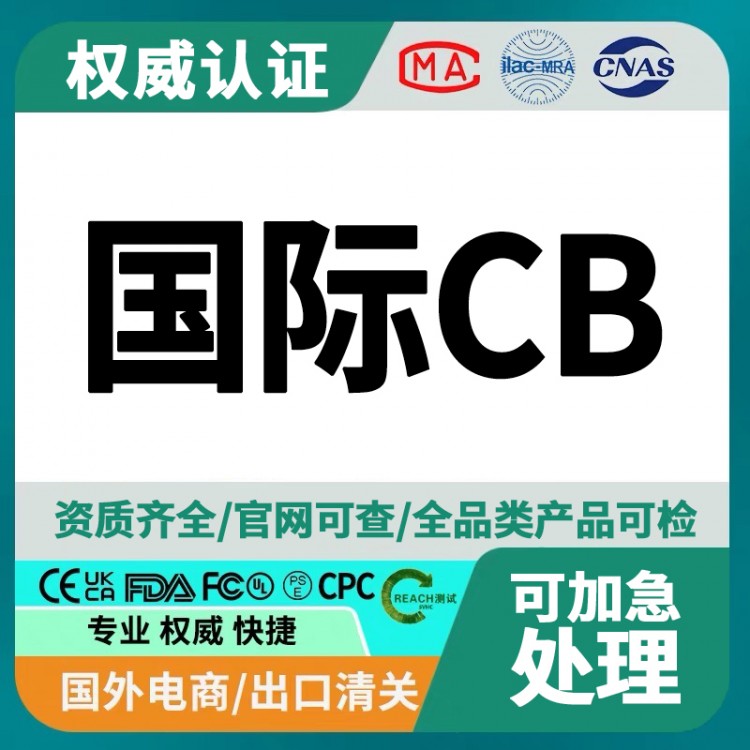








InternationalCBCertification Details
Part 1:Definition and Background
DefinitionInternationalCBCertificationCertification Bodies’ Scheme)isInternational Electrotechnical Commission (IEC) Electrical Product Compliance Testing and Certification OrganizationIECEE)Established a global certification system aimed at eliminating technical barriers in the international trade of electrical products through mutual recognition of test results among member countries.。
Background:
Originated1985Year, previously of EuropeCEE(National Committee for the Qualification Testing of Electrical Equipment), later incorporated intoIECEE。
Covered53Member states (including China, the United States, the EU, etc., major economies), member state certification bodiesNCBBased onIECStandard product testing and certification。
Section IICore Features
International Recognition:
CBTest reports and certificates are universally accepted across all member states, eliminating the need for redundant testing.。
Members may base onCBCertificates quickly converted to local certifications (e.g., EU)CECertification。
Standard Uniform:
Please provide the Chinese content you would like translated into American English.IECInternational StandardsBased on the standard, covering requirements for product safety, performance, and compatibility。
Members are allowed to have certain national differences (to be declared in advance)。
Broad scope:
Inclusive14Category180A variety of electrical products, such as wires, cables, household appliances, lighting equipment, and information technology devices.。
III.Certification Process
Application Preparation:
Submit technical documents (product specifications, circuit diagrams, material lists, etc.) toIECEEApprovedNCB。
Sample Testing:
Safety performance tests (such as electrical safety, mechanical structure) completed by the lab。
Reports and Certificates:
Lab IssuedCBTest ReportNCBIssued after reviewCBCertificate(No fixed expiration limit)。
Multi-Country Certification:
Please provide the Chinese content to be translated.CBCertificate to destination countryNCBApply for local certifications (e.g., Saudi)SABERKoreaKC)。
FourApplicable Product Range
Mandatory Certification Categories:
Appliances: Refrigerators, Air Conditioners, Electric Fans, etc.。
Electronics: Mobile accessories, computers,LEDLuminaries。
Industrial Equipment: Transformers, Capacitors, Power Cables。
Special Requirements:
Export to Saudi Arabia is mandatory.CBCertified products include phone accessories, dishwashers, water pumps, etc.。
FiveMember states and mutual recognition mechanisms
Key member countries:
Region Representing the Nation
Asia China, Japan, South Korea, India, Saudi Arabia
Europe Germany, France, Italy, Russia
America USA, Canada, Brazil, Mexico
Oceania Australia, New Zealand
Reciprocal Rules:
If the target country has no additional testing requirements, acceptance is direct.CBCertificate。
Supplement testing for country-specific differences (e.g., EU)EMCInstruction), only local inspection required。
Six.Certification Advantages
Reduce trade costs:
One test covers multiple international markets, reducing redundant certification costs.。
Shorten the time to market:
The certification cycle typically lasts4-6ZhouFaster than traditional multi-country phased certification。
Enhanced market trust:
ThroughCBCertified products are deemed to meet international safety standards, enhancing brand competitiveness.。
Section 7:Relationship with Other Certifications
WithCECertification:
CBCertification covers only safety requirements (such as)LVDInstructions), additional testing requiredEMCWait for instructions to proceedCELogo。
WithSABERCertification:
Saudi Arabia requires prior certification for certain products.CBCertification required for registrationSABERSystem。
ThroughCBCertification enables businesses to efficiently break through international trade barriers and achieve product“One test, global acceptance”。