









I. Definition and Implementing Organizations
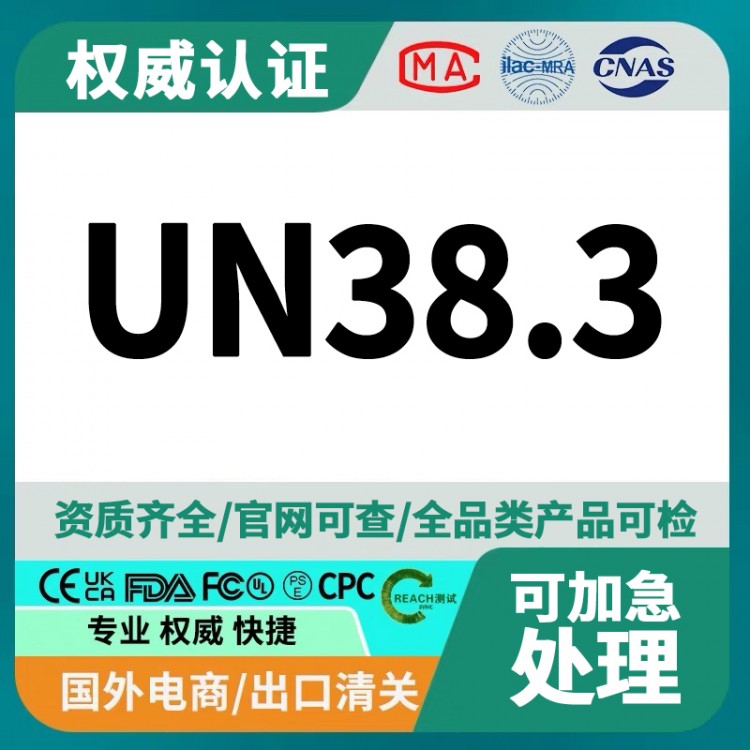
UN38.3Is the "Manual of Tests and Standards" of the United Nations38.3Section Abbreviation, established by the United Nations Sub-Committee of Experts on the Transport of Dangerous Goods, specifying safety testing requirements for lithium batteries in aviation, maritime, and land transport.The standard has been2003Yearly enforcement begins, the new version is the 7th revised edition.1。
Section II: Certification Purpose
Transport Security AssuranceBy simulating extreme transportation conditions (such as high and low temperatures, vibration, and impact), ensure that lithium batteries do not leak, catch fire, or explode during transportation.。
International regulatory compliance: Meets IATA (International Air Transport Association)IATAInternational Civil Aviation Organization (ICAO)ICAOMandatory requirements for air transportation in various countries。
Risk Prevention and ControlReduce transportation accidents caused by battery defects and safeguard personnel and property safety。
Section 3: Applicable Scope
Covering the following battery types:
Lithium Metal BatteryIncluding button cells, power batteries, etc.。
Lithium-ion batteryBattery for devices such as smartphones, laptops, drones, etc.。
Special Purpose BatteriesPowertrain batteries, energy storage batteries, and medical equipment配套batteries。
IV. Core Testing Items
UN38.3Total includes8Item mandatory test:
T1High-fidelity simulation testIn11.6kPaLow-pressure and20±5℃Continuous in the environment6Hourly, verify battery sealing and structural stability。
T2Temperature Cycle TestOn-40℃Please provide the Chinese content to be translated.72℃Between the parties10This cycle, test the battery's tolerance to extreme temperature differences.。
T3Vibration TestSimulate transportation bumps, via7Hz-200HzLog-s扫频 vibration, continuous3hour。
T4Impact TestApply150g/6msOr50g/11msHalf-sine impact, testing the battery's resistance to mechanical shock。
T5External short-circuit testAt55±2℃Short-circuit the battery under controlled conditions until the temperature stabilizes.1Hourly, ensure no thermal runaway。
T6Impact/Compression TestThrough9.1kgHeavy goods61cmDrop Impact, Evaluate Battery's Resistance to Physical Damage。
T7Overcharge TestPlease provide the Chinese content you would like translated into American English.2Twice the charging current and voltage retention24Hour, tested overcharge protection mechanism。
T8Forced Discharge TestSeries12VPower source forced discharge, verify battery safety protection function。
V. Certification Process
Application and Submission of DocumentsPlease fill out the application form and provide the battery specifications, samples (with voltage, capacity, and watt-hour value marked).。
Laboratory Testing: ByCNASThe recognized lab has completed all tests and issued the report.。
Review and CertificationIssued upon approvalUN38.3Test Report and Transport Certificate。
Packaging and ShippingMeets packaging requirements (such as anti-short-circuit design)1.2Milling drop test completed; transport permitted.。
Six, Required Materials
Application Form (including model, voltage, capacity, etc. parameters)。
Battery specification sheet and samples (consistent with shipment product)。
Transportation Packaging Design Files (if to be shipped separately)。
Section 7: Cautionary Notes
Packaging Requirements:
Batteries without installed equipment must be packaged separately to prevent short circuits, and the outer packaging must pass1.2Millet Drop Test。
Over24A single cell12Each battery package must be labeled with warning information and include random documents.。
File integrityLack of test reports or certificates will result in air freight refusal.。
Standard UpdatePlease regularly check for updated versions of the "Manual of Tests and Standards" to avoid using expired standards.。
ThroughUN38.3Certified lithium batteries are permitted for air transportation and significantly reduce trade barriers in international trade.。