
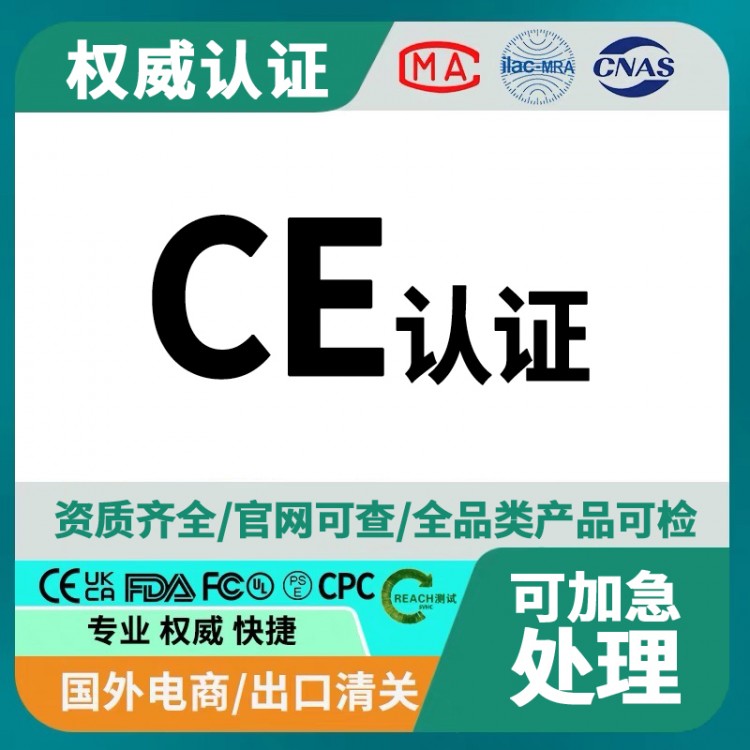









CE certification is a mandatory certification for products entering the EU market, indicating that the product complies with relevant EU regulations and standards. Below is the process and required documents for obtaining CE certification:
I. CE Certification Application Process
Identify applicable directives and standards for the product
Determine the applicable EU directives (such as the Low Voltage Directive, Electromagnetic Compatibility Directive, and Machinery Directive, etc.) and harmonized standards based on the type of product.
2. Select a Certification Body
Select a qualified Notified Body for certification based on the type of product. Some products can be self-declared, without the need for third-party involvement.
3. Product Testing
In accordance with relevant instructions and standards, products are subject to testing (such as electrical safety, electromagnetic compatibility, etc.). Tests can be conducted in our own laboratory or at a third-party laboratory.
4. Technical Documentation Preparation
Prepare technical documents (Technical docu)Documentation, including product design, test reports, and risk assessments.
5. Write a Compliance Declaration (DoC)
Manufacturer or authorized representative signs a conformity declaration, stating that the product complies with relevant EU regulations.
6. Apply CE Mark
Apply the CE mark to the product to indicate compliance with EU requirements.
7. Market Surveillance
Once the product enters the EU market, it must undergo inspections by the market supervision authorities to ensure ongoing compliance.
Section 2: Documents Required for CE Certification
Company Profile
Company Name, Address, Contact Information.
Authorization Representative Information (if applicable).
2. Product Information
Product Name, Model, Specifications.
Product manual (including usage instructions, warning information, etc.).
Product photos or drawings.
3. Technical Documents
Product design drawings, circuit diagrams, structural diagrams, etc.
Bill of Materials (BOM)
Test reports (such as electrical safety, EMC testing, etc.).
Risk Assessment Report (if applicable).
User Manual (including installation, operation, and maintenance instructions).
4. Compliance Declaration (DoC)
Compliance Declaration signed by the manufacturer or authorized representative.
5. Additional Information
Product labels (including CE mark).
Quality Management System documentation (e.g., ISO 9001 certificate, as applicable).
Other relevant certificates or test reports.
III. Cautionary Notes
Product Categories
Different products have different regulations and standards applicable, so the specific process needs to be determined based on the type of product.
2. Self-Declaration and Third-Party Certification
Some products can be self-declared, but high-risk products (such as medical devices, pressure equipment, etc.) require certification by a third-party agency.
3. Technical Document Storage
Technical documents must be retained for at least 10 years for potential review by regulatory authorities.
4. CE Marking Requirements
The CE mark must be clearly and durably affixed to the product or packaging, and the size must comply with regulations.
By following this process and preparing the necessary documents, the company can successfully complete the CE certification, ensuring the product is legally allowed entry into the EU market.
WeChat Official Account

Scan to follow Official Account