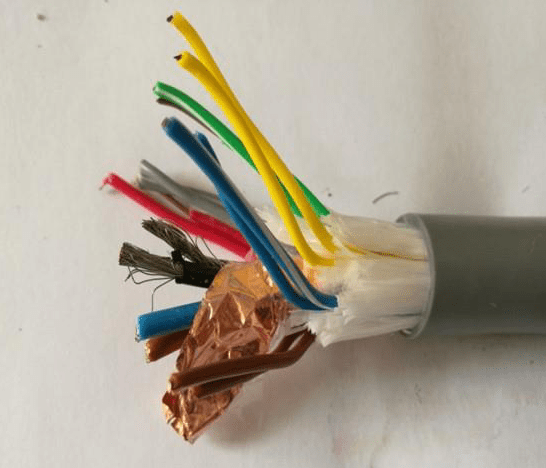

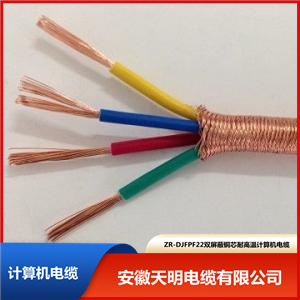













Anhui Tianming Cable Co., Ltd. offers computer cables, which are multi-core flexible wires or cables specifically designed for transmitting data and electrical power, commonly used to connect computers with external devices. Flame-retardant computer cables are enhanced with a fire-resistant layer, ensuring stable and secure data transmission during fires. High-temperature computer cables are mainly used for data transmission in high-temperature environments, featuring higher temperature resistance and suitable for applications in extreme heat and harsh climates. Flame-retardant computer cables can quickly cut off flames and prevent their spread, effectively reducing fire risks. These computer cables cater to various usage needs, with specific selection depending on the actual application scenario and safety standards. Computer cables are cables designed for transmitting data and energy, including computer control cables, signal cables, and shielded cables. Flame-retardant computer cables are upgraded with a fire-resistant layer, improving the cable's flame-retardant properties. High-temperature computer cables use high-temperature-resistant materials, enhancing the cable's ability to withstand heat. Flame-retardant computer cables incorporate flame-retardant additives, improving the cable's flame-retardant performance.
ZRA: Indicates flame-retardant type A, meaning the cable has flame-retardant properties and can to some extent prevent the spread of fire.
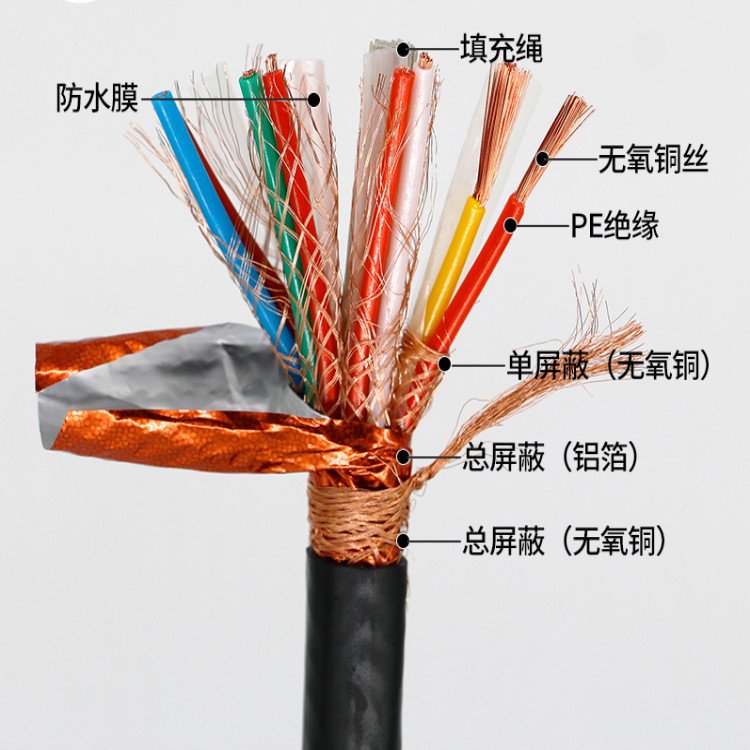
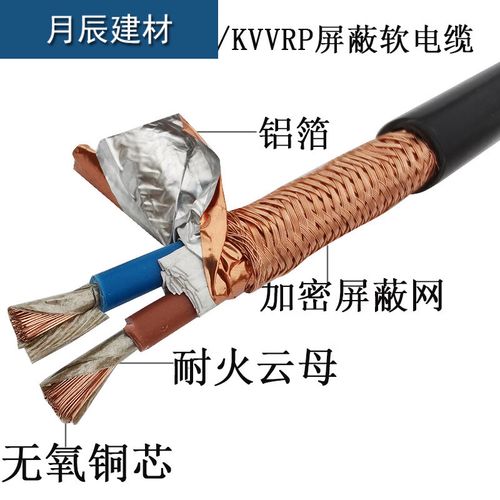
DJYPVP: Represents a flame-retardant cable for electronic computers, with a woven shielded poly-insulated copper wire and a total shielded poly sheath. In this abbreviation, "D" stands for cable, "J" for cross-linked (though more commonly used to describe a polymer processing technique, here it is generally understood as a general term for insulation material), "Y" for poly-insulation, "P" for shielding (with each "P" representing partial and total shielding), and "V" for poly sheath.
II. Structural Features
Conductor: Typically made of oxygen-free copper, offering excellent electrical conductivity.
Insulation layer: Made of polymer materials, offering excellent insulation properties and resistance to aging.
Shielding Layer: Consists of two layers, partial shielding and total shielding, both woven with copper wire, effectively resisting external electromagnetic interference and ensuring stable signal transmission.
Housings: Made of poly materials, featuring flame-retardant, corrosion-resistant, and wear-resistant properties.
Section 3: Technical Specifications
Rated Voltage: Typically 300/500V or 450/750V, determining the voltage range the cable can safely carry.
Operating Temperature: Generally not exceeding 70°C, some models may reach higher operating temperatures (e.g., models with a 105 suffix).
Bend Radius: Unarmored cables should not be less than 6 times (or 10 times, depending on different standards) the cable's outer diameter; armored cables should not be less than 12 times the cable's outer diameter.
Installation Environment Temperature: The ambient temperature during cable installation should not be below 0°C, otherwise it may cause damage to the cable.
Computer Cables - Flame Retardant Computer Cables - High Temperature Computer Cables - Fireproof Computer Cables