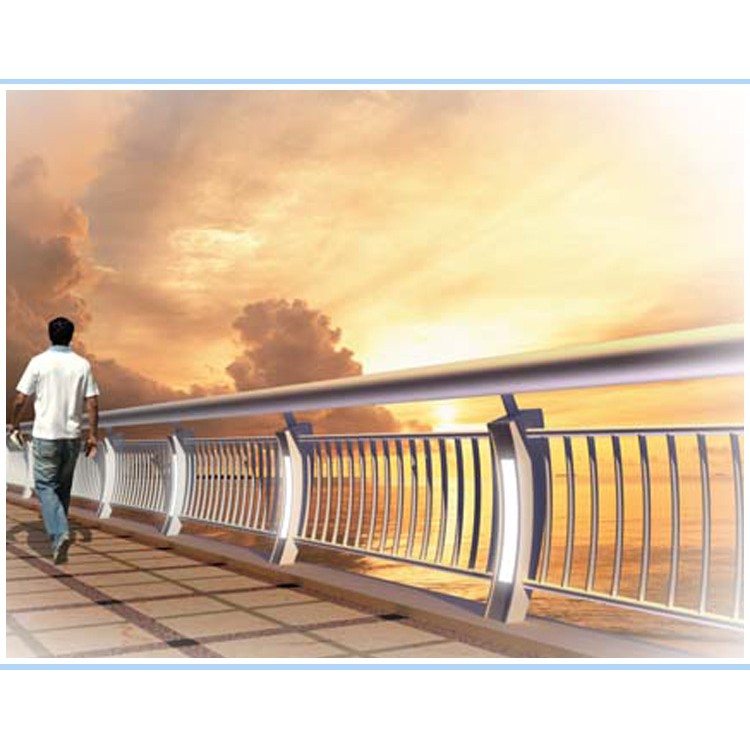











Customized bridge railing composite tube railing river barrier safety railing bridge railing collision barrier Welcome to call for consultation


Bridge guardrails refer to the barriers installed on bridges. Their purpose is to prevent out-of-control vehicles from crossing over the bridge, ensuring that vehicles cannot break through, pass under, or climb over the bridge, while also enhancing the aesthetics of the bridge architecture.
There are numerous methods to classify bridge guardrails, including categorization by installation location, construction features, and collision resistance performance. By installation location, they can be divided into bridge-side guardrails, central reservation guardrails, and pedestrian/laneway divider guardrails. By construction features, they can be categorized as beam-column guardrails (made of metal and concrete), reinforced concrete wall-type widened guardrails, and composite guardrails. By collision resistance performance, they can be classified as rigid guardrails, semi-rigid guardrails, and flexible guardrails. Common guardrail types include concrete guardrails, steel beam guardrails, and cable guardrails.
Bridge Guardrail Construction: Issues to Note [2]
1. When constructing guardrails, it's crucial to accurately obtain information on various facilities, especially the precise locations of pipelines embedded in the subgrade. Any damage to underground facilities during construction is strictly prohibited. If underground communication pipelines, drainage pipes, or insufficient fill depth over culvert caps are encountered, adjust the column positions or alter the column fixing methods.
2. If a pillar is driven too deep, do not pull it out to correct it. Instead, remove all the pillars, recompact their foundations, and then drive them in again, or adjust the position of the pillar.
3. Bridge guardrails should be installed with flanges, paying attention to the positioning of the flanges and the control of the top elevation of the posts.