












Operating Principle and Key Features
2. 1 Principle of Operation
The blow-off level gauge is mainly composed of three parts: the blow-off unit, a differential pressure (pressure) transmitter, and the blow-off pipeline. Single-line blow-off units are suitable for measuring the level of atmospheric or open-top containers, while dual-line blow-off units are used for measuring the level of pressurized containers.
The working principle of the blow-off level gauge is shown in Figure 2.1.

2.1 Operating Principle of the Blowing Type Level Gauge
After filtering and减压, the gas enters the blow-off device, where it is steadily blown out through the blow-off pipe, forming bubbles at the end of the blow-off pipe inserted into the medium being measured. Due to the very small gas flow from the blow-off pipe, the gas pressure at point A (PA) is equal to the pressure of the liquid medium, the gas pressure at point B (PB) is equal to PA plus the pressure difference DPAB between points A and B, and the gas pressure at point D (PD) is equal to the gas pressure at point C (PC) plus the pressure difference DPCD between points C and D. The liquid level height h of the container can be obtained by measuring the differential pressure DPBD between points B and D with a differential pressure transmitter.
PA-rgh=PC,
PB = PA + DPAB, which can be deduced to:
PB=PC+DPAB+rgh,
PD=PC+DPCD,
DPBD = rgh + DPAB - DPCD, where r is the liquid density, g is the local gravitational acceleration.
The pressure difference between AB and CD is related to the pipeline distance between AB and flow rate. When designing to take the pressure, try to minimize the distance between AB.
The distance and flow rate to CD are consistent, thus DPAB = DPCD. Therefore, DPBD = rgh. By measuring DPBD, the liquid level height h inside the container can be calculated.
The blow-through level gauge can be understood as a non-contact liquid level measuring instrument, capable of measuring the liquid in open or closed containers. Apart from the blow tube coming into contact with the medium being measured, the blow-through device and the differential pressure (pressure) transmitter measuring elements do not come into contact with the medium, thereby protecting the measuring elements, reducing the maintenance of the instrument, and increasing the reliability of the measurement. Since the blow-through device ensures a constant flow of gas output, the pressure measured by the differential pressure (pressure) transmitter can automatically follow the change in the blow tube outlet pressure, so the signal output by the differential pressure (pressure) transmitter is correlated with the height of the medium's liquid level.
Bubbler level gauges are not only suitable for measuring the level of clean liquids but are particularly ideal for corrosive acidic, alkaline, and saline liquids, liquids with high viscosity, crystalline liquids, high temperatures, and liquids containing solid particles, as well as for measuring the level of fluidized bed materials.
2.2 Key Features
The liquid level measurement system composed of blow-off devices has no moving parts, with the exception of the blow-off pipe, the other measuring elements do not come into contact with the medium being measured.
Single-table installation, panel installation available with single, dual, or multi-channel configurations.
Compact and sturdy, integrating the main components required for measurement on a single panel for easy installation and maintenance.
All-mechanical structure, excellent sealing, low failure rate, minimal maintenance required.
3 Key Technical Parameters
Measurement Accuracy: ±0.5% F.S.
Measurement Range: 0-250 kPa, corresponding to a water level height of 25 meters.
Response Time: 0.5 seconds.
Pipe Length: 25 m.
Pipe material: 304S.S., 316S.S., 316LS.S., PVC.
Process connection flange standard: HG/T 20592-2009, dual: DN80 PN40; single: DN25 PN40.
Structural Styles: Single Table Installation, Single-Lane Panel Installation, Double-Lane Panel Installation.
Gas Source Pressure: £0.8 MPa.
Power Supply: 24V DC.
¡ Analog Signal Output: 2-wire 4-20 mA DC or 2-wire 4-20 mA DC + HART communication protocol.
4 Dimensional Drawing
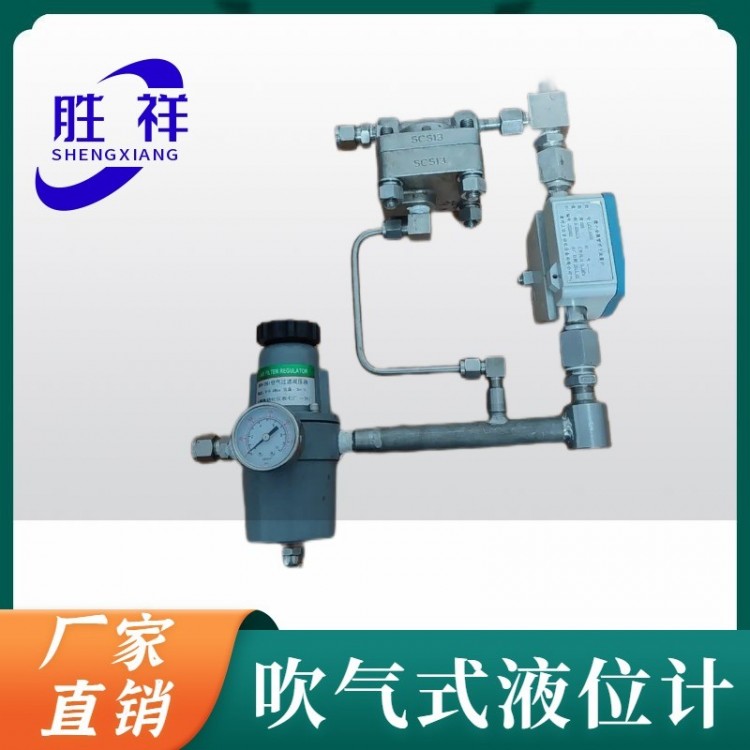
4.1 Dimensions Drawing of Single Table Blowing Device Installation

Image:
1. Filter Pressure Relief Valves, 2. Pressure Gauges, 3. Pressure Regulators, 4. Flow Meters, 5. Flow Control Valves.
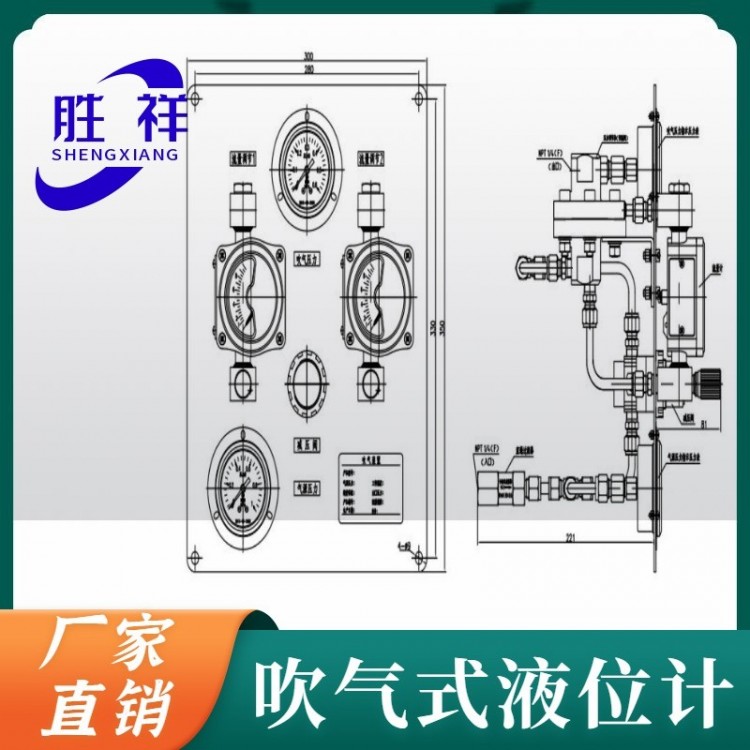
4.2 Panel Installation Single Blowing Device Outline Dimensions Diagram

Image: 1 NPT1/4-M20x1.5 Adaptor, 2 Nuts, 3 PTFE Washer, 4 Welding Short Pipe

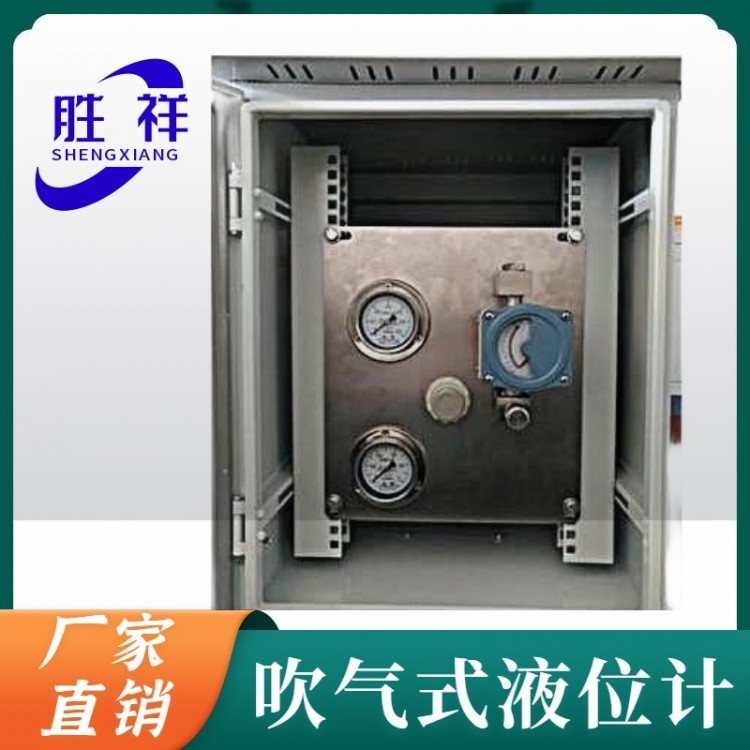
Image:
1. Inlet shut-off valve: Open or close the blow air source.
2 Gas Source Pressure Indicator Gauge: Gas Source Pressure Indication.
3 Pressure Regulator: Increase or decrease blowing pressure.
4 Airflow Adjustment: Adjust the size of the blowing airflow.
5 Blow Molding Pressure Gauge: Pressure indicator after pressure reducing valve.
6. Export shut-off valve: Controls the gas flow to the blowing tube, opening or closing it.