














The two-way swing cover diverter valve meets the requirements of conveying equipment to redirect powders, debris, or granules from one unloading point to another, featuring low pressure drop and high sealing efficiency.
Description
The Flip Disc Valve uses a movable flip disc to transfer material from one pipeline to another. The Flip Disc Divert Valve is installed in air conveying pipelines where material needs to be switched to different production lines. Briefly: The Bi-directional Swing Cover Divert Valve meets the requirements of pneumatic conveying equipment to redirect powders, chips, or granules from one discharge point to another, featuring low pressure drop and high sealing efficiency.
Feature
Bi-directional flip gate分流阀, designed specifically to meet the requirements of the wind conveying industry, capable of redistributing powdered, spherical, or granular materials from one discharge point to another with minimal pressure drop and a sealed manner. Product features:
Shell Material: Aluminum Casting Alloy
Roller Door Seals: - EPDM - Metal Plate: 304 Stainless Steel - Operating Temperature: -20~80℃ - Operating Pressure: +2.0bar and -0.3bar - Diameter Range: 50mm, 65mm, 80mm, 100mm, 125mm, 150mm, 200mm
Driver:
Pneumatic actuator + Limit switch (for indicating switch position of model). - Power voltage: 24 V AC, 110 V AC, 230 V AC, 24 V DC; Electric actuator - Power voltage: 230/400 V AC 50/60 Hz; Manual actuator CM4 - Manual operation:
Convenient for use as a diverter valve or directional valve
Small steering angle of 22.5°
Low转向impact, significant pressure drop not observed
Smooth inner surface (no material spots)
Modular design with fewer components, easy to maintain
Lightweight and compact structure
Quickly connect components through DIN flanges.
Utilizing food-grade certified materials, free of contamination.
Three-way directional valves, three-way directional switches, and three-way branch valves are devices used in solid material (powder, granular material, powder-granule blends, sheet material) conveying systems to switch the flow direction of material in the pipeline. The three channels of the three-way directional valve are arranged at an angle, featuring one inlet and two outlets or two inlets and one outlet. The actuation of the valve core is controlled by the switching of an electromagnetic valve to drive the pneumatic actuator. The two positions of the valve core are detected by limit switches, which are directly mounted on the pneumatic actuator. During normal operation, the valve core rotates to one position. Upon receiving a directional change command, it rotates to another position, completing the directional change action.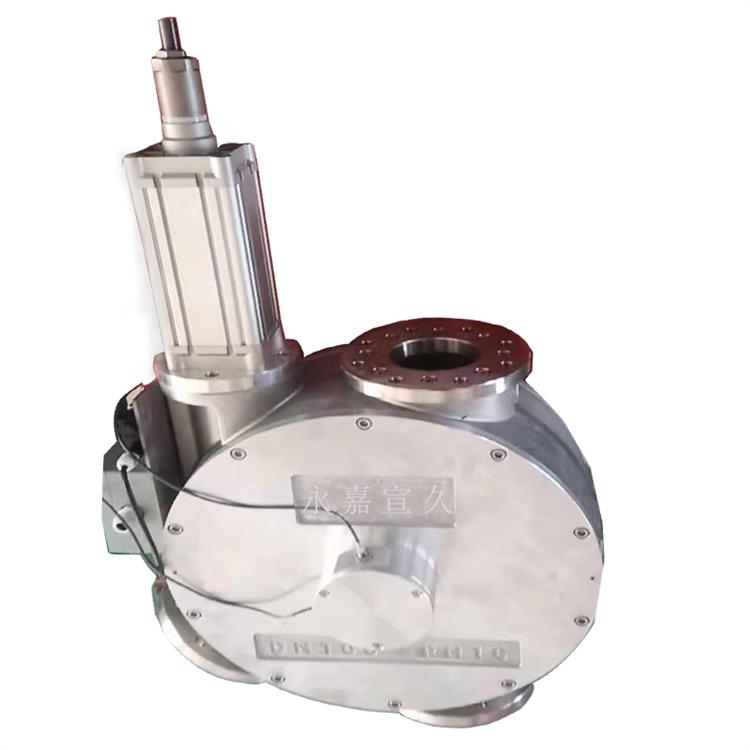
WeChat Official Account

Scan to follow Official Account

















