






Structure and Features of Pneumatic Three-way Ball Valve:
1. Compact structure, quick opening and closing, smooth flow path, and low fluid resistance.
2. Excellent sealing performance: Achieves leak-proof sealing through the use of tetra elastic deformation material in the four-way valve seat.
3. Multi-functional Valve: Any port can be used without leakage; the three-way valve can be made into an L-shaped port or a T-shaped port.
4. Easy Maintenance: Inspection and repair can be performed without removing the entire valve body after the system is depressurized.
5. Suitable for pipeline systems in water supply, petrochemical, metallurgy, mining, light industry, energy, papermaking, food, and steel industries, where medium flow direction switching,分流, or fluid mixing is required.
6. Low fluid resistance; its drag coefficient is equal to that of a pipe section of the same length.
7. Simple structure, compact, and lightweight.
8. Tight and reliable, plastic is widely used as the sealing material for ball valves, offering good sealing properties, and has also been extensively applied in vacuum systems.
9. Easy to operate, with quick opening and closing; it takes just a 90-degree rotation from fully open to fully closed, making it convenient for long-distance control. 10. Easy to maintain; the ball valve structure is simple, and the sealing rings are generally mobile, making disassembly and replacement straightforward.
11. When fully open or closed, the sealing surfaces of the ball and valve seat are isolated from the medium. Erosion of the pneumatic three-way ball valve sealing surface occurs when the medium passes through.
12. Wide application range, from a few millimeters to several meters in diameter, suitable for high vacuum pressure as well.
13. The three-way ball valve features an integrated structure, a sealing type with four valve seats, minimal flange connections, high reliability, and a lightweight design.
14. Ball valves are divided into two types based on their actuation: single-acting and double-acting. The characteristic of the single-acting type is that the valve will remain in the state required by the control system in case of a power source failure.
Why are pneumatic three-way ball valves highly reliable?
(1) A pair of spherical and valve seat sealing components suffer from abrasion and rapid wear, which can get stuck during operation (especially without lubricant). Therefore, they can be reliably used in corrosive media and low-boiling point liquids.
(2) Integrated valve stem structure eliminates the potential accident隐患 of the valve stem being ejected due to the loosening of the packing cover under the action of fluid pressure.
(3) Static dissipative, fire-resistant pneumatic three-way ball valves are used for pipelines transporting oil and gas.
(4) The valve body channels are smooth and even, making them more suitable for conveying viscous fluids, slurry, and solid particles.
(5) Due to its resistance to jamming during operation (especially without lubricant), it can be reliably used in environments with corrosive media and low-boiling point liquids.
(6) The spherical closure can automatically locate in position and withstand high pressure differentials during closure.
(7) Achieves complete bidirectional sealing over a wide range of pressures and temperatures.
(8) During full open and full close, the sealing surfaces of the sphere and valve seat are isolated from the medium, thus the erosion of the sealing surfaces is caused by the high-speed medium passing through the valve.
(9) The pneumatic three-way ball valve features a compact structure and light weight, making it a reasonable valve design for low-temperature medium systems.
(10) The valve body is symmetrical, especially in the case of welded valve body structures, allowing it to effectively withstand stresses from the pipeline.
(11) Full-welded body pneumatic three-way ball valve, suitable for direct burial underground, protecting the valve internals from erosion, with a long service life of up to 30 years, used for oil and gas pipeline valves.
Pneumatic three-way ball valve stem anti-leakage design
1. The valve rod features a blow-out prevention design.
2. Stage-sealed, the conical valve stem seal effectively prevents leakage of the medium during the rotation of the valve stem, and also effectively prevents leakage under abnormal overpressure conditions.
3. Stage sealing, where a set of V-shaped packing combinations expand to the sides upon compression, effectively preventing leakage.
4. Automatically compensates for the wear of the packing and valve stem seal by releasing the pre-tensioned compression force of the disc spring.
5. The pneumatic three-way ball valve utilizes a valve stem nut to tighten the entire valve stem sealing system, preventing leakage.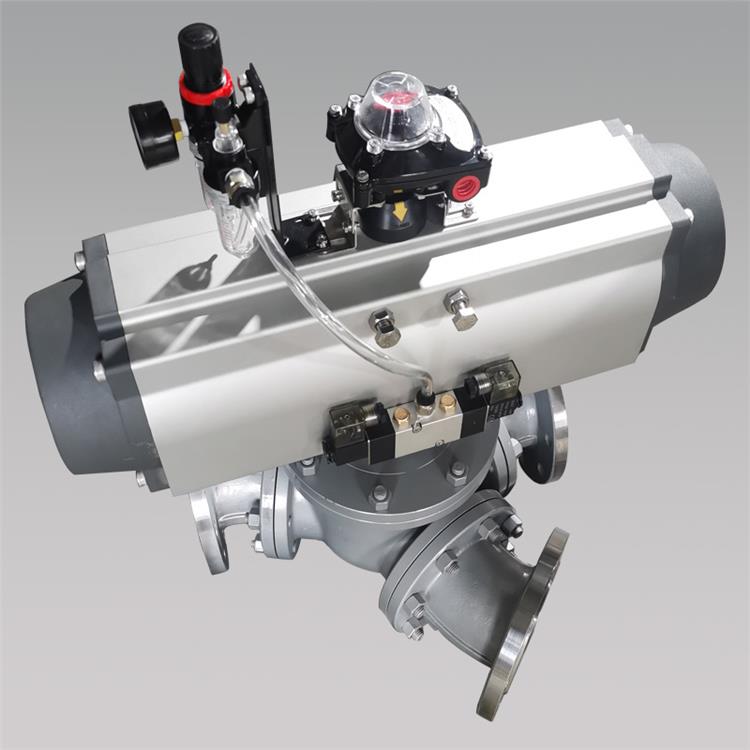
WeChat Official Account

Scan to follow Official Account