














Product Name: Three-way Directional Valve (Also Known as Three-way Branching Valve, Three-way Directional Converter)
Work Pressure: Atmospheric/low pressure ATM/LP ATM < 0.1 Mpa
Medium Pressure MP 0.15~0.35 Mpa
High Pressure HP HP > 0.35 MPa
Operating Temperature: -20℃ to 200℃ / ≤500℃
Structure Forms: Rotating Plate Type, Cylinder Type
Pipe fitting angles: 30°, 30°, 45°, 45°
Main Specifications: DN50~600 (2"~24")
Applicable Operating Conditions: Gravity Discharge Directional Change, Pneumatic Conveying Pipeline Directional Change
Drive Method: Manual, Pneumatic
Main Materials: SS304, SS304L, SS316, SS316L, WCB
Connection Method: Clamp Connection
Applicable Medium: Solid materials (powders, granular materials, powdered blends, sheets, etc.)
Features:
A is primarily made of stainless steel.
High polishing accuracy.
The system can be configured to meet user-specific needs, enabling full automation for increased operational efficiency.
The housing and main parts are all cast, featuring sturdy construction, high strength, resistance to deformation, and an aesthetically pleasing appearance.
The E conveyor channel is smooth and glossy, ensuring the material flows smoothly and preventing blockages.
In applications requiring pressure-sealed configurations, special sealing structures can be provided to meet usage requirements.
Customers can freely choose the appropriate installation orientation according to the requirements of the conveying pipeline.
Application: Equipment used in solid material (powder, granular material, powder-granule blend, sheet material) conveying systems to switch the direction of material flow within pipes. The three ports of the directional switch are arranged at an angle, allowing for one in and two out, or two in and one out configurations. The direction of the pneumatic actuator is controlled by switching the solenoid valve. The two positions of the valve core are detected by limit switches, which are directly mounted on the pneumatic actuator. During normal operation, the valve core rotates to one position. Upon receiving a directional command, it rotates to another position, completing the directional change.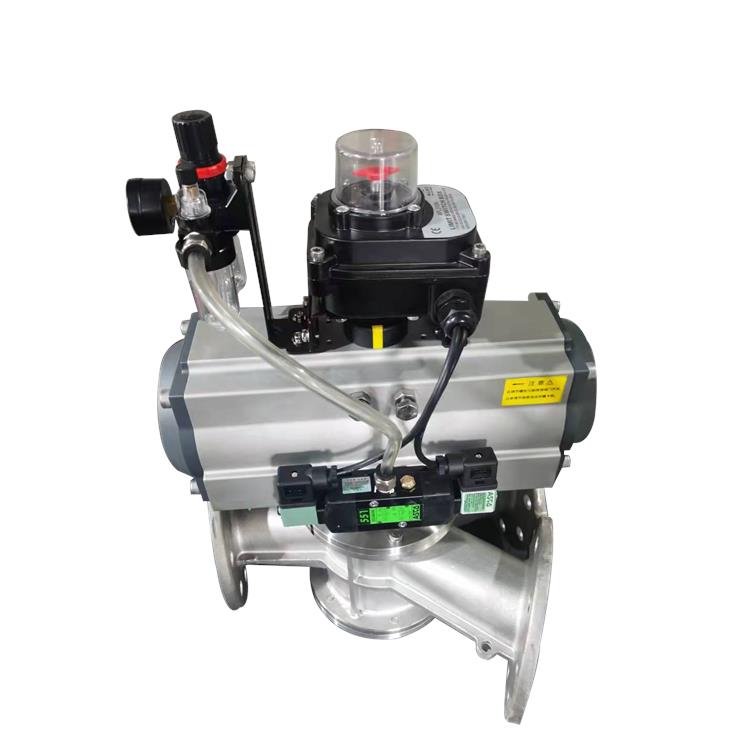
WeChat Official Account

Scan to follow Official Account

















