


















As industrial manufacturing companies increase their water production, the variety and functionality of equipment expand, and the level of automation grows as well. The equipment management level of industrial manufacturing companies, which produce mainly through equipment, will directly affect their production development. With the growing scale of company equipment, the proportion of equipment in the total amount of fixed assets also increases, thus the operational effectiveness of equipment management directly impacts the overall profitability of industrial manufacturing companies.
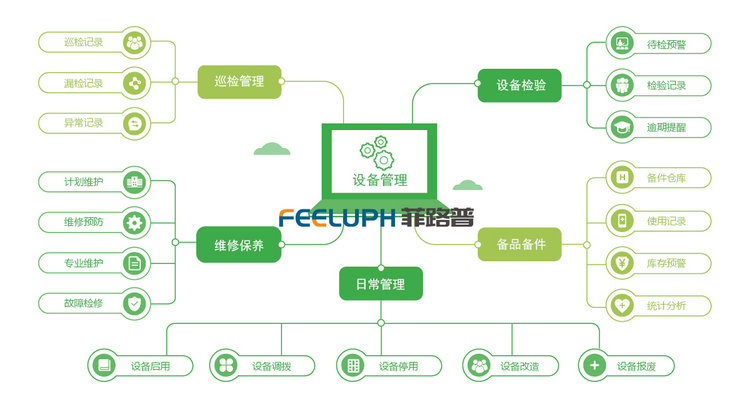
The Filup Equipment Information Management System, considering the overall business development of enterprises, integrates IT technology to offer professional equipment management solutions to various manufacturing companies. The system features centralized deployment, a multi-layered architecture, and customizable, flexible control. It seamlessly connects equipment档案 management, operation management, inspection management, procurement management, spare parts management, maintenance management, safety management, and accident management, helping enterprises reduce equipment management costs, improve efficiency in equipment management and utilization, and enhance their market competitiveness.
Equipment Card Management
Asset management of equipment displays the hierarchical structure of equipment by category and defines specific attributes of the asset files, such as specifications, models, management categories, design capacity, capacity units, equipment components, spare parts, equipment parameters, equipment documents, and equipment change records, etc., for maintenance of these data.
Equipment File Management
Manage equipment user manuals, maintenance manuals, technical documents, operation specifications, and management regulations, facilitating quick access for maintenance and administrative staff.
Equipment patrol inspection
Establish inspection standards, generate inspection schedules based on these standards, support on-site inspections with handheld devices (PDAs, check-in devices, tablets), and integrate with RFID technology to record the execution of inspections. It can alert or generate records for abnormal or potential issues, enhancing the on-site control capabilities of equipment inspection work.
Equipment Defect Management
Manage the entire process from maintenance planning, development of maintenance strategies, preparation of work orders, issuance, to acceptance; handle emergency equipment accidents.
Preventive Maintenance
Achieve functions such as application, approval, plan issuance, task reminders and push notifications, tracking for equipment maintenance and upkeep, automatically generate maintenance plans, and present them in graphical and tabular formats.
Maintenance Schedule
Based on the equipment operation records in the schedule and the maintenance staff's work logs, compile a plan for the overall maintenance and repair task schedule. Determine the repair workers based on the priority of tasks and the types of maintenance staff available.
Work Order Generation and Tracking
Plan, approve, execute, inspect, and report completion for personnel, spare parts, tools, work steps, progress, and track work order status for both auto-generated preventive and predictive maintenance orders and manually entered request orders.
Replacement Parts Management
Establish spare parts inventory, compile spare parts plans, manage daily inventory tasks (receiving, issuing, moving, inventorying, etc.), automatically generate procurement plans based on spare parts inventory levels or reorder points, and track the relationship between spare parts and equipment.
Cost of Repair Estimation
Based on information such as personnel time, materials used, tools, and services listed on the work order, compile the cost of maintenance and repair tasks, and perform an analysis and comparison of actual costs versus budgeted amounts.
Statistical Report
Search and analyze various information, including equipment's three ratios report, equipment maintenance cost report, equipment status report, equipment history report, spare parts inventory turnover rate, supplier analysis report, etc.