






Safety Instructions for Molding Temperature Controller:
1. Main power safety switch design, capable of emergency power cutoff under abnormal conditions.
2. Equipped with phase sequence protection, power short-circuit protection, level protection, electronic time delay, etc.
3. When the machine automatically detects an anomaly, the status indicator light illuminates to indicate the anomaly and an alarm is triggered.
China's research on mold temperature control machines started late, only beginning in the late 1970s, but progress has been rapid. Some products have caught up with international counterparts. The production materials can be divided into two main categories. One category uses petroleum products as raw materials, known as thermal oil. Due to the high specific heat capacity of oil and the availability of suitable fractions, resources are also abundant. Generally, naphthenic or aromatic mixed base raw materials are chosen and combined with antioxidant and heat-resistant additives to produce it. The other category is obtained from organic substances.

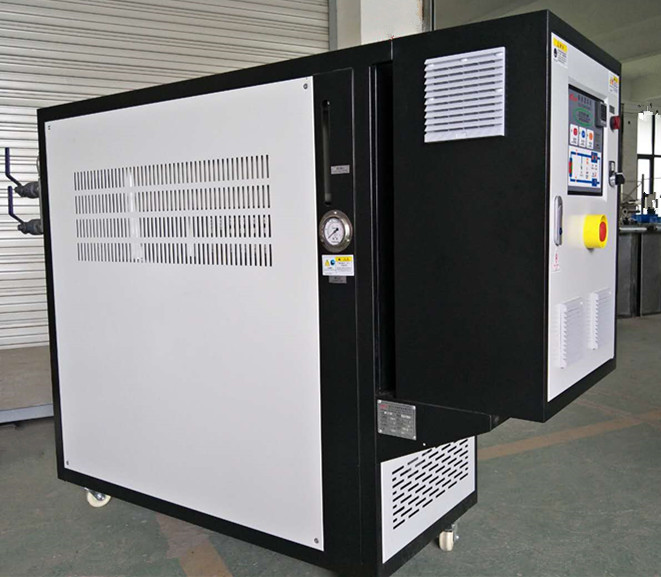
Mold temperature controller main configuration and features:
1. Equipped with full digital PID temperature control and automatic cooling control, it can automatically maintain the required mold temperature, ensuring precise control within ±1℃.
2. Utilizes imported high-temperature pump, featuring high pressure, low noise, and excellent stability.
3. Imported level switches, full stainless steel inner lining, explosion-proof piping.
4. Heat tanks are made of stainless steel, offering rapid heating and cooling times, enhancing efficiency.
5. Utilizing imported components, PID intelligent temperature control gauge, precise temperature control, long service life.
6. Compact in structure, comprehensive in functions, and easy to operate.

Mold temperature controllers, also known as mold temperature control machines, are increasingly prevalent in the machinery industry as it continues to grow. They are no longer limited to the temperature control industry for injection molding molds, but are widely used in various fields such as plastic molding, light guide plate die casting, rubber tires, roller, chemical reaction vessels, bonding, and compounding. There are now two types of mold temperature controllers: water temperature machines and oil temperature machines.