








Safety Instructions for Molding Temperature Controller:
1. Main power safety switch design, capable of emergency power shutdown under abnormal conditions.
2. Equipped with phase sequence protection, power short-circuit protection, level protection, electronic time delay, etc.
3. When the machine automatically detects an anomaly, the status indicator light illuminates to display the anomaly and trigger an alarm.

The system can be heated under stable pressure conditions, but the temperature should not rise too quickly during the process. Monitor the pressure to ensure stability; do not increase the temperature when it is unstable. Once the pressure stabilizes at the equipment's set value, the mold temperature controller adjustment is successful.

Mold temperature controllers, also known as mold temperature control machines, are increasingly prevalent in the mechanical industry as it continues to grow. They are no longer limited to the temperature control industry for injection mold applications but are now widely used in various fields such as plastic molding, light guide plate die-casting, rubber tires, roller manufacturing, chemical reaction vessels, bonding, and compounding. There are now two types of mold temperature controllers: water temperature machines and oil temperature machines.
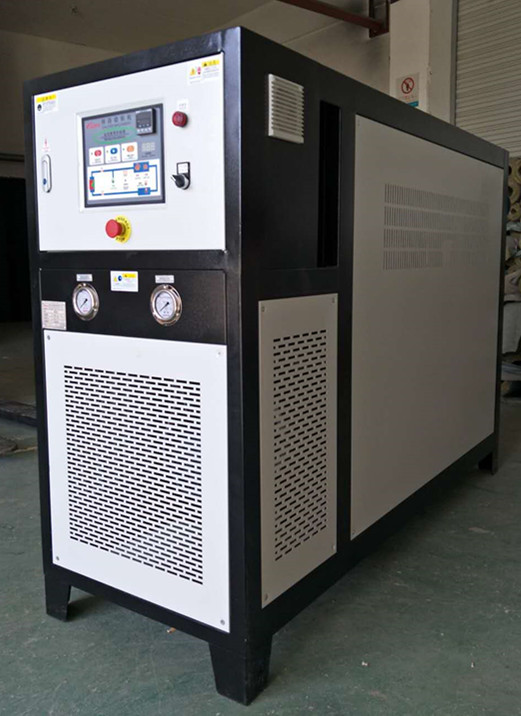
Mold temperature control machines are primarily used for injection molding and hot pressing of composite materials, maintaining a constant temperature. The heat transfer medium that indirectly transfers heat from the heater to the mold is known as a heat carrier. Industrial heat carriers can be divided into two main categories: organic heat carriers and inorganic heat carriers, with organic heat carriers commonly referred to as thermal oil.