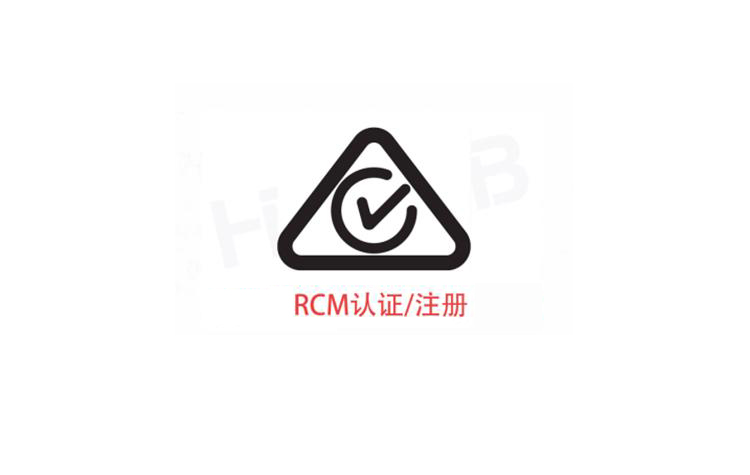









The owner of the RCM mark is the Federation, and both the electrical safety statutory authority and the EMC statutory authority recognize the RCM mark as a supplier's declaration of conformity. Once a supplier is approved to use the RCM mark in any state, the statutory authorities in other states can also accept it, achieving a one-time approval for all states.
RCM Certification Application Process
1. Third-party laboratories evaluate products and determine the applicable testing standards.
2. In case of any non-conforming items during testing, the lab will modify the product to meet and comply with Australian standards requirements.
3. Passed the test and issued a test report.
4. Submit the test report to the Australian certification authority for document review.
5. Australia's approval granted, RCM certificate issued.
6. Customers may register on the Australian website themselves or have it done by a laboratory.
RCM Certification Requirements
1. The new regulations will be officially enforced as of March 1st.
2. The SAA certification and C-Tick certification will be gradually phased out, replaced by the RCM certification, which covers safety regulations and EMC (C-Tick may still apply to some low-power wireless products).
3. All electronic products will be categorized into three types: High, Medium, and Low Risk. We do not have detailed classification data, but generally, products powered by batteries and with a voltage below 12V are considered Low Risk, products with the standard 240V voltage are Medium Risk, and those with high voltage are High Risk. The buffer period for Low Risk products is 6 months, while for Medium and High Risk products, the buffer period is 3 years (this duration is recommended by relevant Australian associations, but has not been finally confirmed in specific regulations).
4. RCM certification can only be applied for by local Australian companies, which must obtain an RCM number from Australia. Chinese manufacturers and exporters can apply for IEC or AS/NZS reports in their own name, but these reports must be applied for by Australian importers to obtain RCM. The registration fee is AUD 75 per product per trademark per year (for example, an Australian company owns two trademarks: A and B. It imports a batch of identical products from China, half marked with A and the other half with B. This means a registration fee of AUD 150 per year). The Australian Electrical Product Testing and Certification Authority, along with Australia and New Zealand, is introducing the RCM mark to unify the identification of electrical products. This mark is a trademark owned by Australian and New Zealand institutions, indicating that the product meets both safety and EMC requirements and is non-mandatory.
RCM Certification Precautions
1. The RCM logo must be uniformly added to the products by then, note that this requirement was announced in Australia on April 19, 2013.
2. When undergoing RCM safety certification for a plug-in adapter, random testing of the plug must be conducted.
3. Lighting Tube Products: Such as T8 LED tubes, fluorescent tubes pose a higher safety risk due to direct replacement by users, and require sending samples to Australia for evaluation.
Our company collaborates with numerous industry associations and certification bodies. Zhongzheng is committed to providing you with fair and transparent third-party testing and certification services, as well as global quality control solutions.