









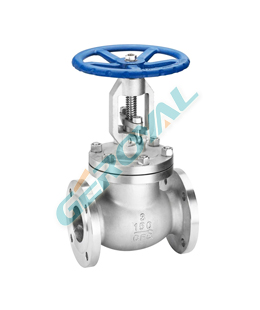
The manual stop valve's closing element is a plug-shaped valve disc, with a sealing surface that is either flat or conical. The valve disc moves in a straight line along the centerline of the fluid. The motion of the stop valve stem can be either lifting stem (the stem rises and falls, while the handwheel does not) or lifting and rotating stem (the handwheel rotates and rises or falls along with the stem, with the nut mounted on the valve body). The stop valve is only suitable for full open and full close positions; it is not allowed for adjustment or throttling.
Check valves are of the forced-sealed type, thus when the valve is closed, pressure must be applied to the valve disc to ensure that the sealing surface does not leak. When the medium enters the valve from below the valve disc, the resistance that must be overcome by the operating force is the friction between the valve stem and the packing, as well as the thrust produced by the medium's pressure. The force required to close the valve is greater than the force to open it, so the diameter of the valve stem must be larger to prevent bending. In recent years, since the emergence of self-sealing valves, the medium flow direction of the check valve has changed to entering the valve chamber from above the valve disc. At this point, under the action of the medium pressure, the force required to close the valve is smaller, while the force to open it is greater, allowing for a reduction in the diameter of the valve stem. Additionally, under the action of the medium, this type of valve is also more airtight. China's "Three Standardization Groups" for valves have stipulated that the flow direction of check valves should always be from top to bottom. When the check valve is fully open, the height of the valve disc opening is 25% to 30% of the nominal diameter, indicating that the flow rate has reached its maximum, signifying that the valve is fully open. The fully open position of the check valve should be determined by the stroke of the valve disc.
Types of stop valves: classified by the position of the valve stem thread, there are external threaded and internal threaded types. By the direction of medium flow, there are straight-through, direct current, and angle types. Stop valves are categorized by sealing method into packing-sealed stop valves and bellows-sealed stop valves.
Stop valves available include: Flanged Stop Valves, Stainless Steel Stop Valves, Carbon Steel Stop Valves, JIS Standard, ANSI Standard Stop Valves, Bellows Sealed Stop Valves, Forged Steel Stop Valves, High Temperature and High Pressure Stop Valves, and a series of other products.