GH-800A Infrared Spectrophotometric Oil Analyzer
This instrument is primarily used for measuring oil content in surface water, groundwater, industrial wastewater, oil fumes in the catering industry, welding wires, welding rods, soil, and solids.
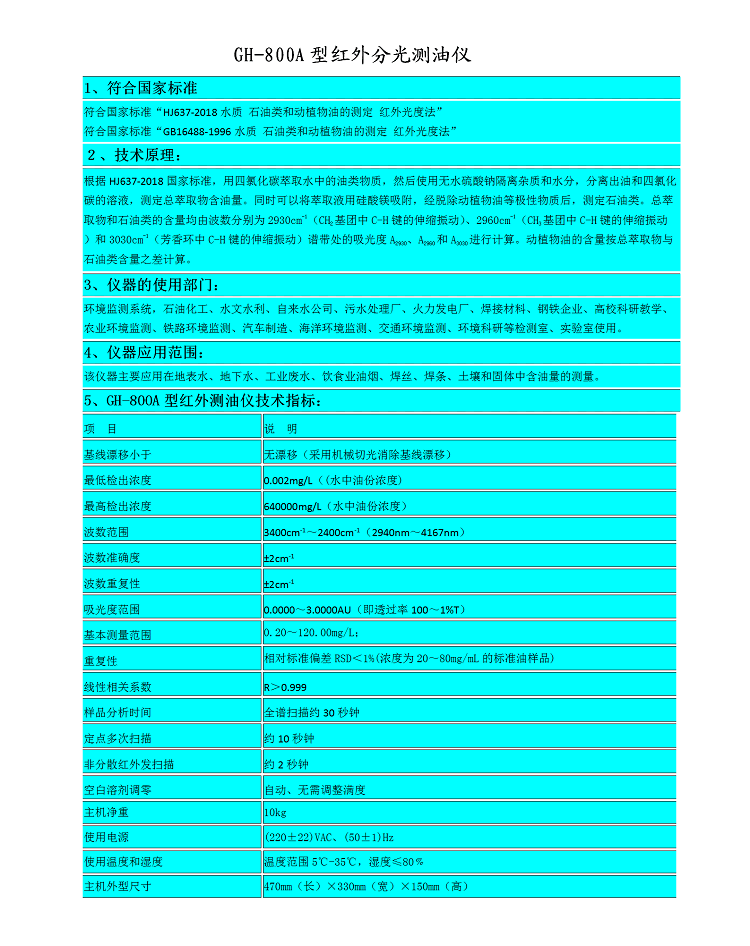
1. Meets standards
Meets the standard "HJ637-2018 Water Quality Determination of Petroleum and Vegetable Oils by Infrared Spectrophotometry"
Meets the standard "GB16488-2018 Water Quality – Determination of Petroleum and Fats and Oils – Infrared Spectrophotometric Method"
2. Technical Principle:
Based on the HJ637-2018 standard, extract oil substances from water using carbon tetrachloride, then isolate impurities and moisture with anhydrous sodium sulfate, separating the oil and carbon tetrachloride solution. Determine the total extract oil content. Additionally, adsorb the extract with magnesium silicate, removing polar substances like animal and vegetable oils, and then measure the petroleum content. The total extract and petroleum content are calculated based on the absorbance A2930, A2960, and A3030 at the wavenumbers of 2930 cm-1 (C-H stretching vibration in CH2 groups), 2960 cm-1 (C-H stretching vibration in CH3 groups), and 3030 cm-1 (C-H stretching vibration in aromatic rings), respectively. The content of animal and vegetable oils is calculated as the difference between the total extract and petroleum content.
3. Department of Instrument Usage:
Environmental monitoring systems, used in petrochemical, hydrological, water supply companies, wastewater treatment plants, thermal power plants, welding materials, steel enterprises, university research and teaching, agricultural environmental monitoring, railway environmental monitoring, automotive manufacturing, marine environmental monitoring, traffic environmental monitoring, and various testing rooms and laboratories for environmental research.
4. Instrument Application Range:
This instrument is primarily used for measuring oil content in surface water, groundwater, industrial wastewater, oil fumes from the catering industry, welding wires, welding rods, soil, and solids.
5. GH-800A Infrared Oil Measuring Instrument Technical Specifications:
Item Description
Baseline Drift Less Than No Drift (Baseline Drift Eliminated by Mechanical Cutting)
Low Detection Concentration: 0.002 mg/L (Oil content in water)
High detection concentration 640,000 mg/L (oil concentration in water)
Wavenumber Range: 3400 cm^-1 to 2400 cm^-1 (2940 nm to 4167 nm)
Wavenumber accuracy ±2 cm⁻¹
Wavenumber repeatability ±2 cm^-1
Absorbance range: 0.0000 to 3.0000 AU (equivalent to transmission 100 to 1% T)
Basic measurement range: 0.20~120.00 mg/L
Repeatability: Relative Standard Deviation (RSD) < 1% (for standard oil samples with a concentration of 20-80 mg/mL)
Linear correlation coefficient R > 0.999
Sample Analysis Time: Full-spectrum scan in approximately 30 seconds
Spot multiple scans, approximately 10 seconds
Non-dispersive infrared scanner Approximately 2 seconds
Zero the blank solvent automatically; no adjustment needed for full scale
Net Weight of Main Unit: 10 kg
Power Supply: (220±22)VAC, (50±1)Hz
Operating Temperature and Humidity: Temperature range 5℃-35℃, humidity ≤80%
Main Unit Dimensions: 470mm (Length) × 330mm (Width) × 150mm (Height)
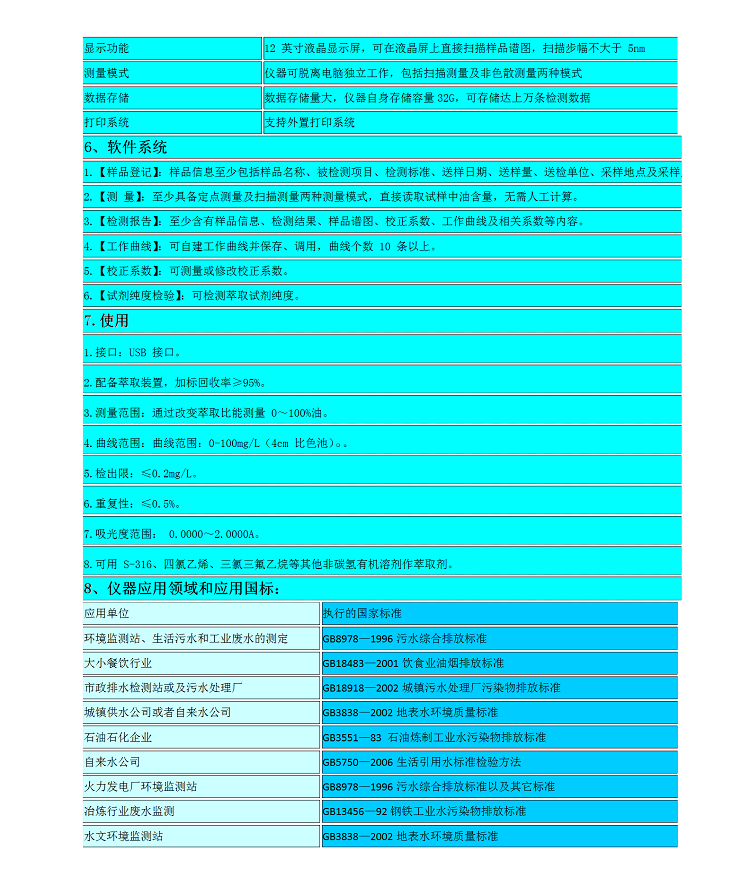
12-inch LCD display, capable of directly scanning sample spectrum on the LCD screen, with a scanning step not exceeding 5nm
Measurement Mode: The instrument can operate independently of a computer, including two modes: scanning measurement and non-dispersive measurement.
Large Data Storage - The instrument has a built-in storage capacity of 32G, capable of storing tens of thousands of test data records.
Print System - Supports External Print Systems
6. Software System
1. [Sample Registration]: Sample information must include at least the sample name, tested items, testing standards, sample submission date, quantity, submitting unit, sampling location, and sampler.
2. [Measurement]: Equipped with at least two measurement modes - fixed-point and scanning, directly reads the oil content in the sample without manual calculation.
3. [Inspection Report]: At least includes sample information, test results, sample spectrum, calibration coefficients, working curve, and correlation coefficients.
4. **Working Curves**: Ability to create and save, retrieve custom working curves; over 10 curves available.
5. **Calibration Coefficient**: Measure or modify the calibration coefficient.
6. [Reagent Purity Testing]: Capable of testing the purity of extraction reagents.
7. Utilize
Interface: USB interface.
2. Equipped with an extraction device, with a marked recovery rate of ≥95%.
3. Measurement Range: Can measure 0% to 100% oil by adjusting the extraction ratio.
4. Curve Range: 0-100mg/L (4cm cuvette)
5. Detection Limit: ≤0.2 mg/L.
6. Repeatability: ≤0.5%.
7. Absorbance range: 0.0000 - 2.0000 A.
8. Available for extraction are non-hydrocarbon organic solvents such as S-316, tetrachloroethylene, trichlorotrifluoroethane, and others.
8. Instrument Application Fields and National Standards Compliance:
Applying Unit Standard Implemented
Environmental Monitoring Station, Determination of Domestic and Industrial Wastewaters, GB8978—1996 Comprehensive Emission Standard for Sewage
GB18483-2001 Standard for油烟排放 in Catering Industry
Municipal Drainage Inspection Station or Sewage Treatment Plant - GB18918-2002 Urban Sewage Treatment Plant Emission Standard
Municipal Water Supply Company or Public Waterworks, GB3838-2002 Surface Water Environmental Quality Standard
Petroleum and Petrochemical Enterprises - GB3551-83 Standard for Emission of Water Pollutants from Petroleum Refining Industry
Waterworks Corporation GB5750—2006 Standard Test Methods for Potable Water
Power Plant Environmental Monitoring Station, GB8978-1996 Comprehensive Wastewater Emission Standard and other standards
Waste Water Monitoring in Smelting Industry - GB13456-92 Emission Standard for Water Pollutants from Iron and Steel Industry
Hydrological Environment Monitoring Station GB3838-2002 Surface Water Environmental Quality Standard