







——Product Introduction——
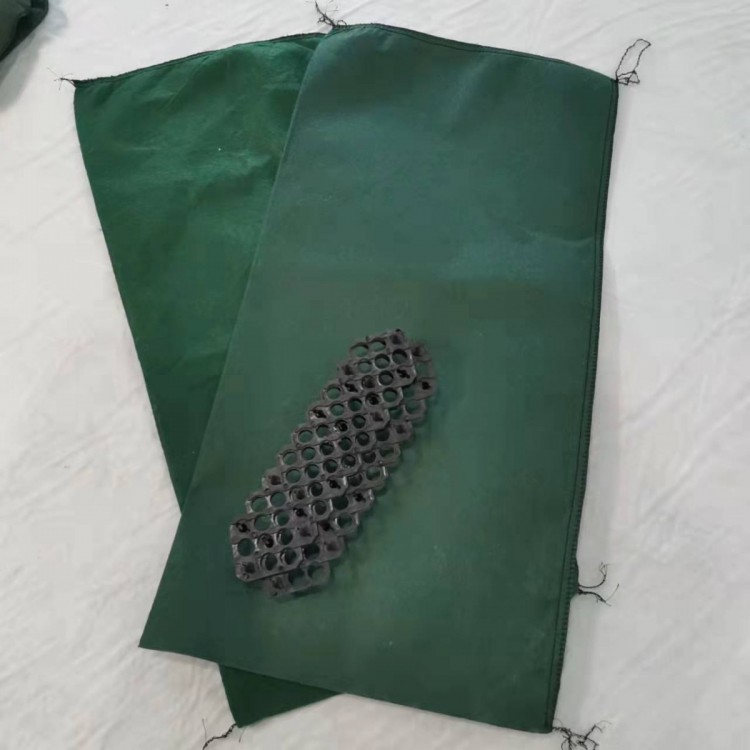
Plastic blind channels are composed of a plastic core wrapped with filter fabric. The plastic core is primarily made from thermoplastic synthetic resins, modified and extruded into fine plastic strips in a molten state through a nozzle. These strips are then fused together at junctions by a molding device, forming a three-dimensional mesh structure.Good water retention, high porosity, excellent drainage, strong compressive resistance, good pressure resistance, flexibility, adaptable to soil deformation, durable, lightweight, easy to install, and high installation efficiency.

——Product Features——
1. The plastic blind trench is composed of fibers in the range of about 2mm, fused together at their junctions to form a three-dimensional mesh structure. Its principle is similar to the truss principle of steel structural constructions. The surface has openings covering 95-97%, which is more than five times that of a perforated pipe and 3-4 times that of a resin mesh pipe, with an extremely high water absorption rate.
2. Due to its three-dimensional structure, the porosity is between 80-95%, making it space-efficient and lightweight with management ease. Its compressive strength is over 10 times stronger than that of tube structures. Therefore, even when subjected to overloading, the residual porosity remains above 50%, eliminating issues with water passage, and there is no need to consider damage from soil pressure. 3,
High compressive strength, with less than 10% compression at 250 KPa pressure.
4. Enhanced with anti-aging agents, it is durable and long-lasting, ensuring stability even when placed underwater or in soil for decades.
5. Resilient and durable, suitable for curved sections like bends; extremely lightweight. Can be backfilled using a bulldozer if the backfill depth is around 10 cm.
6. Due to the aforementioned features, issues such as uneven settlement or partial blockage caused by overloading, leading to complete loss of voids and functional disruption due to damage, can be addressed by using plastic blind channel materials.
7. Due to the molding process using thermal melting without the use of adhesives, there is no risk of spalling caused by adhesive aging or peeling.