









Material Type
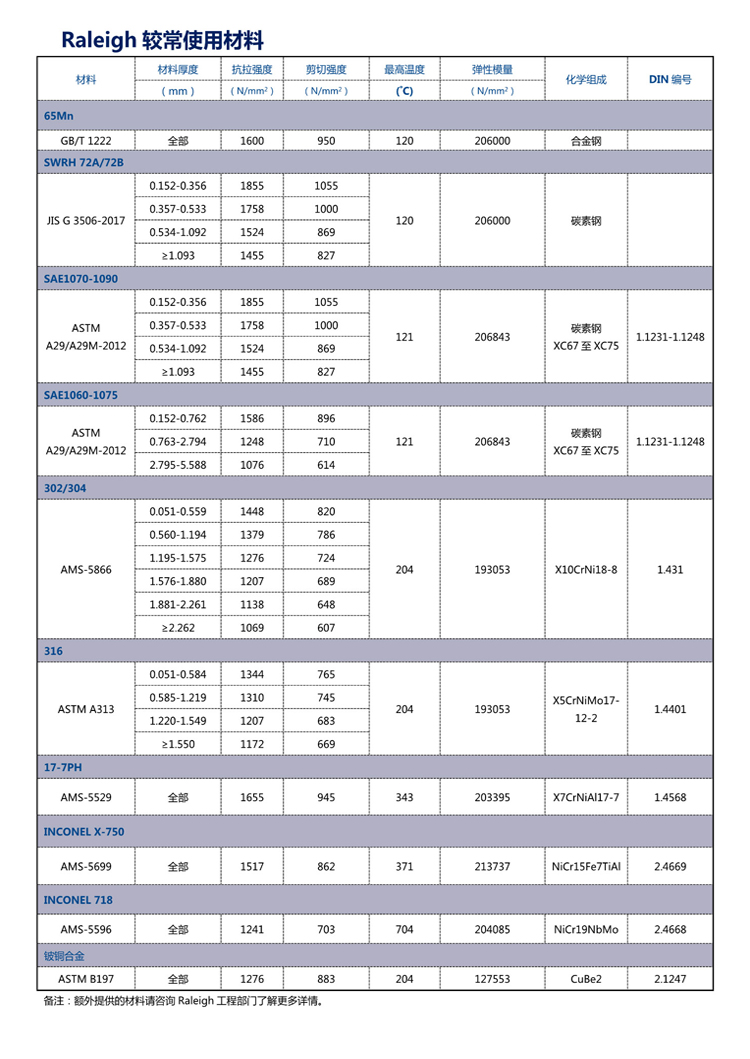
Selecting the appropriate material for application requiresRaleighWe have a good understanding of the common materials used in flat wire products. The correct material can prevent additional costs and malfunctions during operation. Carbon steel is a commonly used material. While stainless steel is more expensive than carbon steel, it offers better corrosion resistance and a wider working temperature range.
Carbon Spring Steel
65Mn
SWRH 72A/72B
SAE1070-1090
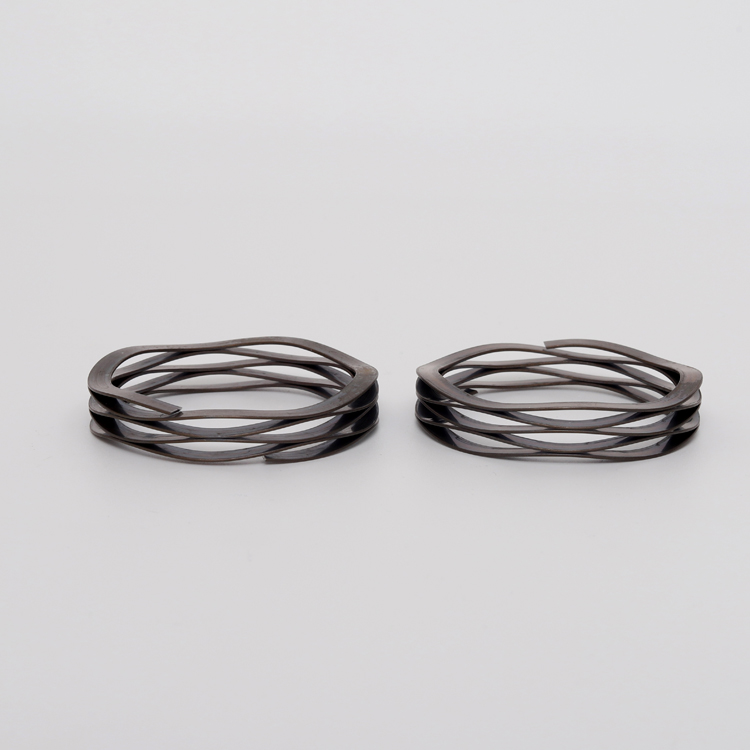
SAE1070-1090High-carbon tempered spring steel is the standard material for helical retainers and wave springs. The martensitic structure produced by the oil quenching process significantly enhances the tensile and yield strength of the material.
SAE1060-107
SAE1060-1075High-carbon hard-drawn spring steel is the standard material for snap ring retainers. Hard-drawn carbon steel is not numbered because its strength is determined by the drawing process.
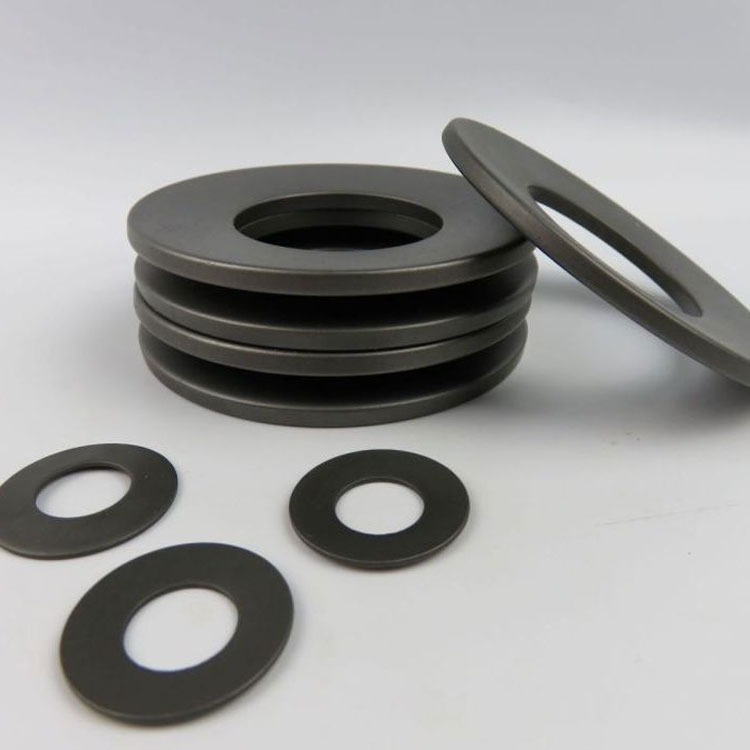
These carbon steels produced by these tempering processes are suitable for environments with existing protective measures, as they can corrode without lubrication or sealing. Additional corrosion protection can be achieved through special surface treatments. The retainers and springs are typically supplied with an oil immersion surface treatment to provide protection during transportation and storage on shelves.
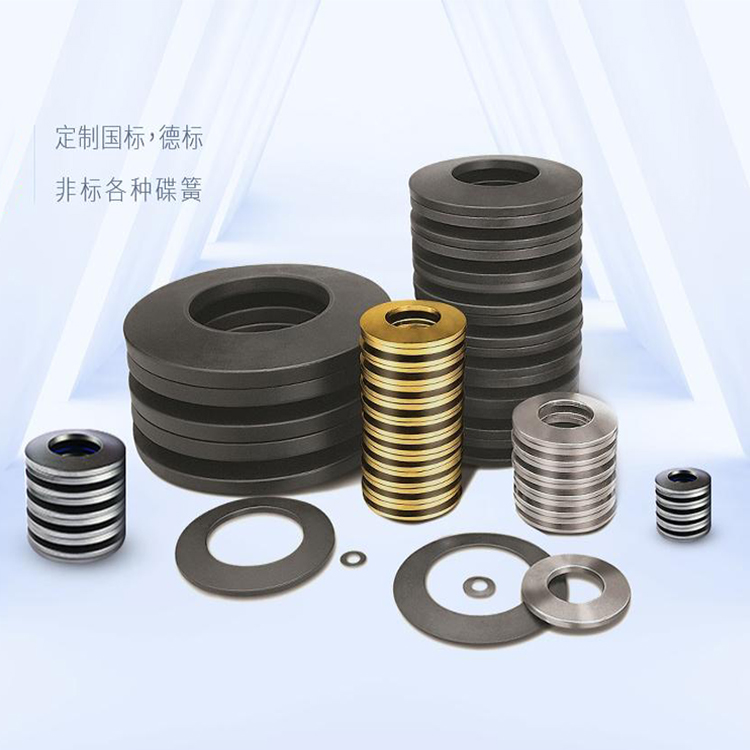
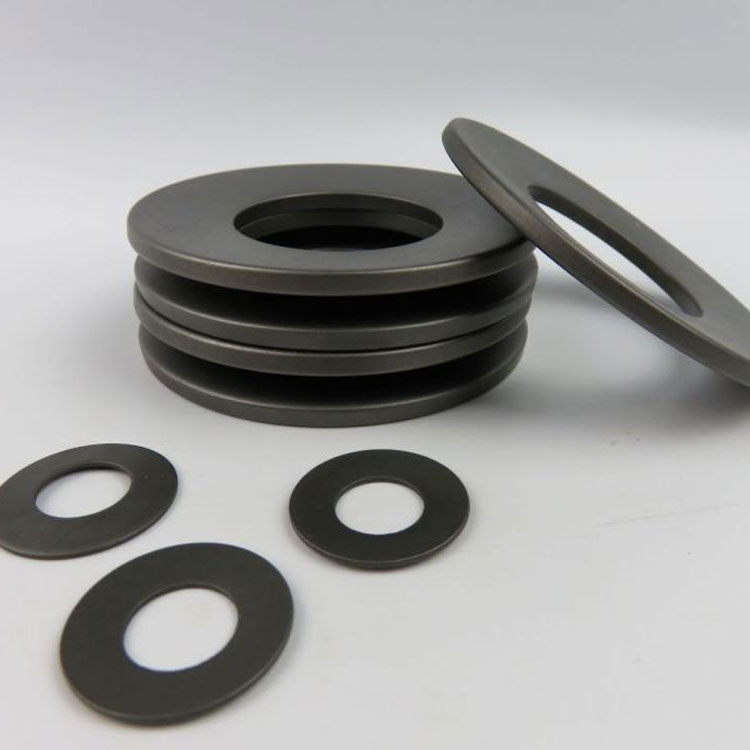
•Carbon steel has high magnetic properties and can exhibit various colors, including blue, black, and gray.
Stainless Steel
302Stainless Steel
302Stainless steel is the standard material used for spiral retainers. This material is widely used due to its combination of corrosion resistance and good physical properties.302The elasticity of stainless steel originates from the cold working process. Although it is non-magnetic stainless steel, it becomes so after cold working.302It will have a slight magnetic property. It cannot be hardened by heat treatment.
•302Silver gray.
316Stainless Steel
316Stainless steel and302Stainless steel has similar physical properties and heat resistance. Due to the presence of molybdenum, it boasts enhanced corrosion resistance, particularly against pitting corrosion.316Stainless steel is commonly used in food, chemical, and seawater applications.
316Stainless steel has less magnetism than302Stainless steel. But with302Similar to stainless steel, its magnetism increases as the wire is cold rolled.316Stainless steel cannot be hardened through heat treatment.
•316Silver gray.
17-7PHMartensitic stainless steel with precipitation hardening
The corrosion resistance of this alloy is302Stainless steel alike, but with higher tensile and yield strengths, suitable for special snap ring applications. Resistant to fatigue and under high stress conditions,17-7The performance is superior to that of high-performance carbon steel.
Its elasticity is achieved byCState sedimentation hardened toCH900To achieve the status. Therefore, this material can withstand.343℃Retains elasticity at high temperatures without loss.17-7PHPrecipitation HardeningCH900The magnetic properties of the state stainless steel are similar to those of high-carbon steel.
•After precipitation hardening,17-7Due to the open-air heat treatment, it presents in blue, brown, or silver, while the controlled air heat treatment offers bright colors.
Super Alloy
InconelX-750
This nickel-chromium alloy is commonly used in high-temperature and corrosive environments. Two commonly used chromium-nickel iron alloys are described as follows. Generally speaking,InconelX-750Through precipitation heat treatment to achieve spring condition. The alloy treated in this manner can withstand high371˚CThe temperature. Corrosion Engineers Association(NACE)Permitted in compliance with specificationsMR-01-75(RC50Products processed through this hard tempering technique (high value) are used for spiral retainers and wave springs./Coiled Springs.1Hardening number requires a longer heat treatment than spring hardening, with lower tensile strength, but offers high538˚CTemperature protection.
Spring tempering and1The tempering process can be conducted in an open-air or controlled atmosphere furnace. Open-air heat treatment may result in oxidation, often leading to slight black residue. A controlled atmosphere environment eliminates oxidation issues, resulting in no residue on the products produced.
•Retainer washers and springs made from this grade of chrome-nickel iron alloy are blue./Silver gray and non-magnetic.
Copper
25Beryllium Copper Alloy
Typically used in its hard temper, this alloy boasts superior spring properties due to the combination of low elastic modulus and high ultimate tensile strength. Its physical properties are achieved through precipitation hardening. Compared to other copper alloys, beryllium copper alloys exhibit high strength and undergo minimal changes in physical properties with temperature increase.
•Beryllium copper alloys are non-magnetic. Their conductivity is approximately that of beryllium bronze.2-4Multiple
AGrade Phosphor Bronze
Phosphor bronze offers excellent spring properties and conductivity, slightly inferior to beryllium copper alloys in performance. It is sold in spring temper to maximize spring characteristics.
•Phosphor bronze can only be hardened through cold working. This material also lacks magnetic properties.
Material Surface Treatment
Blacken
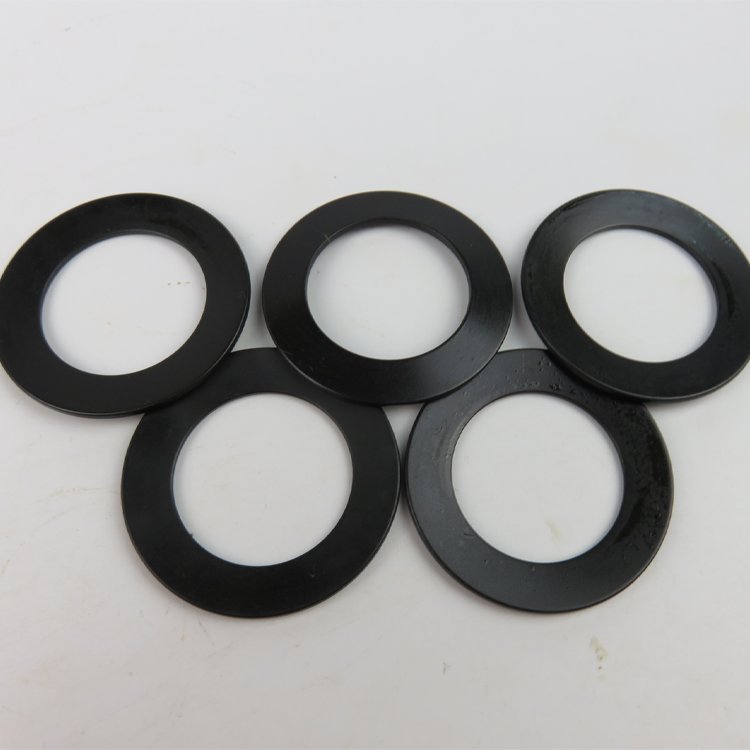
This surface treatment offers a matte black finish. Black oxide is more commonly used for aesthetic purposes rather than enhancing corrosion resistance.
Galvanized
Zinc is electroplated onto carbon steel to enhance the product's corrosion resistance. Compared to cadmium plating, zinc plating is often used as a cost-effective and environmentally friendly alternative. Our standard zinc plating solution is:TypeVAndTypeVIAll meet the standard.RoHSCoating thickness is determined by the service condition number (SC(No.) Decision allows the customer to proceed. Galvanizing does not necessarily cover the area between each spring coil. This process can cause the retainer to undergo hydrogen embrittlement.RaleighOffer stainless steel as an alternative choice for cadmium and zinc plating.
Oiled
This isRaleighAll products produced with carbon steel feature standard surface treatment. Oil imparts corrosion resistance during transportation and daily storage. Oil immersion surface treatment should not be considered as a durable surface treatment.
Passivation
Passivation is an optional cleaning operation for stainless steel. It provides a bright surface and enhances corrosion resistance. Passivation can dissolve iron particles and other substances embedded in the surface of stainless steel during the production process. If not dissolved, these foreign particles can cause rusting, discoloration, or even electrochemical corrosion.
In theory, the corrosion resistance of stainless steel is provided by a thin, invisible oxide layer that completely covers the retaining ring surface, which also prevents further oxidation. Removing contaminants can prevent the destruction of the oxide layer, thereby achieving good corrosion resistance.
Phosphatized
The appearance is gray-black. Phosphate coating offers better corrosion resistance than black oxide, but is not as durable as cadmium plating or stainless steel. Phosphate coating is not applicable to stainless steel.
Steam Degreasing/Ultrasonic Cleaning
This is the standard cleaning and surface treatment for all stainless steel. The process uses chloride-based solvents to remove oil and other organic substances from the material's surface. This solvent effectively removes grease from the exposed surfaces of retainers or springs.
The solvent flows between each circle of the retaining ring via ultrasonic action.
Deburring by Vibration/Manual burr removal
AlthoughRaleighAll circumferential surfaces and edges of the retaining ring are smooth, but due to the shearing operation, sharp corners are always present at the gap end. To remove the sharp corners and achieve coordination/Smooth surface finish; can be deburred by vibration on the retaining ring or by hand to meet your requirements.