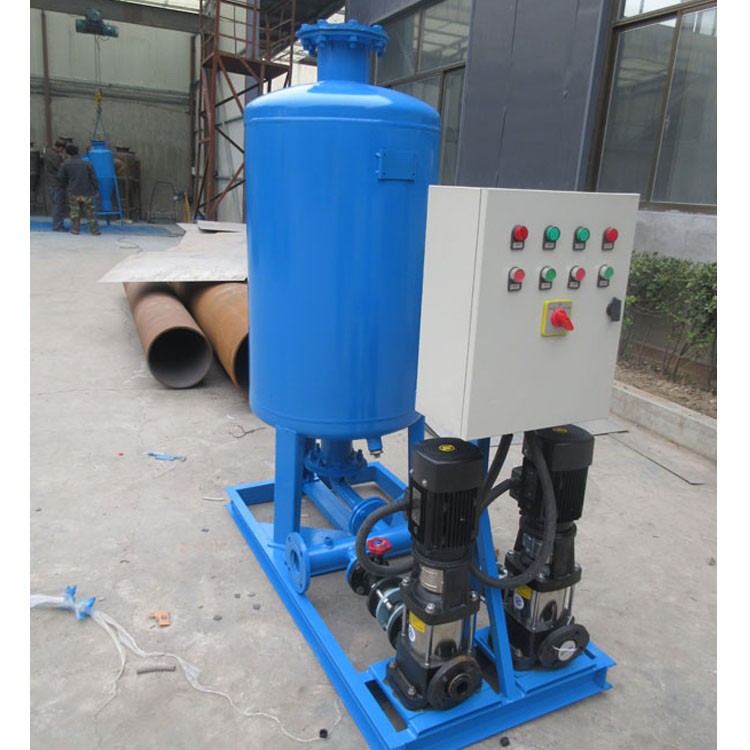
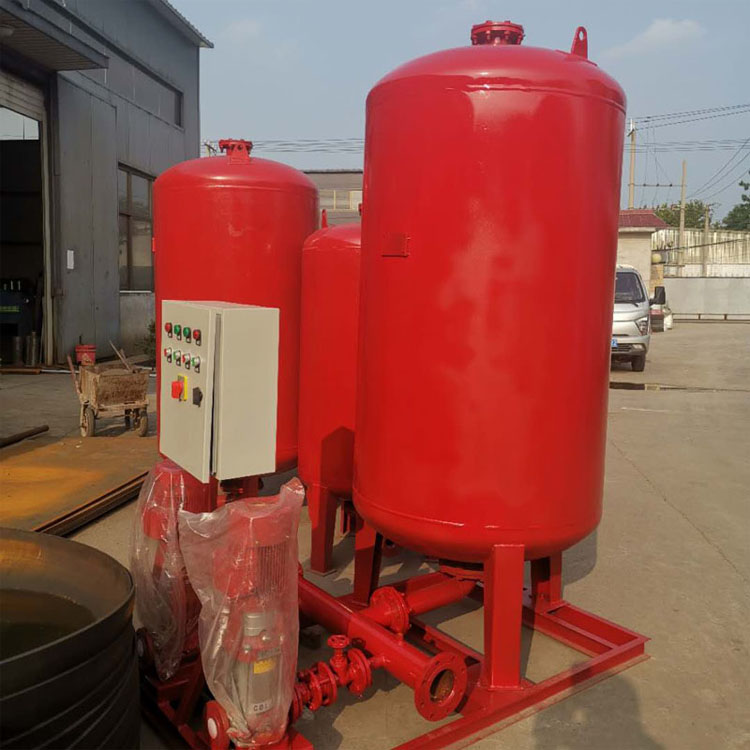

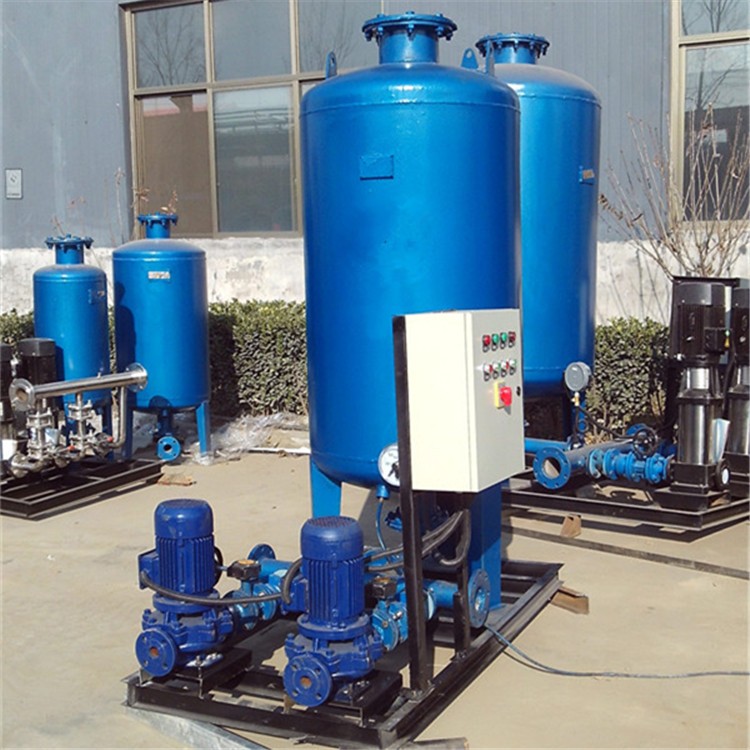
Atmospheric pressure pressure-regulating water supply and return system, a commonly used supply and drainage equipment in air conditioning systems, serves to maintain stable pressure and replenish water. It is widely used in underground air conditioning rooms, large-scale circulating water pipelines, thermal insulation systems, ground-source heat pumps, and other scenarios. It can also be applied in areas such as subway stations, skyscrapers, airports, hospitals, and ice rinks.
Principle of Atmospheric Pressure Constant Pressure Water Supply System:
According to the scientific laws of expansion due to air and water pressure, the product of pressure and volume of a gas of a certain mass remains constant at a given temperature. As the pressure-boosting pump operates, water is supplied to the water distribution network while excess water enters the air pressure water tank. The water chamber expands, compressing the gas inside, and the gas chamber contracts, causing the tank's pressure to rise. When the pressure reaches the high working pressure P2, the electrical control cabinet cuts off the power to the pump, stopping its rotation. At this point, the compressed gas inside the tank is used to push stored water into the water distribution network, causing the water chamber to contract and the gas chamber to expand, thereby lowering the tank's pressure. When the pressure drops to the working pressure P1, the electrical control cabinet reconnects the pump's power source, restarting the pump. This cycle repeats continuously, maintaining stable water pressure and supplementing the system medium.
Advantages of Atmospheric Pressure Constant Pressure Water Supply System:
1. Fully tested before shipment, available with manual/automatic control
2. Carefully selected brand components (such as Southern Pumps), high water replenishment efficiency
3. Connections such as flanges are made of 304 stainless steel.
4. A wide variety of models available, covering most of the department's needs
5. Excellent sealing performance: The tank is a sealed device with minimal gas and water contact, ensuring water quality remains unpolluted.
6. Performance: The system has been fully tested before leaving the factory
7. Easy Installation: Simply connect the in/out water and drainage pipes, perform a quick adjustment, and it's ready for use; no on-site fabrication required.
8. High-precision sensors that reduce the frequency of pump startups, saving energy and electricity
Atmospheric pressure constant-pressure water make-up system selection:
The system selection primarily includes the following three aspects: the selection of the water replenishment pump, the selection of the pressure tank, and the system's water capacity.
1. Selection of water supply pumps:
a. The system's head ratio is 30~50 kPa higher than the pressure at the make-up water point.
b. Total hourly flow should be 5 times the system's water capacity.
c. For larger systems, it is advisable to set up two pumps, using one on a regular basis, and both pumps running simultaneously during initial filling or accident replenishment (usually two water-replenishment pumps are set up).
2. System Water Capacity:
The hourly leakage rate of a recirculating water system should be calculated based on 1% of the system's water capacity.
The air conditioning water system for cooling and heating with air conditioners can be estimated according to Table 1. A larger value should be chosen if the outdoor piping is longer.
3. Pressure Vessel Selection
The volume of the pressure vessel should be determined according to the following formula:
V≥Vmin=(β*Vt)/(1-α1)
Equation V - Actual Total Volume of the Pressure Vessel (L)
Vmin — Small Pressure Vessel Volume (L)
Vt—Adjustable Volume (L), should not be less than 3 minutes of the normal operating flow rate of the water supply pump (when using a variable frequency pump, the water supply pump flow rate mentioned above can be determined as 1/3 to 1/4 of the flow rate at the rated speed).
β-Volume Additional Coefficient: 1.05 for diaphragm-type air pressure vessels.
α1-Pressure Ratio, α1 = (P1 + 100) / (P2 + 100), where P1 and P2 are the startup pressure and shutdown pressure of the feed pump (gauge pressure in kPa). The value should be determined by considering the factors of the air tank volume and the high operating pressure of the system, and it is recommended to be between 0.65 and 0.85.
Installation Note: Atmospheric Pressure Constant Pressure Water Supply Unit
1. This unit should be installed in a location that is protected from frost, with good drainage, and out of direct sunlight, and should be vertically mounted.
2. Ensure the basic drum is positioned horizontally, with the control unit positioned below the basic drum.
3. The base drum is equipped with a weighing sensor system; therefore, the base drum feet must not be fixed to the ground, as this would prevent the weighing sensor from functioning properly. Additionally, ensure there are no obstructions in the vertical direction of the drum.
4. No debris should be placed on the basic can, as it may mislead the weighing system signal.
5. To ensure the accuracy of horizontal weighing, the basic drum and control unit, as well as the basic drum and the first in-line drum BI, must be connected by a flexible hose.
6. Install a filter on the water supply line to prevent impurities from clogging.
7. When the pipeline length exceeds 10M, the pipeline diameter should not be less than DN32.
8. Ensure the pipeline for expansion is clear, no need for excessive valves.